EasyManua.ls Logo

Mitsubishi Electric LGH-100RVX-E - User Manual

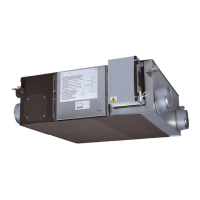
Mitsubishi Electric LGH-100RVX-E
7 pages
Print Icon
To Next Page IconTo Next Page
Loading...
Heat exchange system
Heat recovery ventilating system
Heat exchanger material
Special treated paper plate heat exchanger
Cladding
Galvanized steel sheet
Heat insulation material
Self-extinguishing urethane foam
Motor
DC motor
Blower
Filter
Non-woven fabrics filter (Gravitational method 82% EU-G3)
Surrounding air condition
Shall be between -10
℃
and 40
℃
, 80%RH or less
Suction air condition
Shall be lower than 40
℃
, 80%RH
-10
℃
to -15
℃
: Intermittent operation 60 min ON, 10 min OFF.
-15
℃
or less : Intermittent operation 55 min OFF, 5 min ON.
Function
Heat recovery ventilation/ Bypass ventilation, Fan speed 1,2,3,4
Weight
54kg
Electrical power supply
220-240V/50Hz, 220V/60Hz
Ventilation mode
Heat recovery mode
Bypass mode
Fan speed
SP4
SP3
SP2
SP1
SP4
SP3
SP2
SP1
Running current
[A]
2.50
1.20
0.50
0.17
2.50
1.20
0.51
0.19
Input power
[W]
420
200
75
21
420
200
75
23
Air volume
[m
3
/h]
1000
750
500
250
1000
750
500
250
[L/s]
278
208
139
69
278
208
139
69
External static pressure
[Pa]
170
96
43
11
170
96
43
11
Exchange
Temperature
80.0
83.0
86.5
89.5
-
-
-
-
efficiency
Enthalpy
Heating
72.5
74.0
78.0
87.0
-
-
-
-
[%]
Cooling
71.0
73.0
77.0
85.5
-
-
-
-
Noise
[dB]
37.0
31.0
23.0
18.0
38.0
32.0
24.0
18.0
Insulation resistance
10M
Ω
or more
Direct strength
AC 1500V 1 minute
※Specification may be subject to change without notice.
DATE TYPE CEILING RECESSED LOSSNAY
22-Sep-2014 MODEL
LGH-100RVX-E
NUMBER
N14HHGU0033A
1/5
MODEL LGH-100RVX-E
SIGN
Supply fan operation under
low outdoor temperature
SPECIFICATIONS
■Attention
1. The running current, the input power, the efficiency and the noise are based on the rating air volume, and
230V/50Hz. The noise is measured at 1.5m under the center of the unit in an anechoic chamber.
2. Temperature exchange efficiency (%) is based on winter condition.
3. Heat recovery ventilation mode starts automatically while detecting OA temperature lower than 8℃, even Bypass
mode is selected. Remote controller continues to display "Bypass ventilation" in this case.
4. Mitsubishi Electric measures figures in the chart according to Japan Industrial Standard (JIS B 8628), therefore the
characteristic curves are measured by chamber method.
5. The noise level at 1.5m away from outlets in the 45°direction is about 21dB greater than the indicated value at
fanspeed4.
6. On-site measurements by pitot tube method could be as much 20% difference from JIS test room conditions. If the
measuring point is close to sources of turbulence like bends, contractions and dampers etc., it is difficult to measure
air volume correctly. A straight duct length more than 10D (D=duct diameter) from the source of turbulence is
recommended for correct measurement. On-site measurement should therefore be measured in accordance with
BSRIA guideline (Commissioning Air Systems. Application procedures for buildings AG3/89.3(2001)).
7. Use this unit between static pressure 60Pa and 240Pa at Fan speed4. Otherwise the motor protection may work
and reduce its output or the noise level might be larger.
0 50 100 150 200 250 300 350 400
20
30
40
50
60
70
80
90
0
50
100
150
200
250
300
350
0 500 1000 1500
Exchange efficiency (%)
Static pressure (Pa)
Air volume
(m
3
/h)
(L/s)
100m
80m
60m
40m
SP1
SP2
SP3
SP4
250㎜ dia straight pipe length
■Characteristic curve

Other manuals for Mitsubishi Electric LGH-100RVX-E

Question and Answer IconNeed help?

Do you have a question about the Mitsubishi Electric LGH-100RVX-E and is the answer not in the manual?

Summary

Technical Specifications

General Specifications Summary

Key technical data including system, materials, conditions, electrical, and performance parameters.

Performance Characteristic Curve

Graphical representation of static pressure vs. air volume and exchange efficiency.

Operational Safety Notes

Important notes for safe and optimal operation, including current, noise, and temperature considerations.

Outline and Dimensional Drawings

Unit Physical Layout

Detailed diagram showing physical dimensions, air inlet/outlet ports, and connection points.

Installation Site Precautions

Critical advice on installation conditions, condensation, outdoor air intake, and ducting.

Electrical Wiring Diagrams

Wiring Diagram and Symbols

Visual representation of electrical wiring, component identification, and symbol definitions.

Electrical Installation Guidelines

Guidelines for electrical installation, cable types, and safety procedures.

Model Selection and Installation Guidance

Operating Environment and Usage

Recommendations for optimal operating environment and avoiding adverse conditions.

Installation Safety Cautions

Warnings and advice for correct installation to prevent malfunction and ensure safety.

Ancillary Systems and Maintenance

Duct Heater Integration

Guidelines for installing and operating duct heaters in conjunction with the Lossnay unit.

Maintenance Schedule and Lifetimes

Recommended maintenance schedule and estimated lifetime for key components like cores and filters.

Overview

This document describes the Mitsubishi Electric LGH-100RVX-E Ceiling Recessed Lossnay heat recovery ventilating system.

Function Description

The LGH-100RVX-E is a heat recovery ventilating system designed to provide fresh air while minimizing energy loss. It utilizes a special treated paper plate heat exchanger to transfer heat and moisture between incoming fresh air and outgoing stale air. The system supports both heat recovery ventilation and bypass ventilation modes, allowing for flexible operation based on ambient conditions. It features a DC motor and a 245mm diameter centrifugal fan for efficient air movement.

Important Technical Specifications

General:

  • Model: LGH-100RVX-E
  • Type: Ceiling Recessed Lossnay
  • Heat Exchange System: Heat recovery ventilating system
  • Heat Exchanger Material: Special treated paper plate heat exchanger
  • Cladding: Galvanized steel sheet
  • Heat Insulation Material: Self-extinguishing urethane foam
  • Motor: DC motor
  • Blower: 245mm diameter centrifugal fan
  • Filter: Non-woven fabrics filter (Gravitational method 82% EU-G3)
  • Weight: 54kg
  • Electrical Power Supply: 220-240V/50Hz, 220V/60Hz

Operating Conditions:

  • Surrounding Air Condition: -10°C to 40°C, 80%RH or less
  • Suction Air Condition: Lower than 40°C, 80%RH
  • Low Outdoor Temperature Operation:
    • -10°C to -15°C: Intermittent operation 60 min ON, 10 min OFF.
    • -15°C or less: Intermittent operation 55 min OFF, 5 min ON.

Performance (Heat Recovery Mode / Bypass Mode): The system offers four fan speeds (SP1, SP2, SP3, SP4) with varying performance characteristics:

Parameter Unit SP4 SP3 SP2 SP1
Heat Recovery Mode
Running Current [A] 2.50 1.20 0.50 0.17
Input Power [W] 420 200 75 21
Air Volume (m³/h / L/s) m³/h 1000 750 500 250
L/s 278 208 139 69
External Static Pressure [Pa] 170 96 43 11
Exchange Efficiency (Temp.) % 80.0 83.0 86.5 89.5
Exchange Efficiency (Enthalpy - Heating) % 72.5 74.0 78.0 87.0
Exchange Efficiency (Enthalpy - Cooling) % 71.0 73.0 77.0 85.5
Noise [dB] 37.0 31.0 23.0 18.0
Bypass Mode
Running Current [A] 2.50 1.20 0.51 0.19
Input Power [W] 420 200 75 23
Air Volume (m³/h / L/s) m³/h 1000 750 500 250
L/s 278 208 139 69
External Static Pressure [Pa] 170 96 43 11
Noise [dB] 38.0 32.0 24.0 18.0

Electrical Safety:

  • Insulation Resistance: 10MΩ or more
  • Direct Strength: AC 1500V 1 minute

Usage Features

Ventilation Modes:

  • Heat Recovery Ventilation: This is the primary mode, where the heat exchanger recovers heat from exhaust air to pre-condition incoming fresh air, reducing heating or cooling loads.
  • Bypass Ventilation: In this mode, the heat exchanger is bypassed, allowing fresh air to be introduced directly without heat recovery. This is useful when outdoor air temperature is favorable and heat exchange is not desired. The system automatically switches to heat recovery mode if the outdoor air temperature drops below 8°C, even if bypass mode is selected on the remote controller.

Control and Monitoring:

  • The unit can be controlled via a remote controller, which allows selection of fan speed (1, 2, 3, 4) and ventilation mode.
  • It includes monitoring outputs for malfunction, exhaust/supply fan status, and bypass/preheater signals.
  • M-NET transmission cable allows connection to a centralized controller, especially when using multiple Lossnay units. A power supply unit is required for standalone Lossnay units connected to a centralized controller.

Environmental Considerations:

  • The system is designed for environments with temperatures between -10°C and 40°C and relative humidity less than 80%.
  • It is not recommended for use in high temperature and humidity conditions (40°C or more, RH 80% or more) or in frequently foggy places, as condensation may build up in the core.
  • Avoid using the Lossnay in environments with acid, alkalis, organic solvent, oil mist, paint, or harmful gases (pesticide, corrosive gas) to prevent insulation failure, rust, fire, or malfunction. High quality filters in the outdoor air duct are recommended in salty or sulfurous air conditions.
  • In cold or windy areas, an electrically operated damper is recommended to prevent cold outdoor air, external winds, or fog from entering the product when it is not operating.

Installation Guidelines:

  • The unit should not be modified, installed vertically, or on an incline, as this may cause malfunction or decreased performance.
  • Sufficient space must be left for maintenance.
  • Air inlets should be located to prevent intake of dirty air or unpleasant smells.
  • Ducts connected to the outdoor (OA and EA) must be tilted at a gradient of 1/30 or more downwards towards the outdoor louvers and properly insulated to prevent rainwater entry and condensation.
  • Indoor ductwork should also be insulated, especially if the ambient temperature around the unit is expected to be high during summer.
  • An inspection opening (450 x 450mm or more) must be installed on the filter and Lossnay core removal side.
  • Anchor bolts or correctly rated wire/chain should be used to secure the unit, ensuring it can withstand its weight and earthquake loads.
  • Avoid installing the product in direct ultraviolet light, as UV may damage insulation.
  • Electrical installation must comply with local regulations, including the use of double-insulated PVC cable for transmission, a single-pole isolator at the mains power supply, and proper grounding.
  • When connecting external devices (e.g., electrically operated dampers, lamps, monitoring units) using output signals from the Lossnay unit, safety equipment for these external devices must be installed.

Duct Heater Interlock:

  • If a duct heater is installed in conjunction with the Lossnay, it must comply with local and national laws/standards and have a non-self-resetting safety device.
  • Do not directly power the duct heater from the Lossnay unit.
  • Install a separate circuit breaker for the duct heater.
  • The duct heater should be installed at least 2m away from the Lossnay unit to prevent damage from residual heat.
  • If the heater lacks temperature control, select a capacity matched to the air volume.
  • Do not operate the heater outside the set air volume. Ensure proper wiring and configuration of Lossnay function settings, and verify operation through trial.

Maintenance Features

Regular Maintenance:

  • Regular removal of dust and dirt from air filters and Lossnay cores is essential to prevent deterioration of the Lossnay function.
  • Refer to the model's operation instructions for specific maintenance periods and methods.

Component Lifetimes (General Indication):

  • Lossnay Cores: Approximately 10 years with stated maintenance.
  • Air Filters: Approximately 5 years with stated maintenance.
  • High Efficiency Filters: 3000 hours.
  • Motor: 30000 hours.

Note: These lifetimes are general indications and are not guaranteed periods for service. Actual part exchange periods may vary depending on usage conditions.

Mitsubishi Electric LGH-100RVX-E Specifications

General IconGeneral
BrandMitsubishi Electric
ModelLGH-100RVX-E
CategoryFan
LanguageEnglish

Related product manuals