Need help?
Do you have a question about the Mitsubishi Electric PAC-SE41TS-E and is the answer not in the manual?
Symbol denoting dangers that could lead to serious injury or death if misused.
Symbol denoting dangers that could lead to personal injury or property damage if misused.
Important safety notes regarding appliance use, handling, and supervision.
Select an appropriate location for the remote sensor considering temperature and environment.
Properly connect the 2-core cable to the terminal block and electrical box.
Mount the lower sensor case on the wall or switch box and seal wiring holes.
Attach the upper case, ensuring it is securely fitted to prevent detachment.
Cut and prepare the wiring hole in the lower case for wall or conduit installation.
Seal the wiring hole with putty or silicon to prevent entry of moisture and pests.
Adjust DIP switch Nos 1-6 on the control PCB for K control models.
Adjust DIP switch Nos 3-8 on the control PCB for M-NET control models.
Refer to the A-control air-conditioners Service Technical Guide for A control models.
This document outlines the installation and safety guidelines for the Mitsubishi Electric PAC-SE41TS-E Remote Sensor, designed for air-conditioners in building applications. It emphasizes safe and correct installation to prevent hazards and ensure optimal performance.
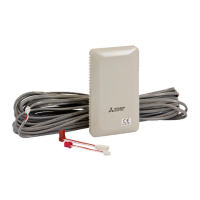
The PAC-SE41TS-E Remote Sensor is an external temperature sensing unit that connects to an indoor air-conditioner unit. Its primary function is to detect the average room temperature, providing more accurate readings than the sensor integrated within the indoor unit itself, especially when the indoor unit's location might be subject to localized temperature variations (e.g., direct sunlight, heat sources, or air conditioner blow-off). By providing an external temperature input, the remote sensor allows the air conditioning system to maintain a more consistent and comfortable room temperature based on the actual ambient conditions in the occupied space. This is particularly useful in scenarios where the indoor unit's built-in sensor might not accurately reflect the overall room temperature, leading to improved comfort and potentially more efficient operation of the air conditioning system. The sensor unit is designed to be discreetly mounted on a wall or within a switch box, blending into the room's aesthetics.
The remote sensor is designed for straightforward integration into Mitsubishi Electric air conditioning systems. When installed, it overrides the indoor unit's internal temperature sensor, ensuring that temperature control is based on the remote sensor's readings. This feature is crucial for optimizing comfort in various room layouts and applications. The installation process involves connecting a 2-core cable from the remote sensor to the indoor unit's electrical box, with multiple wiring methods provided to accommodate different installation scenarios, including direct wall mounting or integration into a switch box. The manual highlights the importance of selecting an appropriate location for the sensor to ensure it detects an average room temperature, free from direct sunlight, heat sources, or the air conditioner's airflow, which could skew readings.
Once installed, the system's temperature settings will automatically adjust to account for the remote sensor's input. Specifically, when the remote sensor is connected and the room temperature detection position is changed, the "Set temp. 4-deg. up" setting in the heating mode needs to be reset. This adjustment ensures that the system accurately interprets the remote sensor's data for heating operations, preventing over- or under-heating. The manual provides specific instructions for resetting this setting based on the type of control model (K control, M-NET control, or A control models), typically involving DIP switch adjustments on the indoor unit's control PCB. This user-configurable aspect allows for fine-tuning the system's response to the remote sensor's input, ensuring precise temperature management. The sensor's design is robust, intended for use in various commercial and light industrial settings, including shops, farms, and general commercial use by laypersons, as well as by expert or trained users.
The PAC-SE41TS-E Remote Sensor is designed for minimal maintenance, primarily focusing on proper installation to ensure long-term reliability. The installation manual emphasizes several key points that contribute to the device's longevity and prevent common issues. Firstly, it stresses the importance of firm and correct wiring connections using specified cables, ensuring they do not exert force on the terminals. This prevents wire breakage, heating, and potential fire hazards, which are critical for electrical safety and device function. The manual also advises against modifying or repairing the unit by oneself, directing users to consult their dealer for any repairs, thereby ensuring that any servicing is performed by qualified personnel using appropriate parts and procedures.
A crucial maintenance-related instruction is to securely seal the wiring lead-in port with putty or silicon. This prevents the ingress of dew, moisture, cockroaches, and other insects, which could otherwise lead to electric shocks or malfunctions. This sealing step is vital for protecting the internal components from environmental damage and maintaining the sensor's accuracy and operational integrity over time. Furthermore, the manual warns against washing the unit with water, as this could cause an electric shock or malfunction, reinforcing the need for dry cleaning methods if necessary. It also advises against installing the sensor in environments exposed to oil, steam, sulfuric gas, or acidic/alkaline solutions, as these can deteriorate performance or damage components. Avoiding such environments is a proactive maintenance measure that extends the device's lifespan.
The document also highlights the importance of preventing dust accumulation on the Printed Circuit Board (PCB) and avoiding direct contact with the PCB using hands or tools, as this could lead to fire or electric shock. These guidelines underscore the need for a clean installation environment and careful handling during any inspection or adjustment. By adhering to these installation and environmental guidelines, the PAC-SE41TS-E Remote Sensor is expected to operate reliably with minimal need for ongoing maintenance, contributing to the overall efficiency and longevity of the air conditioning system. The robust design and clear instructions aim to empower installers to set up the device in a way that maximizes its operational life and minimizes potential issues.
 General
| Category | Accessories |
|---|---|
| Communication | Wired |
| Compatibility | Mitsubishi Electric CITY MULTI systems |
| Display | LCD |
| Functions | On/Off, Mode, Temperature, Fan Speed |
| Power supply | 12 V DC |

 To Next Page