Need help?
Do you have a question about the Miyachi Unitek 250DP and is the answer not in the manual?
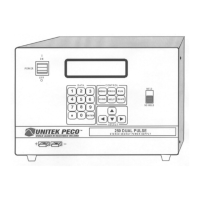
Describes the 250DP as a versatile, 250 watt-second stored energy, capacitor discharge, dual pulse power supply.
Details the multi-function microprocessor control, dual pulse welding benefits, and available weld functions.
Overview of the 250DP as a 1.5 to 250 watt-second stored energy power supply with dual pulse capability.
Defines pulse width, polarity, rise time, and pulse height measurements for the 250DP.
Information on saving and defining up to 127 different weld schedules in SRAM.
Lists the information defining a weld schedule, including number, function, polarity, and energy.
Describes how to change system options like units of measure, schedule number, and buzzer settings.
Details options and utilities for the Weld Sentry monitoring system if installed.
Defines default system parameters for head type, footswitch, security, and timing.
Explains the selectable weld functions: Basic, Repeat, and Rollspot, and their duration settings.
Describes compatibility with manual, user-actuated, or air-actuated weld heads and automatic detection.
Explains the requirement for 1-level or 2-level footswitches and their automatic detection.
Describes the feature controlled by options menu for aborting the welding sequence via footswitch.
Details the types of input signals the 250DP can use: single pole, 3-wire, or optical switches.
Explains the role of the force firing switch (manual) or footswitch (air) as the initiation switch.
Details the three types of alarms issued by the 250DP and how to clear them.
Details the use of two output relays for status signals and controlling external devices or weld heads.
Illustrates and identifies the operating controls on the front panel of the 250DP.
Details the function of each key on the 250DP front panel, including keypad, navigation, and mode keys.
Illustrates the information displayed in various operational states like RUN, PROGRAM, NO WELD, and MENU.
Step-by-step guide to turning on the 250DP and selecting initial settings for operation.
Instructions for setting up and adjusting air actuated weld heads, including pressure and flow controls.
Guide to establishing parameters for making and evaluating successful welds.
Defines the three basic welding parameters: heat, time, and pressure, and their controlling factors.
Step-by-step instructions for initiating and performing a weld using the 250DP.
Methods for assessing weld quality, including visual inspection and pull tests.
Describes the seven operational states of the 250DP: RUN, NO WELD, PROGRAM, MENU, HELP, STANDBY, and FIRE.
Explains how to access options common to all schedules, Weld Sentry, and general information via the menu.
Details the context-sensitive help feature accessible by pressing the HELP key for operational guidance.
Recommends contacting the Repair Department for calibration and modification advice.
Guidelines for checking the calibration of the 250DP, emphasizing qualified technician performance.
Helps diagnose and resolve issues, such as circuit breaker trips, by identifying probable causes.
Provides contact information and procedures for telephone and factory service repairs.
 General
| Rise Time | 1 ms |
|---|---|
| Input Frequency | 50/60 Hz |
| Efficiency | 85% |
| Operating Temperature | 0 - 40°C |
| Storage Temperature | -20 - 60°C |
| Type | DC Resistance Welding Power Supply |
| Operating Mode | Constant Voltage, Constant Current |
| Voltage Range | 1 - 10 V |
| Output Voltage | 10 V max |
| Cooling Method | Air |


 To Next Page