SAFETY
LIQUID NITROGEN SAFETY: These Liquid Nitrogen generators have been designed with the highest
level of user safety in mind. They are also designed to minimize direct handling of Liquid Nitrogen
by the user. However care must be taken to ensure no contact is made with the cryogenic fluid
during Liquid Nitrogen removal from a leak or splash.
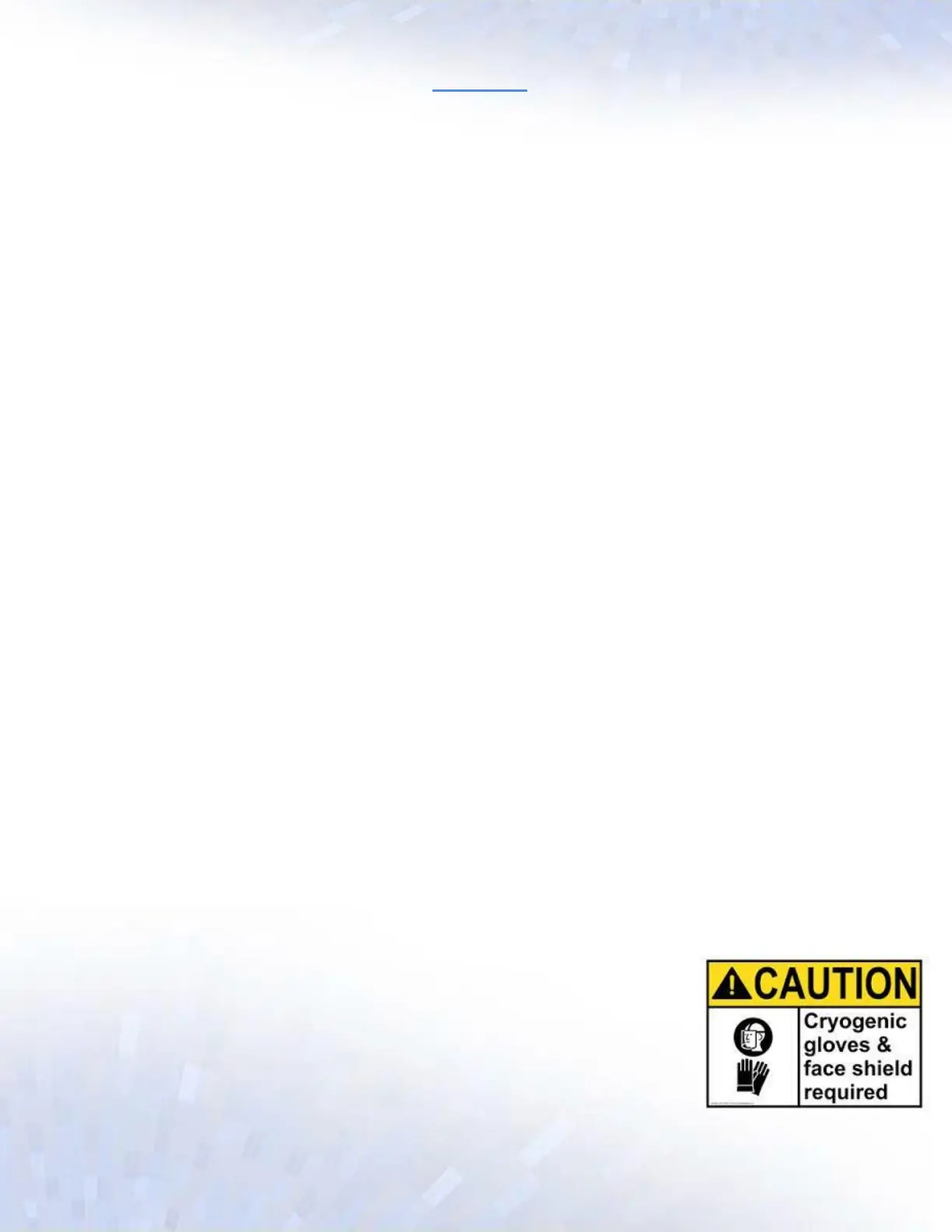
HANDLING: Never allow any unprotected part of the body to touch un-insulated pipes or vessels
which contain cryogenic fluids. The extremely cold fluid can cause severe burns if even momentary
contact with human skin is made. Always wear adequate eye protection and gloves when handling
cryogens.
CONTAINMENT: Never carry Liquid Nitrogen in a vessel not properly suited for Cryogenic Fluids.
MMR assumes no liability for injuries caused through improper handling or use of the provided
Cryogen Storage Vessels (Dewars). MMR has thoroughly tested and approved the following
Cryogenic Storage Vessels (Dewars) for use with this system:
Brymill CRY-AC Series for cryosurgery
MVE Dewars from PrincetonCryo
RISK OF EXPLOSION!
NEVER CAP OR SEAL A STORAGE VESSEL (DEWAR) FOR LIQUID NITROGEN THAT DOES NOT HAVE
ADEQUATE VENTILATION HOLES OR A PRESSURE RELIEF DEVICE.
SPECIFICATIONS: Liquid Nitrogen is a colorless, extremely cold liquid and gas (-198°C). It can cause
rapid suffocation when concentrations are sufficient to reduce oxygen levels below 19.5%. Contact
with liquid or cold vapors can cause severe frostbite. Cold vapors in the air will appear as a white
fog due to condensation of moisture. While this may indicate the presence of the gas it should not
be used to determine its concentration in the atmosphere. Oxygen concentrations must be
monitored in the release area. All cryogenic liquids produce large volumes of gas when they
vaporize. One volume of Liquid Nitrogen will expand to produce 696.5 equivalent volumes of gas.
MSDS-OSHA: Not established
ACGIH: Simple Asphyxiate
CAS NUMBER: 7727-37-9
PAGE 3


 To Next Page