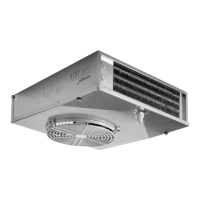
The Modine ECO heat transfer coolers, specifically the EGK, EGF, EGS, and EGW series, are remote location ventilated units designed to optimize heat exchange between air and various fluids in refrigeration or process cooling cycles. These units are classified as "Partly completed machinery" and must be integrated into a larger system that complies with Directive 2006/42/EC before being put into service.
Function Description
The core function of these units is to facilitate heat transfer. Each model in the series features a heat exchanger consisting of a finned pack interconnected to a coil of tubes, housed within a casing. Axial fans, positioned on the top of the casing, draw relatively cold ambient air through the heat exchanger.
- EGK Series (Condensers): These units optimize heat exchange between air and H(C)FC fluids in a refrigeration cycle. The compressed hot gas flowing inside the tubes condenses as it is cooled by the ambient air.
- EGF Series (Condensers): Similar to the EGK series, EGF condensers are specifically designed for R410A fluid in a refrigeration cycle, facilitating the condensation of compressed hot gas.
- EGS Series (Gas Coolers): EGS gas coolers are used in systems with carbon dioxide (CO2) as a refrigerant, replacing traditional remote condensers. They cool compressed hot CO2 gas flowing through the tubes, but the refrigerant gas is not liquefied within the cooler; liquefaction occurs later in the expansion valve. These units operate at significantly higher pressures than air-cooled condensers. Continuous monitoring of CO2 concentration is recommended when EGS models are installed in confined spaces due to the fluid's tendency to stratify near the floor.
- EGW Series (Liquid Coolers): EGW remote liquid coolers are designed to optimize heat exchange between air and a process liquid, cooling the hot liquid flowing through the tubes.
Important Technical Specifications
The units are supplied with heat exchangers manufactured according to internal DIN8964 standards for internal cleaning. The minimum protection level for all models is IP54. Detailed technical data, including model code, serial number, year of manufacture, max pressure PS, project number, fluid type, internal volume, weight, fan code, sound power level, current, and voltage, are provided on the data plate and in Section 14 of the manual.
For EGK, EGF, and EGS condensers, the units are supplied with a pre-charge of dry air at 2 bar and have 1/4” SAE charging couplings. It is crucial to check for the presence of this pressure upon receipt, as its absence indicates potential damage during transport.
Power cables must meet minimum cross-section requirements as specified in Table 1 (e.g., 1.5 mm² for 11A, up to 120 mm² for 170A), adhering to local technical standards for cable laying and length. The electrical system can be earthed using a pin under the front cover to minimize the risk of indirect contact.
Usage Features
- Intended Use: The units must only be used for their expressly designed purpose. Any other use is considered improper and voids the warranty.
- Fluid Compatibility: Ensure that the fluids used are compatible with the model's construction materials. For CO2 systems, verify that the water concentration in the CO2 is compatible with all system components.
- Frost Protection (EGW): Water-based fluid models (EGW) require adequate protection against ice formation in the tubes, as complete circuit emptying is not always possible. For EGW dry cooler models using water without glycol, the ambient temperature must always be above 0°C to prevent frost damage.
- Installation Environment: Installation should preferably be outdoors. If installed indoors, an air intake must be provided to exclude any additional static pressure. The units are fitted with axial fans not designed for additional static pressures, so ducting, air intake filters, or strong opposing air currents are prohibited.
- Support Base: The support base must be adequate for the operational weight of the model and securely anchored using all fixing points. Shock absorbers may be used to prevent noise transmission.
- Space Requirements: Adequate space for air circulation and maintenance must be provided. Avoid directing airflow against reflective surfaces or surfaces that increase noise levels. Minimum spacing between models can be reduced with special raised legs or support platforms.
- Temperature Limits: Ambient temperature must not be below -25°C or above 60°C. For installations below 5°C, ensure snow or ice does not obstruct fins or impede motor rotation.
- Refrigerant Pressure (CO2): CO2 systems can reach operating pressures of up to 130 bar. Always make the system safe according to current regulations before any intervention.
Maintenance Features
All maintenance, inspections, and repairs must be carried out by authorized and qualified personnel in accordance with EN 378. Personal Protective Equipment (PPE), such as gloves, should always be used to mitigate risks from sharp edges.
- Power Disconnection: Always disconnect and discharge electrical power before any work on the machine. Set the main switch to "0 OFF" and padlock it, with the key kept by the technician until work is complete. Wait until all fans have stopped rotating, and 5 minutes after power disconnection before opening the fan junction box.
- Regular Checks: At least every six months, verify the electrical connection, earthing, and condition of wear components (motors, switches). Check all electrical and mechanical parts, fluid circuits, and the integrity of the fan guard grille. Ensure screws are properly tightened (Ref. EN 1090-2).
- Fan Operation: If a fan is off for an extended period, it should be run for at least two hours monthly to remove moisture from the motor.
- Finned Pack Cleaning: Check the finned pack cleanliness monthly. Clean finned pack and fan surfaces at least every six months.
- To clean, place the main switch in "OFF," wait for fans to stop and hot surfaces to cool. Remove the fan group by unscrewing retaining screws.
- Use compressed air (max 10 bar, min 150 mm distance, perpendicular to fins) to avoid damage.
- For damp or greasy dirt, use a water jet (max 50 bar, min 150 mm distance, perpendicular to fins), adding a neutral detergent if necessary. Rinse and dry with compressed air. Ensure electrical components are protected from water.
- Aspirate from the air inlet side if needed.
- After cleaning, visually inspect for remaining dirt or damaged fins.
- Spare Parts: Only use original spare parts. Preventive replacements are recommended to improve performance and extend unit life. Refer to Section 14.3 for fan and conveyor part numbers.
- Post-Maintenance Checks: After any maintenance, perform pre-commissioning checks (Section 9) and post-commissioning checks (Section 10).
- Refrigerant Leaks: In case of refrigerant leakage, immediately evacuate the installation site and activate safety measures. For CO2 leaks, consider the fluid's tendency to stratify near the ground.
- Dismantling/Scrapping: Use appropriate PPE during dismantling and scrapping. Ensure complete draining and proper disposal of fluids. Pay attention to sharp edges.

 Need help?
 General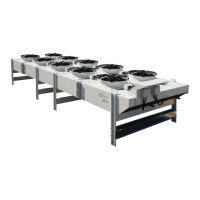

 To Next Page