The MOGAS Coker Switching Valve is a highly engineered product designed for severe coking applications, featuring customized safety features to ensure a "safety-first" approach. This manual provides comprehensive instructions for its installation, operation, and maintenance.
Function Description:
The MOGAS Coker Switching Valve is a critical component in coking processes, designed to manage the flow of media between different drums and a bypass port. It operates with an electric actuator and worm gear to perform switching functions. The valve's design incorporates features to withstand extreme temperatures, high pressures, abrasive particulates, and acidic products, making it suitable for severe service environments. Its primary function is to facilitate the switching of flow paths, ensuring continuous and safe operation in coker units.
Important Technical Specifications:
- ASME Class: 600 / 900
- Pressure Rating: BAR (PSIG) @ 38°C (100°F) and BAR (PSIG) @ °C (°F), as specified on the nameplate.
- Temperature Rating: As specified on the nameplate.
- Size: DN (mm) and Size (inches), as specified on the nameplate.
- Bore: As specified on the nameplate.
- End Type: As specified on the nameplate.
- Materials: Body, Ball/Stem, and Seats are constructed from materials suitable for severe service, with specific details found in the Valve Item Numbers section (pages 6-7).
- Packing: Features stem packing (09A) and anti-extrusion rings (09B) for sealing, with live load springs (07C) to maintain compression.
- Sealing: Utilizes graphite seals (01G, 09D, 21) and body gaskets (04) for robust sealing.
- Bearings: Includes stem thrust bearing (08), stem bearing (8A), ball sleeve bearing (8E), and ball sleeve (08C) for smooth operation.
Usage Features:
- Orientation Flexibility: The valve can be installed with the stem in horizontal, vertical, or angled positions. Vertical installation is preferred. For horizontal or angled positions, drain ports must be angled to allow coke drainage during switching.
- Operator Integration: Requires an operator (electric actuator with worm gear) for switching. If supplied by MOGAS, the operator is pre-assembled and tested. If not, an appropriate adaptor and operator must be installed.
- Position Indicators: The valve operator should be equipped with position indicators for correct ball bore position. Alternatively, the scribe line on the gland flange (07) can be used to determine ball bore position.
- Positional Stop Pins: Includes Bypass (BP) Lock/Stop Pin, Lockout Pin 1, and Lockout Pin 2 to prevent accidental switching once a position is selected. Lock-in pins are provided to secure these positions.
- Purging System: Typically equipped with steam purges, recommended to be continuous in the body cavity area to prevent valve lockup and ensure continuous operation.
- Draining System: Equipped with drain ports to flush out coke and water from the body cavity after each switching cycle. Drains should be opened for 15 minutes after each cycle. Some valves may have automated purge and drain procedures.
- Switching Operations: Detailed instructions and a table are provided for switching between Drum A, B, and BP, including disengaging and engaging pins, and ball rotation (CW/CCW).
Maintenance Features:
- Bolting Torque Verification: After initial exposure to elevated temperature/pressure and cooling, bolting torque must be verified at the packing gland flange, body to bonnet connection, and actuator to valve mounting. This should be checked periodically.
- Actuator Lubrication: Hydraulic, pneumatic, and worm gear actuators must be fully lubricated according to the manufacturer's specifications.
- Field Maintenance for Packing Leaks: If a packing leak develops, packing gland nuts (15) should be properly torqued to specified values from the test certificate. Stem packing replacement is typically done when the valve is removed from service for repair, using factory-recommended packing.
- Disassembly Procedures: Detailed steps are provided for disassembling the operator assembly, gland flange, stem packing, bonnet, stem bushing and bearing, springs, seat rings, ball and stem assembly, and ball sleeve and spring.
- Re-Assembly Procedures: Comprehensive instructions for re-assembly, including cleaning parts, positioning the valve body, installing ball sleeve and spring, ball and stem assembly, graphite rings, seats and springs, stem bearing and bushing, bonnet, packing, and top works assembly.
- Spare Parts Kits: MOGAS offers soft goods kits (gaskets, seals, packing) and trim change kits (ball, matched seats, springs, bearings, rings, gaskets, seals, packing) for maintenance.
- Storage Guidelines:
- Short-Term Storage: Valves are shipped in seaworthy, plastic-lined wooden crates. For short-term storage (up to six months), they should remain in crates/pallets with secured lids, with corrosion-resistant paint and desiccant bags in place.
- Removing from Service: Before removal, the ball bore must be aligned with one of the three ports. After removal, the valve should be placed vertically or angled, steam cleaned or power washed, dried, and a petroleum-based rust inhibitor applied through the bore.
- Long-Term Storage: Internal parts of carbon and alloy steel valves should be sprayed with a rust preventative. Bore protectors must be secured to prevent debris entry, and desiccant dryer bags should be placed inside. The valve should be stored vertically, indoors, out of the weather.
Important Notes and Cautions:
- Disassembling, reworking, and re-assembling the ball valve will void the warranty unless performed by authorized MOGAS service personnel.
- It is crucial to follow all steps to ensure maximum valve performance and safety.
- Always wear a face shield or goggles when cleaning the packing box to protect eyes from flying debris.
- When installing packing rings with skive cuts, ensure each cut is staggered or alternated to prevent leak paths.
- The gland flange must be pulled down evenly and remain perpendicular to the stem to prevent damage and ensure proper operation.
- Bolting torque values are critical and must adhere to the individual valve's test certificate.

 Need help?
 General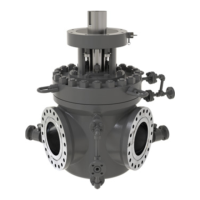

 To Next Page