The Moleaer Neo-N Nanobubble Generator is an industrial-scale system designed to produce nanobubbles for various applications, primarily in sustainable food production, chemical-free water treatment, and natural resource recovery. Its core function is to harness the power of oxygen to improve irrigation water quality, promote plant growth, suppress or eliminate pathogens, and remove biofilm from surfaces. The system achieves this by supersaturating water with dissolved oxygen and trillions of nanobubbles, which exhibit unique properties such as neutral buoyancy, high negative surface charge, enormous surface area, and strong oxidation potential.
Function Description:
The Neo-N Nanobubble Generator operates by injecting gas (typically oxygen, but inert gases and CO2 can also be used on standard models) into a liquid stream to create nanobubbles. The system is available in different models (S2, S3, S5) and variants, including standard (off-board gas) and onboard oxygen generator versions.
For standard models, gas is supplied externally and controlled via a needle valve on a rotameter. For models with an onboard oxygen generator, the unit extracts oxygen from ambient air using Pressure Swing Adsorption (PSA) technology, compresses it, and then injects it into the liquid. The system is controlled by a Programmable Logic Controller (PLC) with an LCD touch screen interface, allowing for easy monitoring of sensor values and configuration of pump and system settings. Operational modes include Manual, Timer Schedule, and Dissolved Oxygen (DO) Schedule.
Important Technical Specifications:
- Liquid Flow Capacity (nominal):
- 50 Hz Standard: S2 (9.1 - 12.5 m³/hr), S3 (17.0 - 25.0 m³/hr), S5 (40 - 57 m³/hr)
- 50 Hz with Oxygen: S2 (9.1 - 13.6 m³/hr), S3 (17.0 - 25.0 m³/hr), S5 (40.9 - 62.5 m³/hr)
- 60 Hz Standard: S2 (40 - 55 gpm), S3 (75 - 110 gpm), S5 (175 - 250 gpm)
- 60 Hz with Oxygen: S2 (40 - 60 gpm), S3 (75 - 110 gpm), S5 (180 - 275 gpm)
- Pump TDH (nominal): 15.2 m (50 ft for 60 Hz models)
- Ambient Temperature Range: 5 - 60 °C (40 - 140 °F for 60 Hz models)
- Max Diameter Solids: < 3.2 mm (< 1/8” for 60 Hz models)
- Gas Supply (Maximum Gas Feed Pressure): 6.9 Bar (100 psig for 60 Hz models) for standard, 6.9 Bar (100 psig for 60 Hz models) for onboard oxygen generator.
- Recommended Gas Flow (Standard):
- 50 Hz: S2 (0 - 7 SLPM), S3 (0 - 15 SLPM)
- 60 Hz: S2 (0 - 15 SCFH), S3 (0 - 30 SCFH)
- Recommended Gas Flow (Oxygen Gen.):
- 50 Hz: S2 (0 - 12.7 SLPM), S3 (0 - 16.3 SLPM)
- 60 Hz: S2 (0 - 12.7 SCFH), S3 (0 - 16.3 SCFH)
- Electrical Power: Available in various voltage, phase, and frequency configurations (e.g., 230V 1F 50Hz, 400V 3F 50Hz, 230V 1F 60Hz, 460V 3F 60Hz).
- Pump Type: Flooded Suction or Self-Priming, TEFC motor.
- Wetted Parts Materials: Viton/316 SS, PVC, PFA, PTFE, PVDF, Brass, Buna-N, Polypropylene, Polyester, EPDM, Neoprene, Technopolymer.
- Frame Material: SS 300 Series, Passivated.
- Envelope Dimensions: 107 cm L x 66 cm W x 110 cm H (42” L x 26” W x 43.6” H for 60 Hz models).
- Weight: S2 (109 kg/240 lbs), S3 (113 kg/250 lbs), S5 (118 kg/260 lbs). Onboard oxygen generator models are slightly heavier.
- Dissolved Oxygen Probe (DOGB-0504): Optical, 0-5V output, measures 0-40 mg/L DO and 0-400% saturation. Operating temperature 0-50 °C.
- Mechanical Pressure Switch: Factory set at 4-6 psig (0.275-0.413 barg).
- Solenoid Valve (GRANZOW MODEL #E2B19-000): 2-Way, Internally Piloted, Normally Closed. 1/4" pipe size, 7/16" orifice, 120 VAC, 8 Watts.
- Back Pressure Regulator (Swagelok KBP1F0D4A5A20000): High-sensitivity, general-purpose regulator.
Usage Features:
- Installation: Designed for indoor use, requiring a minimum 6 ft x 6 ft x 6 ft (2 m x 2 m x 2 m) clearance for maintenance. Can be installed with flooded suction (waterbody surface above pump suction centerline) or suction lift (waterbody surface below pump suction centerline, requiring a self-priming pump). Proper airtight and leakproof PVC piping is crucial for optimal performance.
- Gas Connection: For standard models, connect a high-pressure rated oxygen gas line to a CGA-022 connection and adjust the regulator to 40-140 PSI (2.75-9.65 bar). Onboard oxygen generator models produce their own oxygen.
- Operation Modes (PLC):
- Manual Mode: System started and stopped manually via START/STOP buttons on the main screen.
- Timer Schedule Mode: System runs for a set RUN TIME and stops for a set OFF TIME, alternating automatically.
- Dissolved Oxygen (DO) Schedule Mode: System runs until a target DO setpoint (9.0-40 ppm) is reached, then stops for a set OFF TIME, restarting after the OFF-timer times out.
- Auto Restart: Unit automatically restarts after a power failure.
- Flow Adjustment: Gas flow rates can be adjusted using a knob on the rotameter (main flowmeter on the front, oxygen generator flowmeter on the left side of the enclosure). Liquid pressure and gas pressure gauges provide real-time feedback.
- Suction and Discharge: Intake should not create a vortex, and discharge should produce small bubbles (pea-sized or smaller) for proper installation.
- Safety: Features include GFCI protection, emergency shutoff switch, and warnings against suction entrapment, electrical shock, and hazardous pressure.
Maintenance Features:
- Preventative Maintenance Kits: Moleaer offers kits that include replacement components for various intervals (e.g., 2 years/12,000 hours, 4 years/30,000 hours) for AirSep Topaz and Topaz Ultra oxygen generators.
- Monthly Inspection Checklist: Includes checks for gas leakage, water pressure, compressor vibration, rotameter readings, gas tubing, main pressure regulator, and pump basket (for aquatic pumps).
- Scheduled Maintenance:
- Day 1, Week 1, Week 2, Week 4: Perform monthly inspection.
- 6 Months: Isolate and clean DO probe, replace oxygen generator air intake filter (except standard models), clean O2 generator enclosure (onboard O2 units only).
- 1 Year: Perform monthly inspection, visually inspect electrical enclosure, perform Clean-In-Place (CIP), replace oxygen generator air intake filter (except standard models), swap O2 generator foam filter (onboard O2 units only), clean O2 generator enclosure (onboard O2 units only), perform 6 months maintenance.
- 1.5 Years: Perform 1 year maintenance.
- 2 Years: Replace DO probe membrane cap, rebuild O2 generator feed and waste solenoid valve (onboard O2 units only), reseal O2 generator compressor (onboard O2 only), replace O2 generator mount sandwich (onboard O2 only), reseal the gas recompressor (onboard O2 only), replace O2 generator equalization valve, perform 6 months maintenance.
- 2.5 Years: Perform 1 year maintenance items, check and adjust set pressure of the main back pressure regulator (all units except standard), perform 6 months maintenance.
- 3.5 Years: Perform 1 year maintenance.
- 4 Years: Calibrate Prosense pressure switch, replace DO sensor, rebuild O2 generator feed and waste solenoid valve (onboard O2 units only), replace O2 generator compressor (onboard O2 only), replace O2 generator equalization valve (onboard O2 only). Optional: Reseal pump, replace or calibrate all pressure transducers.
- Clean-In-Place (CIP) Procedures: Detailed instructions are provided for cleaning the nanobubble generator using a syringe kit and cleaning solution (Lysol or Multi-Use CLR for US, Descaler PH = 0.5 for EU). This involves isolating the unit, removing the bottom air fitting tube, injecting cleaning solution, letting it sit, flushing with clean water, and then reconnecting and running the system.
- Compressor Maintenance: Regular inspection and repairs are recommended. Independent shutdown procedures are provided for diagnostic or repair purposes. Service kits are available for replacing components like gaskets, filters, piston rings, and seals.
- Oxygen Generator Maintenance: Includes cleaning the gross particulate filter every two weeks and cleaning the enclosure monthly.
- Winterizing: Precautions are outlined for installations in areas where temperatures can drop below freezing, including insulating pipes and draining the system if there's a risk of power loss.
- Troubleshooting: Comprehensive charts are provided for diagnosing and correcting common issues related to pump operation, gas flow, dissolved oxygen saturation, power consumption, and compressor performance.

 Need help?
 General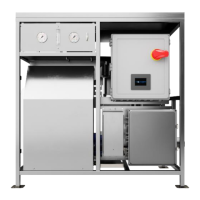

 To Next Page