12
13
DK ENG
In principle
Your stove should be with Primary and Secondary air and Pilot air inlets.
Primary Air is controlled using the lever situated over the door. Moving the control lever to
right position will open the air inlet and will allow a supply of preheated air to enter the rebox
via the ‘airwash’ system situated inside the stove and above the glass.
The secondary air is injected into the ue gases above the re resulting in a cleaner, more
ecient combustion process. The supply of secondary air and Pilot air is xed open and is
not adjustable.
For extra safety, your stove should be with a removable handle.
2.2 Lighting and loading intervals
When rst lighting the stove, a large volume of air is needed. When the stove is cold, you
should leave the door open an inch or two for the rst few minutes and open the primary air
supply completely. While the door is open, do not leave the stove unattended.
To form a reasonable bed of ash on the oor of the stove, you should use 2-4 pounds of dry
kindling at the initial lighting. If possible, maintain a 1-1.5 inch (2-3 cm) layer of ash on the
oor of the combustion chamber for added insulation.
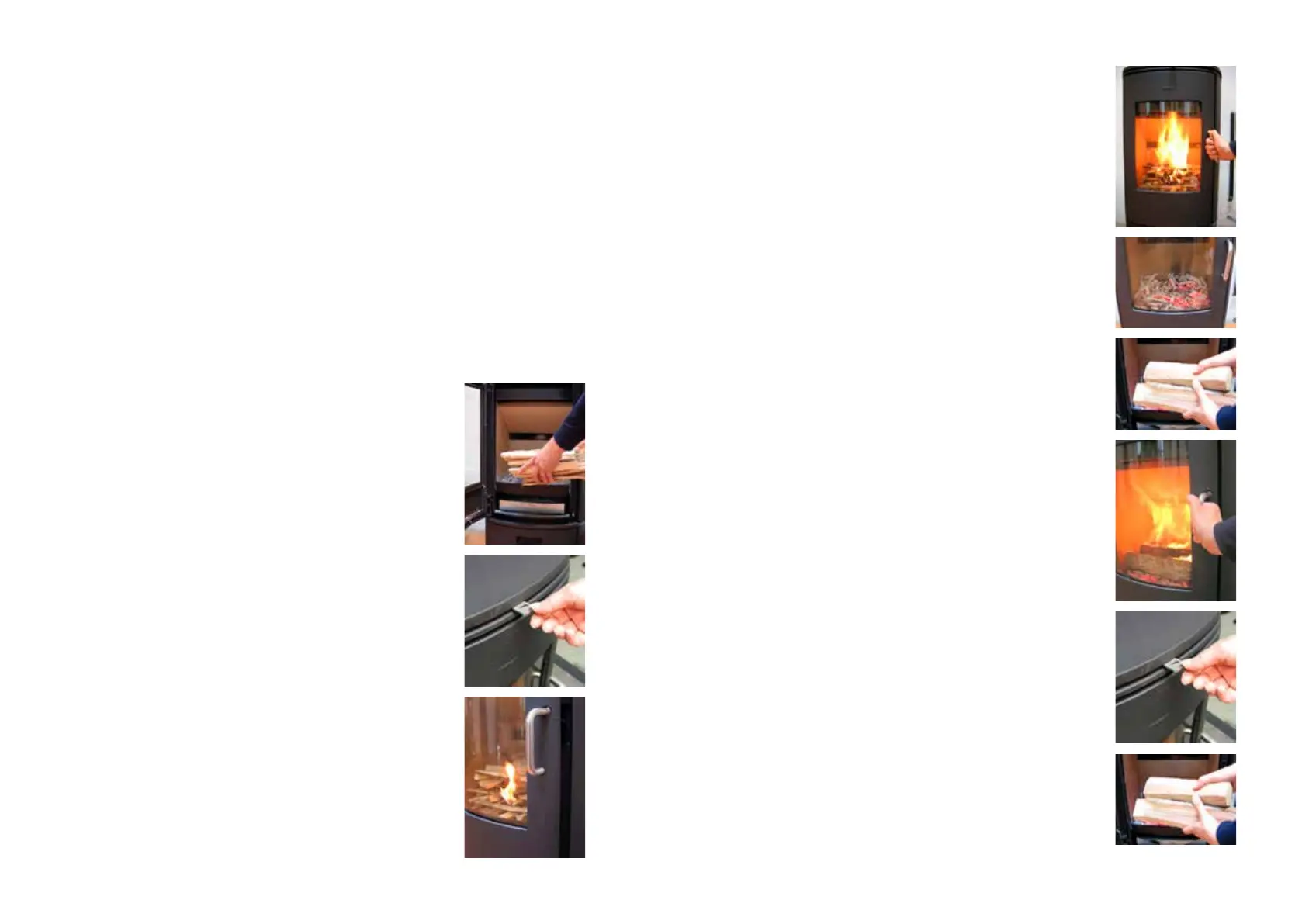
1. We recommend using the “top-down” method to light
your wood-burning stove. It is the most environmentally-
friendly method of lighting. Use two relighters and ap-
prox. 2-4 lbs of dry kindling sticks to quickly create a glow-
ing layer of wood. Place the relighters directly under the
top layer of kindling sticks.This minimizes soot formation
on the glass. Soot formation on the glass is often caused
by too vigorous burning in contact with cold surfaces. If
you avoid the formation of soot when lighting the re and
build up a layer of hot embers, you will have minimal soot
formation when getting the re burning again later.
2. The air supply must be fully open.
3. Light the re.
4. After lighting, partially close the door, leaving it open an
inch or two to allow in plenty of combustion air.
5. When the chimney is warm after about 5-10 minutes,
the door should be closed. A suitable layer of ember will
be formed after about 15-20 minutes.
6. When ready to reload, use a poker to spread the embers
across the rebox oor, bringing plenty towards the front
of the stove.
7. Lay two pieces of wood onto the embers. Leave half an
inch or more between each piece.
8. Close the door. Leave the primary air supply fully open.
If it does not light, leave the door slightly ajar to allow the
necessary amount of air in to ignite the wood.
Close the door again once the wood has kindled.
9. After a few minutes, adjust the primary air supply to suit
your heating requirements.
Make sure that there is always enough air to sustain clear,
enduring ames when you reduce the amount of combus-
tion air, and afterwards.
10. For refueling, add a layer of wood while there are still
plenty of live embers, repeat steps 6-9.
We recommend using fuel load with a weight of 3 lbs
(2 pieces) and up to 6 lbs (5 pieces).
Always keep the fuel load beneath the secondary
stainless-steel air box. The space in front and above the air
box is reserved for volatile gas combustion only.


 To Next Page
 Loading...