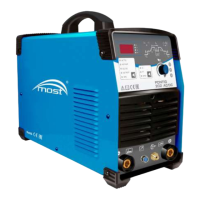
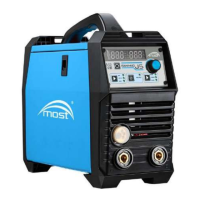
This document describes the PONTIG 210 DC MOST welding rectifier, an inverter-based device designed for DC TIG welding with Argon shielding (suitable for steel and stainless steel) and MMA (Stick) coated electrode welding.
Function Description
The PONTIG 210 DC MOST is a versatile welding machine offering both TIG and MMA welding methods. For TIG welding, it features HF ionizer arc ignition and an automatically opened gas electro-valve. It supports continuous or pulsating current for TIG welding. For MMA welding, it handles electrodes with rutile or basic coatings. The device is equipped with a thermal sensor for overheating protection and complies with the EN 60974-1 Standard, "Arc welding equipment. Part 1: Welding power sources."
The control panel is user-friendly, featuring keys, LED indicators, a digital display, and a knob. The 3-digit display shows parameter settings, current values, and error codes (E-x).
Key functions include:
- TIG Operating Modes: 2T (2-stroke), 4T (4-stroke), and spot welding.
- Adjustable TIG Parameters: Current rise time (upslope time), current drop time (downslope time), gas pre-flow time, and post-flow time.
- ArcForce Function (MMA): Automatically increases welding current when the electrode contacts the material, particularly useful for welding pipes.
- High-Reliability TIG HF Ignition: Ensures consistent arc starts.
- Welding Methods: TIG DC, TIG pulse, and MMA.
- TIG Pulse Method Parameters: Gas pre-flow time, post-flow time, initial current, current rise time (upslope time), current drop (downslope time), welding current, background current, and pulse frequency are all adjustable.
- MMA Parameters: Arc ignition time, pre-set current, and arc current are adjustable.
- Error Display: Shows error codes for overvoltage, too low voltage, or overheating.
- Memory Function: Saves parameters automatically after switching off (if operations are performed within 5 seconds of setting parameters). The last saved parameters apply upon restart.
Important Technical Specifications
- Electrical Power Supply: 1x230V/50-60Hz
- Power Tolerance: +15%/-15%
- Welding Current Range: TIG: 10-200A; MMA: 10-180A
- Welding Current Set Point: Smooth
- Overload Protection: 16A (delayed)
- Work Cycle (MMA DC): 180A/35%, 137A/60%, 106A/100%
- Work Cycle (TIG DC): 200A/35%, 153A/60%, 118A/100%
- MMA Electrode Diameter: 2.0-4.0 mm
- Sockets for Connecting Welding Cable: 35/50 (large)
- Power Factor (cos φ): 0.7
- Power Consumption: 8.2 kW (MMA), 6.0 kW (TIG)
- Efficiency: 85%
- Plug: Schuko 16A
- Insulation Class: F
- Protection Class: IP21S
- Standard: EN 60974-1
- Dimensions: 432x167x312 mm
- Weight: 8.2 kg (11 kg with carton of accessories)
- Catalogue No.: 52 00 005423
Usage Features
The device is designed for use in severe conditions but requires simple preventive measures for reliable operation. It should not be placed on surfaces inclined more than 15°, used for pipe defrosting, or covered during operation to ensure proper airflow. The device housing has an IP21S protection rating, meaning it should be kept dry and not placed on wet surfaces or in puddles. It is strictly forbidden to use the device for welding tanks that previously stored flammable substances.
Environmental Conditions:
- Operation Temperature: -10°C to +40°C
- Storage and Transportation Temperature: -25°C to +55°C
- Relative Air Humidity: Up to 50% at +40°C; up to 90% at +20°C.
Safety Precautions:
- Always wear personal protective equipment (PPE) including a welding mask with protective filter, welding gloves, apron, welding clothing, and leather shoes.
- Ensure the welding area is free of flammable materials.
- Do not expose the device to rain or water vapor.
- Provide adequate ventilation or use individual filters to remove welding fumes.
- Immediately stop work and disconnect the device if power cords are damaged.
- Keep a fire extinguisher nearby.
- Never attempt to repair a damaged gas reducer; replace it with a functional one.
- Avoid accidental contact between the electrode and workpiece in MMA mode, as current is always present in the cables.
TIG DC Welding (without pulsation):
- Connect the device to a 230V mains supply.
- Connect the TIG torch to the negative socket (8), control plug to socket (6), and gas connection to (7).
- Connect the mass cable to the positive socket (5) and the gas to connector (2) at the rear.
- Turn on the device using the ON/OFF switch (1).
- Attach a tungsten electrode with the appropriate diameter and sharpening angle (refer to Table 2 for recommendations).
- Select TIG DC method (indicator 7) and 2T mode (indicator 9) via buttons (5) and (3) respectively.
- Adjust gas pre-flow time (indicator 16), initial current (indicator 15), current rise time (indicator 14), welding current (indicator 13), current descending time (indicator 23), final current (indicator 22), and gas post-flow time (indicator 21) using the parameter selection button (2) and knob (4).
- Adjust argon flow with the bottle reducer.
- Press the TIG torch button to start the solenoid valve and HF ionizer. Maintain the torch 2-4 mm from the workpiece.
- In 2T mode, releasing the torch button reduces current to the final value, then the arc extinguishes, and gas flows for the set post-flow time.
- In 4T mode, releasing the torch button after arc ignition maintains the welding current. Pressing and releasing again reduces current to the final value, then the arc extinguishes, and gas flows for the set post-flow time.
- In spot welding mode, the arc ignites, current increases to the set value, and welding lasts for the set time without needing to hold the trigger.
TIG Pulse Welding:
- Select TIG pulse (indicator 6) and 2T mode (indicator 9) via buttons (5) and (3).
- Adjust gas pre-flow time (indicator 16), initial current (indicator 15), current rise time (indicator 14), welding current (indicator 13), background current (indicator 12), current descending time (indicator 23), final current (indicator 22), gas post-flow time (indicator 21), TIG pulse time factor (indicator 17), and TIG pulse frequency (indicator 18) using the parameter selection button (2) and knob (4).
- The current pulses between I1 and I2 according to the set pulse time factor and frequency.
MMA Coated Electrode Welding:
- Connect the device to a 230V mains supply.
- Connect the ground wire plug to socket (8) (-) and the electrode holder plug to socket (5) (+).
- Switch on the unit.
- Select MMA welding (indicator 8) by pressing button (5).
- Set the proper welding current for the electrode diameter using knob (4). The welding current value is shown on display (1), and indicator (25) lights continuously.
- Initiate the arc by rubbing the electrode tip against the workpiece. Quickly move the tip to a certain distance after arc initiation.
- Adjust arc ignition time (HotStart, indicator 19) and ArcForce (indicator 20) using button (2) and knob (4).
Maintenance Features
- General Maintenance (Daily):
- Check cables and connections; replace if necessary.
- Check welding torch and connection; replace if necessary.
- Check cooling fan operation; keep air inlets and outlets clean.
- Keep the device clean.
- Periodic Maintenance (at least every 3 months):
- Frequency may increase based on working conditions and intensity of use.
- Use dry air (low pressure) to remove dust from the casing and inside the device.
- Check and tighten all screws.
- Check all electrical contacts and repair if necessary.
- Mandatory Device Checks:
- Periodic tests are required at least once a year (EN ISO 17662 clause 4.2).
- Post-repair tests are required after any repair that restores welding functionality (EN 60974-4 clause 4.6).
- All maintenance and repair work should be performed by authorized personnel, specifically RYWAL-RHC technical support.
- Safety during Maintenance:
- Always disconnect the device from the electrical network before performing any maintenance or service work.
- After each repair, perform a respective check to ensure safe use.
Recycling:
In accordance with Directive 2012/19/EU WEEE II (Waste Electrical and Electronic Equipment), the device must be recycled by a specialized company after decommissioning. Do not dispose of worn-out welding equipment with domestic waste.

 Need help?
 General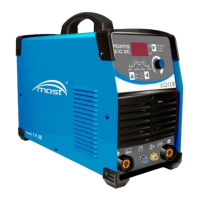

 To Next Page