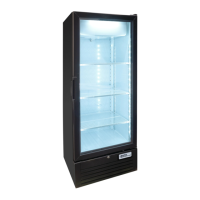
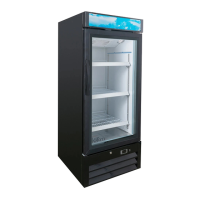
This document is a service and installation manual for a MOTAK Upright Economy Reach-in Refrigerator & Freezer. It provides essential information for safe operation, installation, maintenance, and troubleshooting of the appliance.
Function Description:
The MOTAK Upright Economy Reach-in Refrigerator & Freezer is a commercial appliance designed for storing food products. It comes in both refrigerator and freezer models, offering different temperature ranges suitable for various storage needs. The appliance features a self-contained refrigeration system and is designed for indoor use in a permanent structure. It is equipped with a digital thermostat display for temperature control and monitoring.
Important Technical Specifications:
The manual provides specifications for two models: MSD-1DR-EC-HC (refrigerator) and MSD-1DF-EC-HC (freezer).
- MSD-1DR-EC-HC (Refrigerator):
- Voltage/Hz/Ph: 115/60/1
- AMPS: 3
- HP: 1/3
- Shelves/Shelf Size: 3/ 25.7 x 20.9 inches
- Max Weight Load per Shelf: 53 lbs
- Max Weight Load per Model: 553 lbs
- Cord Lgth (ft): 8.2
- CHARGE OZ: 3.88
- SHIP WEIGHT LBS: 249
- NEMA PLUG: 5-15P
- STORAGE CAPACITY Cu-ft: 25
- Temperature Range: 34°F to 38°F
- MSD-1DF-EC-HC (Freezer):
- Voltage/Hz/Ph: 115/60/1
- AMPS: 7
- HP: 2/3
- Shelves/Shelf Size: 3/ 25.7 x 20.9 inches
- Max Weight Load per Shelf: 53 lbs
- Max Weight Load per Model: 542 lbs
- Cord Lgth (ft): 8.2
- CHARGE OZ: 3.88
- SHIP WEIGHT LBS: 269
- NEMA PLUG: 5-15P
- STORAGE CAPACITY Cu-ft: 25
- Temperature Range: -7°F to -1°F
The appliance uses flammable insulation blowing gas C5H10. The maximum ambient temperature for optimum performance is 95°F, and humidity should not exceed 70%.
Usage Features:
- Temperature Control: The appliance is equipped with a solid-state thermostat with a digital display. Users can set the desired temperature using the "SET" button. The display shows the current temperature and allows for parameter browsing and modification.
- Defrost Function: Both refrigerator and freezer models have an automatic defrost cycle. For refrigerators, the evaporator coil will deactivate when the doors are open, and the controller will initiate a defrost cycle every 6 hours, reaching 41°F. For freezers, the evaporator coil will deactivate when the doors are open, and the controller will initiate a defrost cycle every 6 hours, reaching 54°F. Manual defrost can also be initiated by pressing the "DEF" button.
- Alarm Signals: The thermostat provides various alarm signals, including "P1" (room probe failure), "P2" (evaporator probe failure), "HA" (maximum temperature alarm), "LA" (minimum temperature alarm), "DA" (door open alarm), "CA" (external alarm), and "CA" (pressure switch alarm). These alarms help in identifying potential issues with the appliance.
- Key Combination: The thermostat features key combinations for locking/unlocking the keyboard and viewing the latest room temperature display.
- Door Switch: The appliance includes a door switch that controls the evaporator fan and initiates defrost cycles when the door is open.
Maintenance Features:
- Cleaning:
- Interior and Exterior: The interior and exterior surfaces should be cleaned with soap and warm water. A non-abrasive cleaner is recommended. Stainless steel surfaces should be cleaned regularly to preserve their finish. Avoid abrasive cleaners, steel wool, and wire brushes.
- Condenser Coil: The condenser coil requires regular cleaning, recommended every 90 days. Heavy dust build-up can significantly reduce cooling efficiency and lead to compressor failures. A vacuum or compressed air can be used for cleaning. For heavy grease, de-greasing agents may be necessary. Never use high-pressure water near electrical components.
- Drain Pan: The drain pan should be cleaned regularly to prevent mold and mildew build-up.
- Gaskets: Gaskets should be cleaned regularly with warm soapy water to maintain elasticity and ensure a tight seal. Replace damaged gaskets promptly.
- Doors/Hinges: Hinges should be lubricated regularly, and screws should be tightened to prevent sagging.
- Leveling: The appliance must be level for proper operation. Adjustable bullet feet allow for leveling.
- Unit Repairs: Unit repairs should only be performed by qualified service technicians.
- Power OFF: Before any maintenance or cleaning, the appliance must be turned OFF and disconnected from the power source.
- Stainless Steel Care: Stainless steel surfaces require specific care to prevent corrosion. Regular cleaning with a non-abrasive cleaner and polishing with a stainless steel cleaner are recommended. Avoid abrasive materials, chlorides, and acids.
- Drain Maintenance: The drain unit should be checked regularly for blockages. A clogged drain can lead to water accumulation and overflow.
The manual emphasizes several safety messages using symbols like DANGER, WARNING, and CAUTION.
- General Safety: Always read and obey all safety messages. If the supply cord is damaged, it must be replaced by the manufacturer or a qualified person. Children should be supervised and prevented from playing with the appliance.
- Installation Safety: Ensure proper ventilation, do not block air vents, and avoid installing the appliance in areas with explosive substances. The appliance should be installed on a level, sturdy surface.
- Electrical Safety: A dedicated circuit with a properly grounded three-prong receptacle is required. Do not use extension cords or adapters.
- Flammable Refrigerant: The appliance uses flammable refrigerant (R290) and insulation blowing gas (C5H10). Servicing should only be done by certified technicians.
- Damage Inspection: Inspect the appliance for damage upon receipt. Any damage should be reported to the carrier immediately.
- Disposal: Dispose of the appliance in accordance with local regulations due to the flammable insulation blowing gas.

 Need help?
 General

 To Next Page