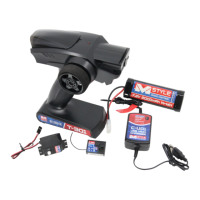
This document describes the Receiver R-301 and Transmitter T-301, components of a digital proportional radio control system operating on the 2.4GHz FHSS frequency.
Receiver R-301
Function Description:
The Receiver R-301 is a crucial component of the radio control system, designed to receive signals from the Transmitter T-301. It translates these signals into commands for various model components, such as the Electronic Speed Control (ESC) and steering servo. The receiver operates on a 2.4GHz FHSS (Frequency Hopping Spread Spectrum) system, which offers improved resistance to interference compared to conventional frequencies. It supports both mechanical and electronic speed control setups. The receiver includes an LED indicator for status feedback and a pair/setup button for binding and fail-safe configuration.
Important Technical Specifications:
- Model: R-301
- Frequency: 2.4GHz FHSS
- Operating Voltage:
- 6.0~8.4V (Alkaline/Ni-Cd/Ni-MH)
- 7.4~11.1V (Li-poly3S)
Usage Features:
- Binding Procedure:
- Power off the transmitter.
- Press and hold the binding button on the receiver.
- While holding the button, turn the receiver on. The LED will flash quickly.
- Release the button.
- Turn the transmitter on. It will automatically bind with the receiver.
- Successful binding is indicated when the LED indicator on the receiver becomes solid.
- Note: If the LED flashes or is off, the setup failed. Shorten the distance between the transmitter and receiver and bind again. Long binding distances can cause setup failure.
- Fail-Safe Setup Procedure:
- Ensure the transmitter is paired with the receiver.
- Turn on the power switches of both the transmitter and receiver; both LED indicators should be on.
- Press and hold the receiver setup button for 2 seconds. The LED will flash rapidly for 5 seconds.
- Put CH2 (throttle) in the brake condition and hold it until the LED continuously lights up.
- Note: The model car is typically preset at a F/S mode to automatically brake after running out of control. Users should check if the F/S mode still works and reset if necessary. Any new binding of the transmitter and receiver will clear the preset fail-safe.
- Antenna Installation:
- The antenna must be kept as straight as possible to avoid reducing effective range.
- It should be perpendicular to the model. For larger models with metal objects that can attenuate the RF signal, antennas should be placed at the sides of the model for optimal signal reception.
- Antennas must be kept at least half an inch away from conductive materials like metal and carbon. The coaxial part of the antenna does not need to follow these guidelines but should not be bent sharply.
- Keep antennas away from the motor, ESC, and other noise sources.
Maintenance Features:
- The receiver contains precision electronic parts and is the most delicate radio component on-board the model.
- It should be protected from vibration, shock, and temperature extremes.
- Wrap the receiver in R/C foam rubber or other vibration-absorbing material.
- If appropriate, waterproof the receiver by placing it in a plastic bag and sealing the open end with a rubber band before wrapping it in foam. Moisture entering the receiver can cause intermittent operation or failure.
- Wrapping the receiver in a plastic bag also protects it from fuel and exhaust residue.
Transmitter T-301
Function Description:
The Transmitter T-301 is the user interface for controlling the model. It sends 2.4GHz FHSS signals to the Receiver R-301, allowing the user to control steering, throttle, and auxiliary functions. It features a steering wheel for CH1 (steering), a throttle trigger for CH2 (throttle), and a Channel 3 Aux Switch. Trim levers and dual-rate adjustments are provided for fine-tuning control.
Important Technical Specifications:
- Model: T-301
- Output Power: <100mW
- Operating Voltage: 4.8 or 6V
- Power Supply: 4 Cell Alkaline/Ni-Cd/Ni-MH
- Frequency/Modulation Type: 2.4GHz FHSS
Usage Features:
- Controls:
- Steering Wheel (CH1): Controls steering.
- Throttle Trigger (CH2): Controls throttle (forward/brake/reverse).
- Channel 3 Aux Switch: For auxiliary functions.
- Throttle Trim Lever (CH2): Adjusts the neutral point of the throttle.
- Steering Trim Lever (CH1): Adjusts the neutral point of the steering.
- Steering Dual Rate Lever (D/R): Adjusts the maximum steering angle.
- Indicators:
- Working Station Indicator: Shows the operational status.
- CH2 EPA: End Point Adjustment for throttle.
- Battery Installation:
- Open the battery holding tray.
- Insert 4 AA batteries into the marked spaces, ensuring correct polarity. Incorrect insertion can damage the transmitter.
- For battery packs, insert the pack into the open section, using chassis cut-outs for wiring if needed.
- Secure the battery with provided straps.
- Connect the battery plug into the speed controller plug, observing correct polarity (red to red, black to black).
- Adjustments:
- CH1 (Steering) Trim:
- If wheels point left, turn CH1 downward.
- If wheels point right, turn CH1 upward.
- No adjustment needed if wheels point straight.
- CH1 (Steering Dual-Rate) D/R:
- If steering angle is too small, adjust D/R upward.
- If steering angle is too large, adjust D/R downward.
- CH2 (Throttle) Trim:
- If wheels move forward without operation, adjust CH2 downward.
- If wheels move backward without operation, adjust CH2 upward.
- CH1 (Steering Reverse): Use this adjustment if steering direction is reversed.
- CH2 (Throttle Reverse): Use this adjustment if throttle direction is reversed.
- CH2 (Throttle end point): Adjusts forward and brake side servo travel independently for each direction.
- Antenna: The 2.4GHz transmitter has an internal antenna.

 Need help?
 General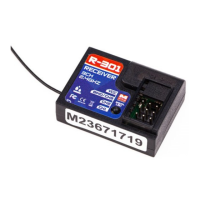

 To Next Page