Need help?
Do you have a question about the Munters Euroemme EM50 and is the answer not in the manual?
Manufacturer's right to alter specifications and no warranty for specific purposes.
Thanks for purchasing the fan and advice to study the manual.
Release date and copyright information, subject to change.
Instructions for proper disposal of the product as WEEE.
Requirements for personnel using the fan, including training and employer duties.
General safety rules, including not removing guards, locking devices, and avoiding sparks.
Details about fixed guards on intake and outlet sides of the fan.
Identification of mechanical and electrical hazards and associated safety signs.
Instructions for inspecting the fan upon receipt for damage and checking rating plates.
Information on how fans are delivered and handling precautions.
Description of the fan's main components and motor specifications.
Specifies the intended applications and operating environment for the fans.
Lists uses considered improper, including tampering and misuse.
Fan is not designed for potentially explosive atmospheres or classified areas.
Guidelines for selecting an installation site and environmental conditions.
Instructions for mounting the fan on metal or masonry structures.
Details on electrical panel components and wiring standards for fan connection.
Procedures for performing checks before the fan's initial startup.
Instructions for fitting control devices on the electrical control panel.
Procedures for starting, stopping, and emergency stopping the fan.
Table and diagram showing the physical dimensions of the fan.
Details on motor power, phases, speed, frequency, voltage, current, and RPM.
Performance data including airflow, specific performance, temperature, and pressure ratings.
General guidance on maintenance, requiring qualified personnel and safety precautions.
Instructions for cleaning the fan, emphasizing safety and avoiding water on the motor.
Procedure for checking and adjusting V-belt tension.
Detailed steps for replacing a damaged propeller.
Procedure for replacing the central pulley, referencing propeller replacement.
Step-by-step guide for replacing the shutter bearing assembly.
Information that fan bearings are lubricated for life and require no additional lubrication.
Instructions for replacing the centrifugal shutter opening device.
The Munters EM50 is an air extraction fan designed for use in environments such as greenhouses and rearing sheds to control temperature and humidity by extracting air. It is not intended for use under pressure and can be installed horizontally without affecting its characteristics.
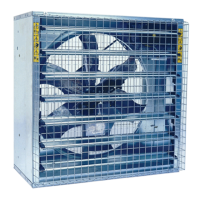
The EM50 fan operates by moving air to regulate environmental conditions. It is specifically designed for air extraction, ensuring that air is pulled out of a space rather than pushed in under pressure. The fan's structure includes a fan housing made of Munters Protect coated steel, a fan shutter also in Munters Protect coated steel, and a propeller with six blades. The fan shutter pivots on UV-protected plastic bushes and pins, while the blades are fixed to the propeller with high-strength pop rivets. The fan is driven by an asynchronous three-phase motor, operating at 60 Hz, with B3 form, F class winding insulation, and IP55 protection. It is a single-speed fan and features a centrifugal-operated shutter opening device.
The fan is designed to operate safely when used according to the manufacturer's intended conditions. It is crucial to ensure that the fan is installed and operated correctly to achieve its full benefit. The EM50 is not designed to operate in potentially explosive atmospheres or to handle materials that release explosive dust. Its metal sheets have a surface coating of a Zinc, Aluminum, and Magnesium alloy (Munters Protect ZM120), providing corrosion resistance.
The EM50 is designed for straightforward operation, though proper installation and commissioning are essential. Before initial use, a thorough check of the fan is required, including inspecting for external damage, verifying rating plate data (especially voltage and frequency), and manually checking the propeller for free rotation and the shutter for proper opening. During unpacking, it's important to ensure that the plastic shutter bearings are in place and to re-check the shutter's opening mechanism.
The fan is supplied without a command and control circuit, but with all internal electrical connections already made. Installation requires setting up a control panel with specific devices, including a lockable isolating switch, a magnetothermic switch (sized for the motor's power), a red mushroom-type emergency stop button with mechanical locking, and a start/stop selector switch. The emergency stop function is critical, designed to halt dangerous movements by isolating the power supply.
For safe operation, the fan must be installed at a height of not less than 2.7 meters from the ground. If installed lower, an optional pyramidal safety mesh must be fitted to protect the internal rotor. It is also vital to ensure no obstacles are in front or behind the fan, with specific clearances for ingoing and outgoing airflow. Warning signs are affixed to the fan to indicate dangers and instruct users to maintain a safe distance.
Starting the fan involves turning the isolator switch to "On" and pressing the starter button. For normal stopping, a control device on the electrical panel is used, which stops the fan blade but does not isolate the power supply. For extended periods of non-use, a more comprehensive stop procedure involves operating the stop button, then the emergency stop button, and finally opening the main isolator switch and attaching a padlock. Resetting after a normal stop involves following the starting procedure, while resetting after an emergency stop requires resetting the emergency stop actuator before restarting.
Some EM50 models allow for adjusting the number of revolutions via an inverter (VFD). When using a VFD, installers must pay particular attention to the ground line resistance to prevent high currents from damaging motor bearings and install proper line filters to avoid interference. The minimum operating frequency for engines without forced external ventilation is 30 Hz; below this, external forced ventilation is necessary.
Regular maintenance is crucial for the EM50 to ensure its longevity, efficiency, and safe operation. All maintenance tasks must be performed by qualified personnel using appropriate tools and methods. Before any maintenance, the power switch must be in the off position and locked with a padlock, and the propeller must be at a complete standstill. The fan's moving parts are either self-lubricating or sealed with lifetime lubrication, so periodic lubrication is not required.
Key maintenance tasks include:
Replacement of components like the propeller, central pulley, shutter bearing assembly, and shutter opening device (centrifugal system) are detailed procedures. For propeller replacement, the entire propeller must be substituted due to the difficulty of balancing it in the field. This involves opening the shutter, removing a pin connecting the central shutter blade to the centrifugal system, loosening the V-belt, and unscrewing fixing nuts to remove the assembly. The new propeller is then assembled following the reverse procedure.
For the shutter bearing assembly, the process involves removing side cover plates, breaking steel stop collars, unthreading tie-rods, unscrewing bolts, pulling off shutter blades, unhooking the damaged assembly, inserting the new one, and reassembling. The shutter opening device replacement follows a similar pattern of opening the shutter, removing a pin, unscrewing hexagonal socket head cap screws, pulling out the centrifugal system, and then reversing the steps for installation.
All components and spare parts must be stored in a dry and clean environment. To prevent white rust formation on tightly packed components, it is recommended to keep them dry, unpack them to allow air circulation, stack them to allow water drainage, and ensure they do not contact the Munters Protect coated surface.
 General
| Type | Exhaust Fan |
|---|---|
| Blade Material | Stainless Steel |
| Voltage | 230 V |
| Frequency | 50 Hz |
| Power | 1.1 kW |
| Fan Diameter | 1270 mm (50 in) |

 To Next Page