Roadside Emergencies
141
FLAT TIRES
Each tire including the spare (if provided), should be checked
monthly when cold and inated to the ination pressure recom-
mended by the vehicle manufacturer on the vehicle placard or
Tire and Loading Information label. (If your vehicle has tires of a
different size than the size indicated on the vehicle placard or Tire
and Loading Information label, you should determine the proper
tire ination pressure for those tires.)
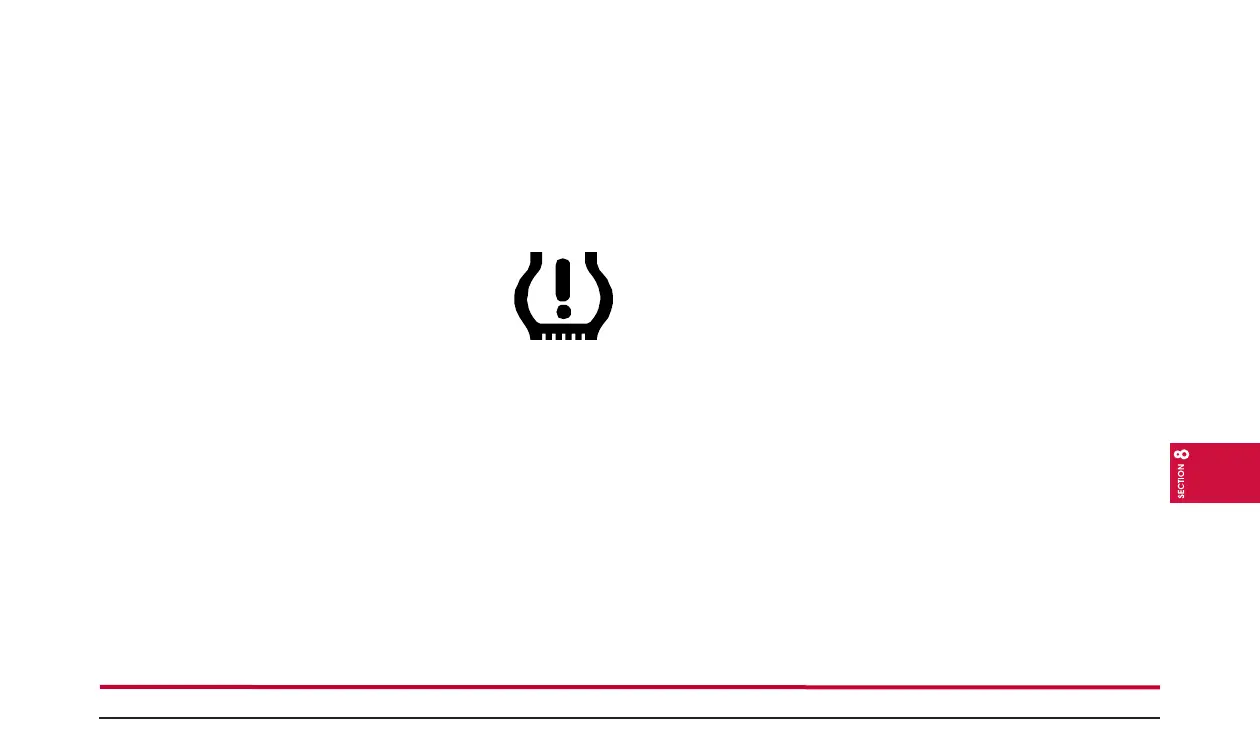
As an added safety feature, your vehicle has been
equipped with a Tire Pressure Monitoring System
(TPMS) that illuminates a low tire pressure tell-
tale when one or more of your tires is signicantly
under-inated. Accordingly, when the low tire pressure warning
light illuminates, you should stop and check your tires as soon
as possible, and inate them to the proper pressure. Driving on a
signicantly under-inated tire causes the tire to overheat and can
lead to tire failure. Under-ination also reduces fuel efciency
and tire tread life, and may affect the vehicle’s handling and stop-
ping ability.
Please note that the TPMS is not a substitute for proper tire main-
tenance, and it is the driver’s responsibility to maintain correct
tire pressure, even if under-ination has not reached the level to
trigger illumination of the TPMS low tire pressure telltale.
TIRE PRESSURE MONITORING SYSTEM
(TPMS)
Your vehicle has also been equipped with a Low Tire warning
light to indicate when the TPMS system is not operating prop-
erly. When a system malfunction is detected, the warning light
will begin ashing. This sequence will continue upon subsequent
vehicle start-ups as long as the malfunction exists. When the Low
Tire warning light is illuminated and ashing, the system may not
be able to detect or signal low tire pressure as intended. TPMS
malfunctions may occur for a variety of reasons, including the in-
stallation or replacement of alternate tires or wheels on the vehicle
that prevent the TPMS from functioning properly. Always check
the Low Tire warning light after replacing one or more tires or
wheels on your vehicle to ensure that the replacement or alternate
tires and wheels allow the TPMS to continue to function properly.
Please note that the TPMS is not a substitute for proper tire main-
tenance, and it is the driver’s responsibility to maintain correct
tire pressure, even if under-ination has not reached the level to
trigger illumination of the TPMS Low Tire warning light.
The Tire Pressure Monitoring System complies with part 15 of
the FCC rules and with RSS-210 of Industry Canada. Operation
is subject to the following two conditions: (1) This device may
not cause harmful interference, and (2) This device must accept
any interference received, including interference that may cause
undesired operation.


 To Next Page