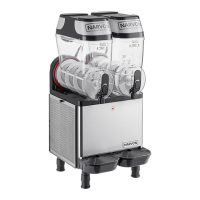
This document is a user manual for the Narvon Slushy machine, available in single, double, and triple bowl configurations (models #378SM1, #378SM2, and #378SM3, respectively). It provides comprehensive instructions for operation, maintenance, and troubleshooting.
Function Description
The Narvon Slushy machine is designed for making granitas, slushies, and cold beverages. It can also be used with dairy-based products, provided the unit is equipped with an extra temperature gauge. Each bowl operates independently, controlled by dedicated switches for mixing and refrigeration.
Important Technical Specifications
The manual provides detailed technical data for each model:
- Dimensions (W x D x L):
- #378SM1: 7.87" x 20.86" x 33.07"
- #378SM2: 15.74" x 19.68" x 33.07"
- #378SM3: 23.62" x 19.68" x 33.07"
- Maximum Electrical Input (W):
- #378SM1: 2.9
- #378SM2: 4.7
- #378SM3: 6.8
- Operating Voltage: 115 V
- Operating Temperature (Air temp): Min. 68°F - Max. 89°F
- Number of Bowls:
- #378SM1: 1
- #378SM2: 2
- #378SM3: 3
- Capacity of each bowl: 3 gallons
- Sound Pressure Level: << 70 dBA
- Class: N
- Refrigeration Type: R290
The machine's controls are located on a side control panel, featuring a main switch for power, a lid light switch (if present), bowl mixing switches (one per bowl), and refrigeration system changeover switches (one per bowl) with "O" (deactivated), "I" (slushies), and "II" (cold drinks) positions. Models with a temperature display show the product temperature inside the tank.
Usage Features
Preparation:
The product must be diluted and mixed with water in a suitable container, ensuring a minimum sugar content of 13° Brix to prevent damage to the augers and/or gearmotors. Hot liquids exceeding 25°C (77°F) should never be introduced. Product should be poured into the bowl only when the machine is off and unplugged, ensuring it does not exceed the maximum level. The lid must be properly closed before operation.
Starting the Machine:
To start, the main switch is turned to "I". For each bowl, the mixer switch is set to "I" to activate mixing. For slushies, the changeover switch is set to "I" (freeze mode). For cold drinks, it's set to "II" (cooling mode). To disable refrigeration while allowing mixing, the changeover switch is set to "O".
Temperature Display (for models with this feature):
The display shows the product temperature. A decimal point on the left indicates Bowl 1, in the center indicates Bowl 2, and on the right indicates Bowl 3. Alarm messages (A1-A6) indicate probe failures (disconnected or short circuit).
Adjusting Slushy Consistency:
Consistency can be adjusted using a screw. Turning the valve counterclockwise (left) increases consistency (thicker), while turning it clockwise (right) decreases consistency (thinner). The factory setting is an intermediate position.
Dispensing:
To dispense, the tap lever is pulled. Regular checks of product temperature using a sample thermometer are recommended. If the machine is not used continuously or with dairy products, sanitizing the spigot area or dispensing a small amount of product before serving is advised.
Locking System:
A rod "R" can be placed to lock the tap handle, and a padlock can be inserted for security.
Emergency Situations:
In an emergency, the main switch should be firmly pressed to "0". In case of freezing, the machine should be switched off, and a specialized technician contacted.
Mechanical Thermostat (for machines with this feature):
Temperature in "cold drink" mode can be regulated by adjusting a potentiometer. Turning it clockwise increases refrigeration power (lower product temperature).
Maintenance Features
Cleaning and Sanitization:
Cleaning and sanitization are crucial for hygiene and product quality. All operations must be performed with the main switch off and the machine unplugged, while wearing personal protective equipment (gloves, glasses). Solvents, flammable materials, abrasive cleaners, and dishwashers are prohibited. Lukewarm water and suitable sanitizing agents should be used.
Emptying Bowls:
Before cleaning, bowls must be emptied. The freeze/cool changeover switch is set to "O" to empty the contents.
Disassembling Components:
The dispensing tap is disassembled by removing a pin and pushing the lever dispenser upwards. The bowl is removed by raising its front part and then pushing and tapping lightly on the rear. The bowl gasket is also removed. The mixer and its seal are extracted.
Washing and Sanitizing:
A three-sink method is recommended: one basin with neutral cleaning detergent, one for rinsing, and one with sanitizing solution. All components (except the lid and evaporators) are thoroughly washed, rinsed, and then wiped with sanitizing solution before a final rinse and drying. The lid and evaporators should only be wiped with a soft cloth.
Reassembling Components:
All washed and sanitized components must be carefully reassembled. Food-safe lubricant should be applied to the mixer (seal A) and the hooks and joint. The bowl gasket is placed on the bowl, and the mixer is reinserted, ensuring the head engages with the shaft and the gasket is properly lodged. The bowl is pressed downward until it clicks into place.
Rinsing Cycle:
Before starting the machine after cleaning, a rinse cycle is performed by filling the bowl with clean water, running the machine in agitation mode for 5 minutes, then turning it off and emptying the tank.
Cleaning the Drip Tray:
The drip tray should be emptied and cleaned daily, especially when the red float rises into view.
Lid Maintenance:
Maintenance of the lighted lid must be performed by a specialized technician. The operator is forbidden to disassemble any lid component. Bulb replacement requires the main switch to be off and the power cord unplugged.
Cleaning the Condenser:
The condenser should be cleaned periodically by a specialized technician. For #378SM1, the rear panel is unscrewed and removed, and a dry brush is used to remove dust. For #378SM2 and #378SM3, safety clips are unhooked to remove the panel. Failure to clean the condenser impairs machine performance. It is forbidden to use the machine if any panel is not properly in place.
Periodic Maintenance:
The machine must be checked at least once a year by a specialized technician to ensure all components are safe and functional. Worn components must be replaced with original spare parts. Users are forbidden to perform periodic maintenance.
Disposal:
Electric and electronic equipment must be disposed of according to EPA regulations, not as normal municipal solid waste. Products are marked with a crossed-out wheeled bin symbol, indicating separate collection obligations.


 To Next Page

 General