This document serves as the owner's manual for the BLUEMAX Gasoline Pole Saw, Model: 53542, manufactured by North American Tool Industries (NATI). It provides essential information regarding the product's function, technical specifications, usage, and maintenance.
Function Description
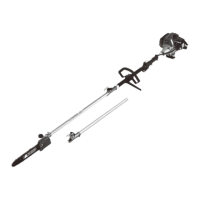
The BLUEMAX Gasoline Pole Saw is a pole-mounted, petrol-powered pruner specifically designed for lopping off tree branches. Its primary function is to provide an extended reach for cutting branches that are otherwise difficult to access. The device is not intended for extensive sawing work, felling entire trees, or cutting materials other than wood. Misuse, such as using it for commercial, trade, or industrial applications, will void the warranty and the manufacturer will not be liable for any resulting damage or injuries.
Important Technical Specifications
The pole saw is equipped with a 2-stroke, air-cooled engine with a chrome cylinder.
- Engine Power (max.): 0.85 kW / 1.2 HP
- Displacement: 32.6 cm³
- Engine Idle Speed: 3400 min⁻¹
- Max. Engine Speed: 9500 min⁻¹
- Max. Cutting Length: 254 mm
- Weight with cutter bar and chain: 7.6 kg
- Chain: Kangxin ALP-50-39S
- Cutter Bar: Kangxin AL10-39-507P,10"
- Ignition: Electronic
- Drive: Centrifugal clutch
- Tank Capacity: 825 ml
- Spark Plug: L8RTF/NHSP LD
- Sound Pressure Level (LPA): 93.9 dB(A) with a KPA uncertainty of 2.5 dB
- Sound Power Level (LWA): 108.2 dB(A) with a KWA uncertainty of 2.5 dB
- Vibration Emission Value (ahv): 6.888 m/s² with a K uncertainty of 1.5 m/s²
- Spark Plug Sparking Gap: 0.6mm
Usage Features
The manual emphasizes several key usage features and safety precautions:
- Assembly: The pole saw requires assembly before use. This includes joining the gear unit to the drive rod mechanism, connecting the drive rod mechanism to the connecting piece, and fitting the cutter bar and chain. Detailed instructions with diagrams are provided for each step.
- Chain Tensioning: Proper chain tension is crucial for safe and effective operation. The chain is correctly tensioned if it can be raised by approximately 2 mm in the middle of the cutter bar. The tension should be checked every 10 minutes, especially with new chains, and adjusted as needed. The chain should be slackened after use to prevent damage as it cools and shortens.
- Fuel and Oil: The pole saw operates on a mixture of unleaded petrol and special 2-stroke engine oil, with a mixing ratio of 40 parts petrol to 1 part oil. It is critical not to use fuel mixtures stored for longer than 90 days or 2-stroke oil with a mixing ratio of 100:1, as this can void the warranty due to inadequate lubrication.
- Chain Lubrication: The chain must always be lubricated with saw chain oil. Operating without sufficient oil will damage the chainsaw. Different viscosity oils are recommended based on ambient temperature to ensure an adequate lubricating film.
- Starting the Engine: Instructions are provided for both cold and warm engine starts. For a cold start, the fuel pump (primer) needs to be pressed 10 times, the On/Off switch set to "I", and the choke lever set to "". The starter cable should be pulled sharply until resistance is felt, then 4 times to start the engine. For a warm start, fewer pulls are typically needed.
- Emergency Stop: The On/Off switch can be set to "Stop" or "0" for an immediate shutdown. For normal shutdown, release the throttle lever and wait for the engine to idle before setting the switch to "Stop" or "0".
- Shoulder Strap: The shoulder strap must always be used when operating the equipment, adjusted so the attachment is at waist level.
- Work Practice: Users are advised to practice all work steps with the engine off before actual use.
- Cutting Techniques: The manual provides guidance on cutting smaller and larger branches, emphasizing the importance of making relief cuts for larger branches. It warns against cutting with the tip of the saw or into the bulging branch collar.
- Kickback Prevention: The document explains kickback and advises users to ensure correct chain tension, use a chainsaw in perfect working order, and use a properly sharpened saw chain to minimize risk.
- Safety Information: The manual includes extensive safety warnings, including wearing protective gear (headgear, goggles, ear muffs, gloves, sturdy footwear, tight-fitting safety clothing), maintaining a safe distance from others and power cables (at least 10 m), and avoiding working under branches or cutting wood under tension without proper training.
Maintenance Features
Regular maintenance is essential for the longevity and safe operation of the pole saw:
- Chain and Cutter Bar Replacement: The cutter bar should be replaced if its guide groove is worn. Instructions for replacement are integrated with the chain fitting process.
- Automatic Chain Lubrication Check: The automatic chain lubrication system should be checked regularly by pointing the cutter bar tip at a smooth surface and running the chainsaw. A growing oil stain indicates proper function.
- Chain Sharpening: A sharp chain is crucial for effective and safe operation. Users are advised to have the chain re-sharpened by a dealer unless they possess the necessary tools and experience.
- Air Filter Maintenance: The air filter (T) should be checked every 25 hours of use (or more frequently in dusty conditions) and cleaned by tapping or blowing out. It should never be cleaned with petrol or flammable solvents.
- Spark Plug Maintenance: The spark plug should be checked for dirt and grime after 10 hours of operation and cleaned with a copper wire brush if necessary. It should be serviced after every 50 hours of operation.
- Gear Unit Lubrication: Approximately 10 g of gear grease should be added to the lubrication nipple (Item 25) every 20 hours of use.
- Cleaning: The tensioning mechanism should be regularly cleaned with compressed air or a brush. The equipment itself should be cleaned with a damp cloth and mild washing-up liquid. Handles should be kept free of oil for a firm grip.
- Storage: For storage longer than 30 days, specific steps must be followed to prevent fuel evaporation and sediment buildup in the carburetor. This includes emptying the fuel tank, running the engine until it stops, removing the spark plug, and adding 2-stroke engine oil to the combustion chamber. The equipment should be stored in a dry place away from ignition sources.
- Transport: Before transport, the petrol tank should be emptied, coarse dirt removed, and the drive rod mechanism dismantled.
The manual also includes a troubleshooting guide to help users identify and remedy common issues, and information on disposal and recycling of the equipment and packaging materials. A limited manufacturer warranty of 1 year from the date of purchase covers defects in materials, but excludes misuse, abuse, negligence, accidents, repairs, alterations, or lack of maintenance.


 To Next Page
 General