EasyManua.ls Logo

National Geographic Epic Forts - User Manual

National Geographic Epic Forts
3 pages
Print Icon
To Next Page IconTo Next Page
Loading...
SAFETY INFORMATION
Use under adult supervision only.
Correct and firm assembly must
be followed.
DO NOT allow children to climb
or stand on this product.
Keep away from fire.
Use lightweight, breathable
fabrics only when covering
structures.
Use this toy only as described.
WARNING:
INJURY HAZARD – Protruding poles can cause eye injury. Do not
allow poles to protrude without a connector on the end. An adult should
check for proper assembly before use.
WARNING:
CHOKING HAZARD – Small parts. Not for children under 3 yrs.
PLEASE READ ALL INSTRUCTIONS before use of this
product. Retain this instruction manual since it contains important
information, address and phone number for future reference.
EPIC FORTS
RECOMMENDED
CARE & CLEANING
Avoid stepping on or
bending poles. If any
part becomes damaged,
discard it immediately.
Damp wipe only and
dry naturally.
To extend the life of this
product, store away from
direct sunlight.
© National Geographic Partners LLC. All rights reserved.
NATIONAL GEOGRAPHIC and Yellow Border Design are
trademarks of the National Geographic Society, used under license.
Visit our website: nationalgeographic.com
© 2022 Blue Marble™ All rights reserved. Blue Marble™
and the Blue Marble logo are trademarks of JMW Sales, Inc.
Customer Service: 1 (541) 708-6738 • help@thinkbluemarble.com
JMW Sales, Inc., dba Blue Marble™
101 A Street, Ashland, OR 97520 USA
For information on Blue Marble patents,
visit: www.thinkbluemarble.com/patents
EU Responsible Person
(Please contact for regulatory inquiries only.)
Alura Group BV, Kroonwiel 2, 6003 BT Weert, The Netherlands
Tel: (31) (0) 70 250-0353
#3 Start at the base and build up.
#4 The best forts are stable, which means you want
every pole pushed all the way into the connectors.
Since the fit is snug, you’ll need to use
both hands and twist while you push,
but be sure to ask an adult
for help if you have any
trouble inserting the
poles all the way.
#6 Look closely at
all your pieces. There
are flexible ones, rigid
ones, and different pole
lengths. Each of these
pieces has its own special
characteristics which can
help you as you build.
With a little practice and
imagination, you’ll
be an expert builder
in no time!
#1 Try building on a carpet or a large blanket
because pieces can slip around on hardwood floors.
#5 If you’re building a really big
fort, try building smaller sections
one at a time. Once you have
those built, you can connect
them all together.
#2 Group all the separate types of pieces
together in piles before you build so you always
know how many of each type you have left.
BUILDING TIPS & TRICKS
Building a fort is really fun and a great way to use your imagination! Getting your fort just right,
though, can take some practice. Here are a few tips to help make things easier if you get stuck.
Question and Answer IconNeed help?

Do you have a question about the National Geographic Epic Forts and is the answer not in the manual?

Summary

Safety and Care Instructions

General Safety Precautions

Essential safety guidelines including adult supervision, avoiding climbing, fire safety, and correct fabric use.

Product Care and Maintenance

Instructions for product care, including avoiding damage, damp wiping, and proper storage to extend its life.

Building Tips and Tricks

Fort Building Advice

Tips for building forts, including surface choice, piece management, stability, and creative techniques.

Parts Guide

Component Identification

Overview of parts like Hemisphere, Extender, Hub, Flex connectors, and Sheet Clips for building forts.

Ball Assembly Instructions

Step-by-step guide for assembling the Ball connector with Hub, Extender, and Hemisphere components.

Additional Building Resources

Links to further inspiration, including guides for more shapes and builds, and a QR code for online resources.

Structural Engineering Concepts

Square vs. Triangle Strength

Explanation of why triangles are stronger than squares in building structures for increased stability.

Polyhedron Shapes

Definition of polyhedrons as shapes like cubes or pyramids, fundamental in structural design.

Real-World Engineering Examples

Fun facts on the Great Pyramid of Giza and the Francis Scott Key Bridge, illustrating structural principles.

Overview

This document is a user manual for the "Epic Forts" building toy by National Geographic, designed to help users construct various fort structures. It provides safety information, assembly tips, a detailed parts guide, and an introduction to structural engineering concepts relevant to fort building.

Function Description:

The Epic Forts toy allows users to build imaginative fort structures using a system of poles and connectors. It encourages creativity, problem-solving, and an understanding of basic engineering principles. The kit is designed for children under adult supervision and aims to make fort building an engaging and educational experience.

Important Technical Specifications:

The kit includes various types of connectors and poles of different lengths, allowing for diverse structural designs.

  • Connectors:
    • Hemisphere (Light Blue): Used in the Ball Assembly.
    • Extender: Used to create extra-long poles and as a core component in the Ball Assembly.
    • Hub (Dark Blue): Functions as feet for forts and is a key part of the Ball Assembly.
    • Hex Flex (Dark Green) and Star Flex (Light Green): These are "Flex connectors" that facilitate easier corner construction, suggesting some degree of flexibility in their design.
    • Sheet Clip: Used to secure sheets to the poles, keeping the fort covering in place.
  • Poles:
    • Short Pole: Shorter length poles for various structural needs.
    • Long Pole: Longer length poles for larger spans and structural integrity.
    • The manual also mentions "flexible ones, rigid ones, and different pole lengths" among the pieces, indicating a variety of pole types beyond just short and long, each with specific characteristics.
  • Ball Assembly: This is a specific connector configuration made by combining a Hub, an Extender, and two Hemispheres. It involves a locking mechanism where the Extender is twisted 90° clockwise into the Hub.

Usage Features:

The manual provides several tips and tricks for effective fort building:

  • Building Surface: Recommended to build on carpet or a large blanket to prevent pieces from slipping on hardwood floors.
  • Organization: Grouping pieces by type before building helps in managing inventory and planning.
  • Construction Order: Start building from the base and work upwards for stability.
  • Pole Insertion: Poles should be pushed all the way into connectors for stability. This often requires using both hands and twisting while pushing due to a snug fit. Adult assistance is recommended for children who have difficulty.
  • Modular Building: For large forts, it's advised to build smaller sections first and then connect them together.
  • Piece Recognition: Users are encouraged to understand the different characteristics of each piece (flexible vs. rigid, different pole lengths) to utilize them effectively in their designs.
  • Experimentation: The manual encourages experimentation with connector positions and building half-ball connectors when many poles need to be connected.
  • Structural Concepts: The manual introduces "Structural Engineering Concepts" to enhance building skills:
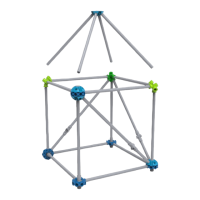
    • Square vs. Triangle: Emphasizes that triangles are stronger than squares. The practice build on page 2 demonstrates this by using extra-long poles diagonally across square sides to create two triangles, significantly strengthening the structure. Users are encouraged to incorporate triangles for sturdiness.
    • Polyhedrons: Defines shapes like cubes or pyramids as polyhedrons, providing a basic geometric vocabulary.
  • Inspiration: The manual directs users to thinkbluemarble.com/fort-instructions or a QR code for more building inspiration and guides.

Maintenance Features:

  • Care:
    • Avoid stepping on or bending poles to prevent damage.
    • Damaged parts should be discarded immediately.
    • Clean by damp wiping and drying naturally.
  • Storage:
    • Store away from direct sunlight to extend product life.

Safety Information:

  • Adult Supervision: Use under adult supervision only.
  • Assembly: Correct and firm assembly is crucial.
  • Choking Hazard: Small parts, not suitable for children under 3 years.
  • Injury Hazard: Protruding poles can cause eye injury. Poles should not protrude without a connector on the end. Adults should check for proper assembly.
  • Usage Restrictions:
    • DO NOT allow children to climb or stand on the product.
    • Keep away from fire.
    • Use only lightweight, breathable fabrics when covering structures.
    • Use this toy only as described in the manual.

The manual also includes "Fun Facts" about the Great Pyramid of Giza and the Francis Scott Key Bridge to illustrate real-world applications of structural engineering principles, particularly the strength of triangles.

National Geographic Epic Forts Specifications

General IconGeneral
BrandNational Geographic
ModelEpic Forts
CategoryToy
LanguageEnglish

Related product manuals