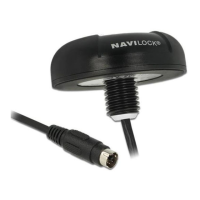
The Navilock NL-6003P is a MD6/serial GNSS receiver featuring an internal antenna and a u-blox NEO-6P GPS module. This device is engineered to provide high-precision positioning, achieving accuracy of under one meter through a combination of PPP (Precision Point Positioning) and SBAS (Satellite-Based Augmentation System) technologies. Its MD6/serial interface allows for versatile connectivity to various devices such as notebooks, UMPCs, tablets, or car PCs. The receiver's design incorporates a rubberized and magnetic bottom, facilitating universal positioning and secure attachment. Its compact form factor and advanced positioning technology make it a suitable companion for both professional and leisure use.
Key Features and Specifications:
Function Description:
The NL-6003P serves as a GNSS receiver, capable of receiving signals from global navigation satellite systems to determine its precise location. It outputs NMEA protocol data, which can be interpreted by navigation or route planner software. The device supports AssistNow!, an A-GPS service that enhances receiver performance by enabling faster position calculation, even in challenging reception conditions. This is particularly beneficial for applications requiring continuous readiness, such as fleet management or handheld devices, where immediate access to local services is crucial. The receiver also supports EGNOS (European Geostationary Navigation Overlay Service) for improved accuracy and integrity.
Important Technical Specifications:
- Chipset: u-blox NEO-6P GPS
- Channels: 50 channels
- Sensitivity: -160 dBm
- Frequency: L1, 1575.42 MHz
- C/A Code: 1.023 MHz
- Target Precisions:
- GPS Position Horizontal (SBAS + PPP): < 1 m (2D, R50), < 2 m (3D, R50)
- Note: Demonstrated under conditions of 24 hours, stationary, first 600 seconds of data discarded, HDOP < 1.5 during measurement, strong signals, continuous availability of valid SBAS correction data.
- Time Synchronization: 1 microsecond synchronized with GPS time
- Speed Accuracy: 0.1 m/s
- Datum: WGS-84
- Protocol: NMEA-0183 V3.01 (GGA, GSA, GSV, RMC, VTG)
- Detection Rates (Average):
- Hot start: 1 s (with ephemerides and almanac)
- Warm start: 32 s (with ephemerides, but without almanac)
- Cold start: 32 s (neither ephemerides nor almanac)
- Re-Acquisition: 1 s (recovery time after interruption)
- Update Rate: 1 Hz
- Dynamic Prerequisites:
- Acceleration limit: smaller than 4 g
- Height limit: 50000 m
- Speed limit: 500 m/s
- Power Supply: 5 Volt, via PS/2 using MD6 to DB9 adapter or via USB using MD6 to USB adapter.
- Connection: MD6/serial baud rate up to 115,200 (preset to 38,400)
- Cable Length: 1.50 m
- Operating Temperature: -20°C ~ 65°C
- Dimensions: 65 mm x 45 mm x 22 mm
- Weight (main unit): 78 g
Usage Features:
- Connectivity: Can be connected to a PC via either a serial interface (using an MD6 to DB9 adapter cable) or a USB interface (using an MD6 to USB adapter cable). Drivers for Windows CE/2000/XP/Vista/7/8 are provided on an 8 cm CD-ROM.
- LED Indicator: A green LED indicates the device's status: flashing signifies a "satfix" (successful satellite lock), while continuous illumination indicates that the device is powered on but has not yet achieved a satfix.
- u-Center Software: The u-Center 7.xx software (available for download) is a pure test program for functional verification, configuration, and updating Assist GPS data or switching between EGNOS/WAAS. It allows users to select the COM port and baud rate, view NMEA data, and manage configurations. It is crucial to close u-Center after testing to free up the COM port for navigation software.
- Positioning: For optimal performance, the NL-6003P requires an unobstructed view of the sky. It cannot receive signals in a closed building. When acquiring a first satfix, especially on a new continent, it may take up to 20 minutes. Positioning the device away from walls can help mitigate signal reflection and improve acquisition time.
Maintenance Features:
- Troubleshooting: The manual provides guidance for common issues such as the LED not lighting up (check PC power, USB port, and contact support if necessary), failure to achieve a satfix (ensure clear sky view, allow sufficient time), and CD-ROM auto-start problems (check PC settings).
- Damage Protocol: In cases of liquid exposure (e.g., water jet, strong rain), the device should not be connected to a notebook or other equipment. It must be returned to the support center for disassembly, drying, and functionality checks. Users are encouraged to provide a detailed and honest description of the defect to facilitate accurate diagnosis and repair.
- Support: Navilock offers a support center for additional questions and troubleshooting, accessible via email (support@navilock.de), website (www.navilock.com), or telephone (+49 30 84716503).
- Warranty: The GPS receiver is covered by a legal warranty period, during which repairs are free of charge, provided the damage is not due to external causes, humidity, or improper usage. Clients are responsible for postage costs when sending units for repair and must include proof of purchase and a detailed error description.
- Environmental Compliance: The device complies with WEEE (Waste Electrical and Electronic Equipment) directive for proper disposal and recycling, RoHS (Restriction of Hazardous Substances) directive for material content, and FCC Class B certification for digital devices, ensuring minimal interference with other electronic equipment.
Safety Precautions:
- Electrical Safety: The product is designed for power supply via USB or PS/2. Use of other power modes may be dangerous and void the warranty. It contains an internal back-up battery, and used batteries should be recycled according to regulations.
- Direct Sunlight: Avoid exposing the unit, battery, or rechargeable battery to very high humidity and temperatures (above 60°C/140°F), such as on a car dashboard or windowsill, to prevent damage and overheating.
- Temperature Changes: If the unit experiences strong temperature fluctuations, allow condensation to dry off before use. When moving the unit between cold and warm environments, allow it to acclimatize to the new temperature before turning it on.
- Explosion Hazard: Do not permanently expose the receiver to temperatures exceeding 60°C (140°F).

 Need help?

 To Next Page
 General