The list below is a general guide to help you select the correct utensils.
NOITANIBMOC LLIRG EVAWORCIM ERAWKOOC
Heat–Resistant Glass Yes Yes Yes
Non Heat–Resistant Glass No No No
Heat–Resistant Ceramics Yes Yes Yes
Microwave–Safe Plastic Dish Yes No No
Kitchen Paper Yes No No
oN seY oN yarT lateM
oN seY oN kcaR lateM
Aluminum Foil & Foil Containers No Yes No
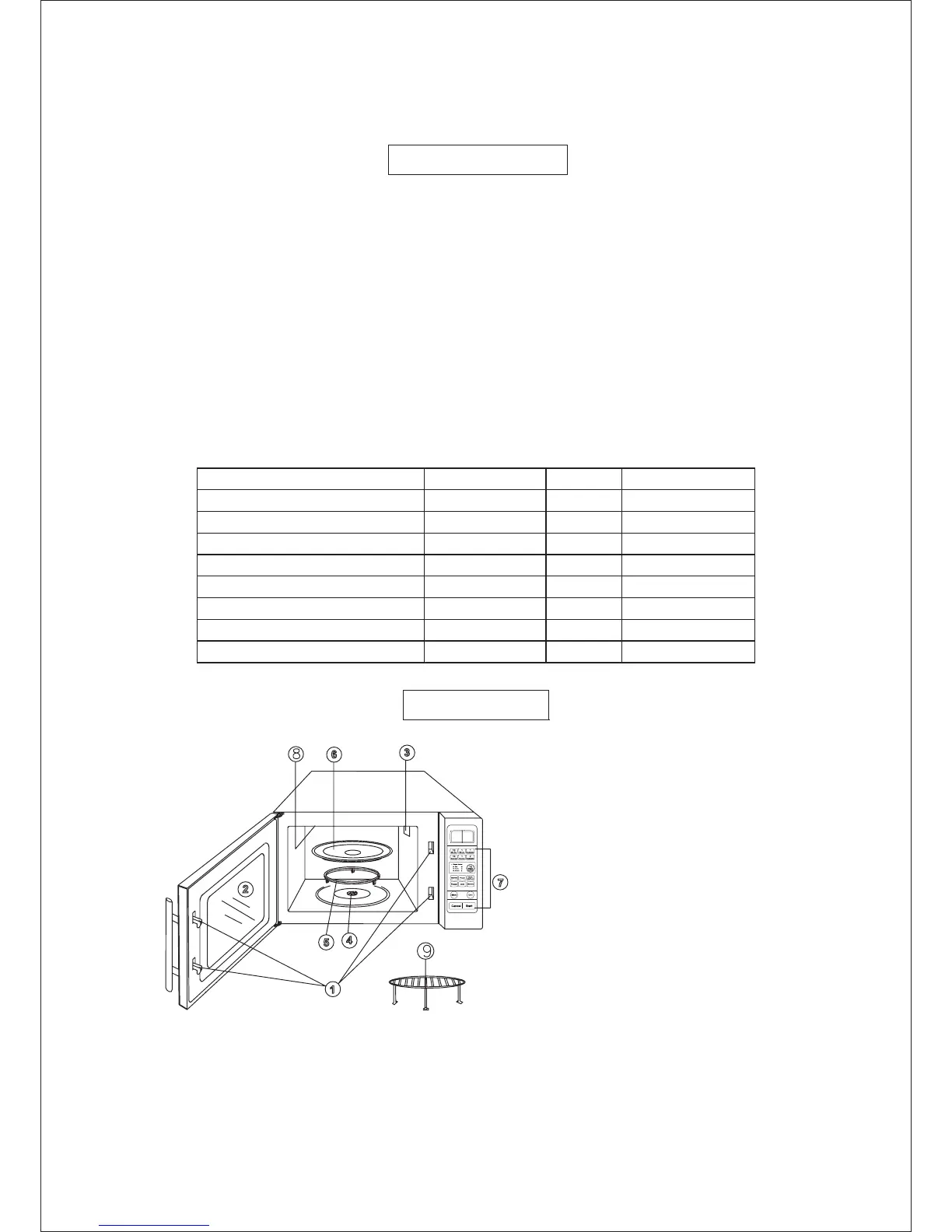
1.Door Safety Lock System
2.Oven Window
3.Oven Air Vent
4.Shaft
5.Roller ring
6.Glass Tray
7.Control Pane
8..Grill Heater
9.Metal Rack
P
P
M
M
E
E
S
S
5
and hamburgers. Large items like roasts
must be turned over at least once.
5 Rearrange foods such as meatballs halfway
through cooking both from top to bottom
and from the center of the dish to the
outside
1 The ideal material for a microwave utensil is
transparent to microwave, it allows energy
to pass through the container and heat the
food.
2 Microwave can not penetrate metal, so
metal utensils or dishes with metallic trim
should not be used.
3 Do not use recycled paper products when
microwave cooking, as they may contain
small metal fragments which may cause
sparks and/or fires.
4 Round /oval dishes rather than
square/oblong ones are recommend, as
food in corners tends to overcook.
5 Narrow strips of aluminum foil may be used
to prevent overcooking of exposed areas.
But be careful don’t use too much and keep
a distance of 1 inch (2.54cm) between foil
and cavity.
U
U
T
T
E
E
N
N
S
S
I
I
L
L
S
S
G
G
U
U
I
I
D
D
E
E


 To Next Page
 Loading...