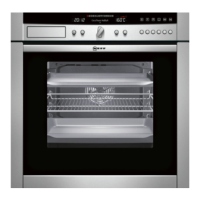
This document provides installation instructions for a built-in appliance, likely an oven, given the illustrations of a cooking compartment and the mention of a "SlideAway door construction." The manual emphasizes safety, proper installation, and technical specifications for connecting the appliance to the power supply.
Function Description
The appliance is designed for integration into kitchen units, either under a worktop or in a tall unit. It features a cooking compartment, and its "SlideAway door construction" suggests a door that retracts or slides away for easier access, a feature that requires careful handling and installation. The appliance is intended for domestic use and must be installed by a licensed professional to ensure safe and correct operation.
Important Technical Specifications
- Dimensions: The appliance has specific dimensions for installation. The main unit measures 548 mm in width and 595 mm in height. The depth is also 595 mm.
- Power Supply: The appliance operates on a 220-240V~ power supply. It requires a connection to a safety earth terminal and corresponds to safety class I.
- Fuse Protection: The fuse protection must match the power rating specified on the appliance's rating plate and local regulations.
- Power Cord: The power cord should be Type H05 V V-F or a higher rating. The yellow-green safety earth wire must be 10 mm longer on the appliance side than the other wires.
- Isolation Switch: An all-pin isolating switch with at least a 3 mm contact gap is required in the installation, or the appliance must be connected via a plug with an earthing contact. This must remain accessible after installation.
- Installation Height: The appliance is intended for use up to a maximum height of 2000 meters above sea level.
- Worktop Thickness (for induction hob): If installed under an induction hob, the work surface thickness must be a minimum of 50 mm.
- Heat Resistance of Units: Kitchen units surrounding the oven must be heat-resistant up to 90 °C, and adjacent cabinets up to 70 °C.
Usage Features
- Built-in Design: The appliance is designed for seamless integration into kitchen cabinetry, offering a clean and modern aesthetic.
- SlideAway Door Construction: This unique design feature, while requiring careful handling during installation, likely provides enhanced user convenience by allowing the oven door to retract or slide, making it easier to access the cooking compartment.
- Ventilation Requirements: Specific ventilation gaps are necessary for proper operation. For under-worktop installation, a 20 mm gap between the intermediate floor and the wall is required. For tall unit installation, a 20 mm gap between all intermediate floors and the wall is needed. These gaps ensure adequate airflow and prevent overheating.
- Adjustable Fascia Panels: The gap between the appliance door and the side fascia panels can be adjusted using left and right adjustment screws, allowing for a precise and aesthetically pleasing fit within the kitchen unit.
- Accessory Removal: When installed in a tall unit, the appliance should be fitted at a height that allows accessories to be easily removed, enhancing user convenience.
Maintenance Features
The manual primarily focuses on installation and does not detail specific user maintenance features. However, the installation instructions imply certain aspects related to long-term care:
- Professional Installation: The emphasis on professional installation ensures that the appliance is set up correctly, which is crucial for its longevity and safe operation. Incorrect installation can lead to damages and may void warranties.
- Clearance Requirements: Maintaining the specified ventilation gaps (e.g., 20 mm between intermediate floor and wall) is essential for preventing overheating, which can prolong the life of the appliance and its components.
- Accessibility for Service: The requirement for the isolation switch or plug with earthing contact to remain accessible after installation suggests that the appliance is designed for easy disconnection for maintenance or service.
- Removal Procedure: The detailed removal steps (disconnecting power, unscrewing fascia panels, undoing securing screws, and lifting out the appliance) indicate that the unit is designed to be removable for potential repairs or replacement, although this would typically be performed by a service technician.
- Cleaning: While not explicitly stated as a maintenance feature, the instruction to remove packaging material and adhesive film from the cooking compartment and door before starting up the appliance implies that the interior should be kept clean. Regular cleaning of the cooking compartment would be a standard maintenance practice for any oven.

 Need help?

 To Next Page
 General