7KHPRVWHIÀFLHQWZD\WRH[WUDFWLVWKURXJKGXFWHGH[WUDFWLRQ2XUDGYLFHLVWRXVHWKHODUJHVWGXFWLQJVL]HSRVVLEOH
VRWKHODUJHVWYROXPHRIDLULVH[WUDFWHG5HIHUWRVSHFLÀFDWLRQSDJHVIRUUHOHYDQWGXFWGLDPHWHUV+LJKTXDOLW\GXFWLQJ
material and accurate installation is important to ensure optimal performance of your rangehood. We also suggest
keeping ducting length and bends to a minimum. Taking these small but essential steps when installing a rangehood
will greatly improve not only the rangehood’s extraction rate, but also drastically reduce the noise level. For further
information, please refer to the installation instructions.
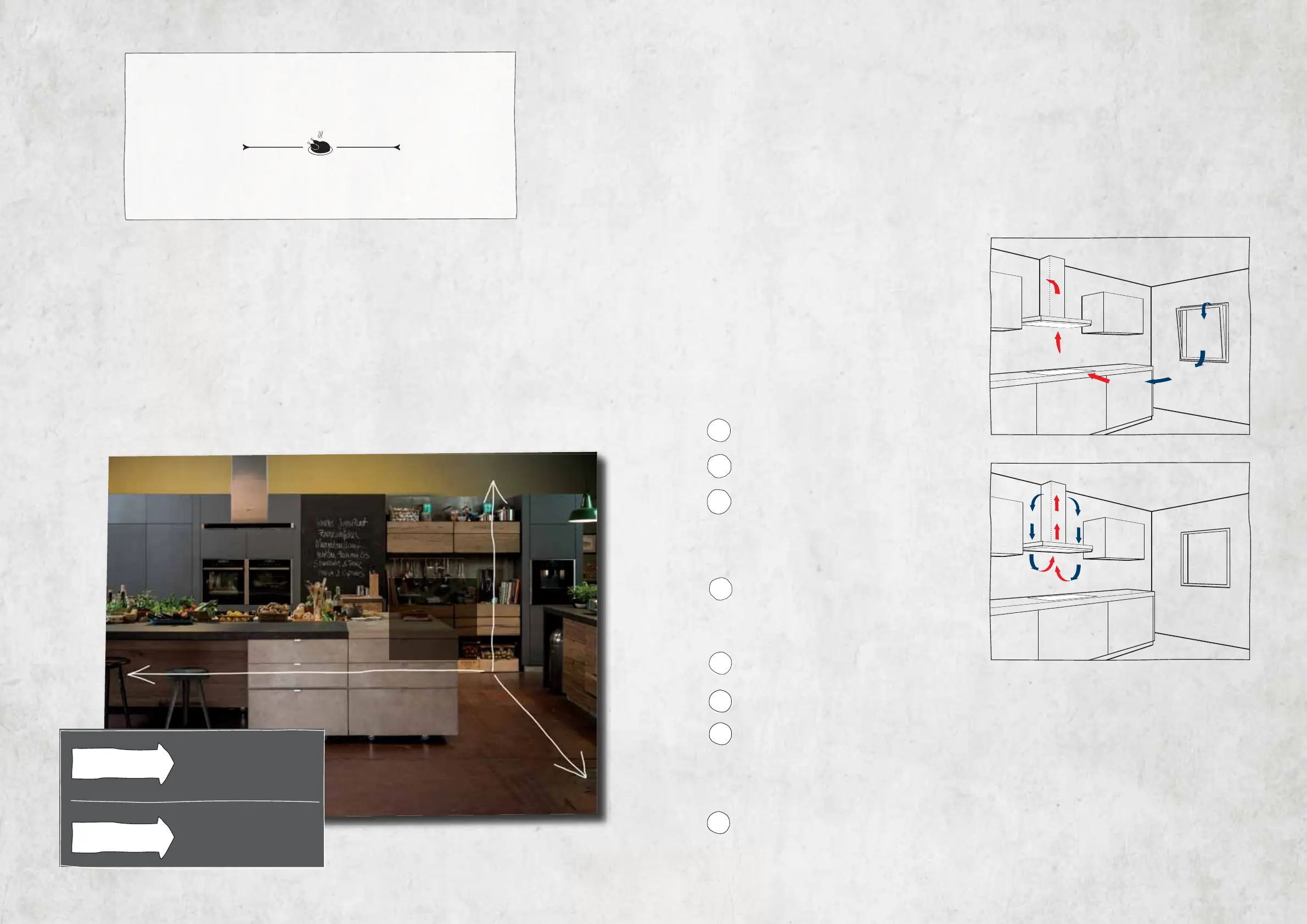
It is recommended that the air be exchanged or extracted in the room 6–12 times per hour to maintain optimal air
quality. (Minimum 6 times per hour for simmering/low to medium cooking and maximum of 12 times per hour for
frying/boiling/stir frying).
86(7+()2//2:,1*(48$7,2172&$/&8/$7(<285(;75$&7,215$7(
Volume of kitchen (length x width x height)
eg. 4m x 4m x 2.5m = 40m³
EXTRACTION REQUIREMENTS
EXPLAINED
We have engineered and designed a rangehood for every type of kitchen.
2XUSRZHUIXOUDQJHKRRGVZRUNTXLHWO\LQWKHEDFNJURXQGHIÀFLHQWO\
extracting unwanted food smells.
(;75$&7,21255(&,5&8/$7,21"
The best way to remove steam and odours is to extract
the air out of the room through ducting. Unfortunately, in
apartments or where the rangehood is too far away from
an outside wall, this may not be possible. In this case, the
only alternative is to recirculate the air. Stale air is sucked
WKURXJKDJUHDVHÀOWHUEHIRUHEHLQJSXULÀHGLQDFKDUFRDO
ÀOWHUDQGWKHQUHWXUQHGEDFNLQWRWKHNLWFKHQYLDDQ
opening in the rangehood.
+,176$1'7,36
The following points should be observed for
optimum ducted extraction results and low noise:
Ensure any pipe elbow bends are at least 30cm
from the rangehood duct opening.
Avoid reducing the diameter or area
of the ducting.
Use wide-angled pipe elbows, but keep the
number used to a minimum. We recommend
where necessary to use a maximum of
2 x 90° elbows with a minimum separation
of 300mm between elbows. Always use 45º
elbows where possible.
Only install pipes with smooth, even inner
VXUIDFHV,IDÁH[LEOHKRVHKDVWREHXVHG
ensure it is pulled tight to smooth out the
ULGJHVEHIRUHÀ[LQJ:HUHFRPPHQGWKH
XVHRIDVHPLULJLGDOXPLQLXPÁH[LEOHGXFW
Use ducting pipes with a diameter of at least
120mm, but ideally 150mm.
Keep piping to a minimum – use the most
direct route to an external outlet.
Make sure that there is an adequate supply
of fresh air to replace the air ducting out of
the kitchen, i.e. windows that can be opened,
doors to adjacent rooms, air bricks. Problems
with installation may occur if points 1–7 are
not observed.
Optional accessories are available for
all rangehood models.
Extraction
Recirculation
1.
2.
3.
4.
5.
6.
7.
8.
:,'7+0
/(1
*
7+0
+
(
,
*
+70
RO
OM
VOL
U
M
E
40m
3
x 6 times / hour
x 12 times / hour
240m
3
necessary air extraction
rate at normal use
(simmering on 2–3 hotplates)
480m
3
necessary air extraction
rate at normal use
(eg. strong frying activities)
QHɡFRQ] QHɡFRQ]


 To Next Page