Need help?
Do you have a question about the NEFF H53W50N3GB and is the answer not in the manual?
Covers fire hazards related to appliance usage and storage.
Warns about exploding liquids/foods and health risks from appliance damage.
Details injury risks from glass/ovenware and electric shock from improper use.
Addresses hazards from hot surfaces, steam, and boiling liquids.
Covers seal condition, operating without food, and popcorn usage guidelines.
Warns about boiled-over liquids, sparks from metal, and foil containers.
Addresses damage from open doors during cooling and managing condensation.
Provides tips on efficient oven usage and preheating.
Explains proper disposal of the appliance according to EU guidelines.
Explains the function and operation of the retractable rotary selector.
Details accessories and how to correctly fit the turntable.
Guides on setting the clock, hiding it, and resetting.
Details suitable and unsuitable ovenware for microwave use.
Lists available power settings and their recommended uses.
Explains how to save custom cooking settings for later recall.
Guides on recalling and starting previously saved cooking programmes.
Details recommended cleaning agents and methods for different appliance areas.
Provides a table of common error messages, causes, and solutions.
Provides contact information and essential technical specifications.
Guides on selecting programmes and inputting food weight for automatic cooking.
Details using automatic programmes for defrosting meat, poultry, and bread.
Explains using automatic programmes for cooking rice, potatoes, and vegetables.
Provides specific settings and notes for defrosting various food items.
Offers advice and settings for heating ready meals and frozen foods.
Provides guidance and settings for heating drinks, baby food, soups, and stews.
Offers tips and settings for cooking meat, vegetables, and other dishes.
Includes tips for quantity adjustments, dry food, and condensation.
Details test dishes and settings for microwave cooking.
Details test dishes and settings for microwave defrosting.
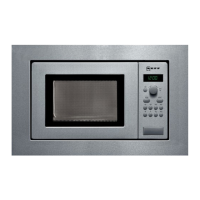
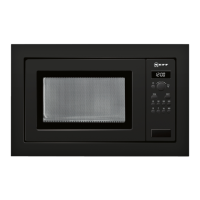
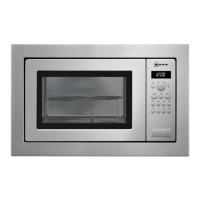
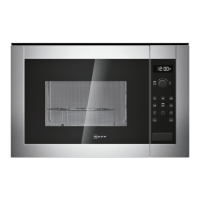
This document serves as an instruction manual for a Neff microwave oven, specifically models H53W50N3GB and H53W50S3GB. It provides comprehensive guidance on the safe operation, installation, maintenance, and various cooking functions of the appliance.
The microwave oven is designed for domestic use and is intended to be fully fitted into a kitchen cabinet. It operates by converting microwaves into heat, allowing for efficient preparation of food and drinks. The appliance features a control panel with a display for clock and cooking time, a rotary selector for adjusting settings, and dedicated buttons for microwave power levels and automatic programmes.
The core function of this appliance is to heat, defrost, and cook food using microwave energy. The control panel allows users to select specific microwave power settings, ranging from 90 watts for delicate defrosting to 800 watts for rapid heating and cooking.
Microwave Power Settings: The manual details various power levels:
Setting the Microwave: Users can set the desired microwave power and cooking time using the dedicated buttons and the rotary selector. The cooking time counts down on the display, and a signal sounds once it has elapsed. The cooking time can be changed, paused, or cancelled at any point during operation.
Memory Function: A convenient memory function allows users to save frequently used settings for a particular dish. This eliminates the need to re-enter settings each time, streamlining the cooking process for favourite meals. The memory can store one microwave power setting and its corresponding cooking time.
Automatic Programmes: The appliance includes seven automatic programmes designed for defrosting and cooking various foods with ease. These programmes simplify operation by automatically setting optimal microwave power and time based on the food's weight.
The manual provides extensive guidance on how to use the microwave effectively and safely.
Setting the Clock: Upon initial connection or after a power cut, the clock needs to be set. The rotary selector is used to adjust the time, which can also be hidden or reset as needed.
Ovenware: Crucial information is provided on suitable and unsuitable ovenware. Heat-resistant glass, glass ceramic, porcelain, ceramic, or heat-resistant plastic are recommended, as they allow microwaves to pass through. Metal ovenware is explicitly unsuitable for microwave-only mode, as it can cause sparks and damage the appliance. A crockery test is described to help users determine if their ovenware is microwave-safe.
Food Preparation Tips: The manual offers practical advice for preparing food, such as using portion-sized, thinly frozen food for defrosting, adding water for vegetables, and covering food during heating to retain moisture and ensure even cooking. It also emphasizes the importance of stirring or turning food during cooking and allowing it to stand for a few minutes afterwards to achieve an even temperature.
Signal Duration: The duration of the acoustic signal that sounds when the appliance switches off can be adjusted, offering either a short (3 tones) or long (30 tones) signal.
Proper care and cleaning are essential for maintaining the appliance's appearance and functionality. The manual outlines specific cleaning agents and methods for different parts of the microwave.
The manual places a strong emphasis on safety, detailing potential risks and preventive measures.
The manual also includes a malfunction table to help users troubleshoot common issues before contacting after-sales service, and information on energy and environment tips for efficient and eco-friendly use and disposal of the appliance.
 General
| Turntable | Yes |
|---|---|
| Clock type | Electronic |
| Door hinge | Left |
| Control type | Buttons |
| Display type | LED |
| Product color | Stainless steel |
| Door open type | Button |
| Microwave power | 800 W |
| Appliance placement | Built-in |
| Number of power levels | 5 |
| Auto programs quantity | 7 |
| Connected load | - W |
 Weight and Dimensions
| Width | - mm |
|---|

 To Next Page