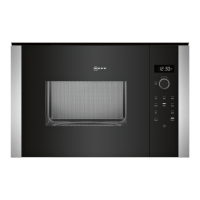
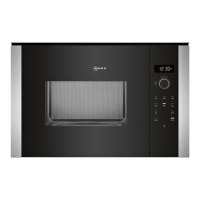
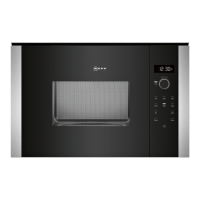
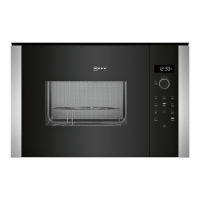
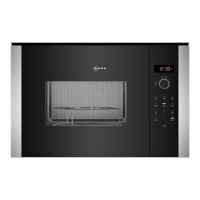
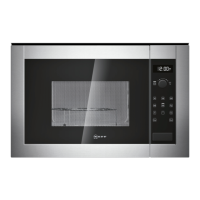
This document is the user manual and installation instructions for the NEFF Microwave Oven models HLAWD53N0B and HLAWD53W0B.
Function Description
The NEFF Microwave Oven is designed for preparing meals and drinks, including defrosting, cooking, and heating various foods and liquids. It operates using microwave technology, producing microwaves for heating food. The appliance is a group 2, class B product, suitable for private households and similar applications such as employee kitchens, agricultural settings, hotels, and bed and breakfasts. It can be used at altitudes up to 4000 m above sea level.
The control panel allows users to configure all functions and view the operating status. Key controls include an automatic door opener, touch fields for selecting functions, a clock button for setting/displaying time, a rotary selector for setting time, cooking time, or automatic programs, and a display for clock or cooking time. The rotary selector can be pushed in to engage or release.
The appliance features several microwave power settings: 90 W (defrost delicate foods), 180 W (defrost food, continue cooking), 360 W (cook meat/fish, heat delicate foods), 600 W (heat/cook food), and 900 W (heat liquids). Specific cooking times are associated with these settings, such as 900 W for 30 minutes, 600 W for 60 minutes, and lower wattages for up to 99 minutes.
Automatic programs are available for defrosting and cooking. Defrosting programs (P01-P04) cover minced meat, pieces of meat, chicken, and bread, with weight ranges from 0.20 kg to 1.80 kg. Cooking programs (P05-P07) are for rice, potatoes, and vegetables, with weight ranges from 0.05 kg to 1.00 kg. These programs automatically select optimum settings.
A memory function allows users to save settings for frequently prepared dishes and recall them easily. This function cannot save multiple microwave power settings in succession or automatic programs.
Important Technical Specifications
The appliance is a microwave oven with various power settings ranging from 90 W to 900 W. It complies with EN 55011 and CISPR 11 standards. The minimum installation height is 850 mm. The installation cabinet must not have a back panel behind the appliance, and ventilation slots must not be covered. Fitted units must be temperature-resistant up to 90 °C, and adjacent unit fronts up to 65 °C. The appliance contains light sources from energy efficiency class G, which should only be replaced by trained specialist staff. Product and production numbers (E-Nr. and FD) are located on the rating plate, visible when the appliance door is open.
Usage Features
Initial Configuration: Upon first connection or after a power cut, the appliance will sound a signal, display zeros, and then allow the user to set the clock. The clock can be hidden to reduce standby consumption.
Cookware: Only microwave-safe cookware made from heat-resistant, microwave-safe materials like glass, glass ceramic, porcelain, and temperature-resistant plastic should be used. Fully glazed ceramic without cracks is also suitable. Metal cookware or cookware with metal edging should not be used during microwave-only operation as it can cause sparks and damage the appliance. Metal cutlery, such as a spoon in a glass, can be used to prevent delayed boiling of liquids. A cookware test can be performed to check suitability by heating empty cookware at maximum microwave power for 30 seconds to 1 minute.
Operation:
- Starting: Place food in the cooking compartment, close the door, select desired settings (microwave power, duration, or automatic program), and press Start.
- Pausing: Open the appliance door or press Stop. Operation will pause. To resume, close the door and press Start.
- Cancelling: Press Stop twice, or open the door and press Stop once.
- Cooling Fan: The cooling fan operates as needed, even if the cooking compartment remains cold during microwave operation, and may run after the oven is switched off.
- Condensation: Condensation may occur in the cooking compartment and on the door during cooking; this is normal and should be wiped away.
- Turntable: The appliance must always be used with the turntable correctly fitted and engaged in the drive. The turntable can rotate clockwise or anti-clockwise.
Safety during Use:
- Never operate the appliance if the cooking compartment door or plastic door frame is damaged, as microwave energy may escape.
- Do not store combustible objects in the cooking compartment.
- If smoke is emitted, switch off the appliance, pull the plug, and keep the door closed to stifle flames.
- Remove loose food remnants, fat, and meat juices before use to prevent fire.
- Always use oven gloves when removing hot accessories or cookware.
- Open the appliance door carefully to avoid scalding from hot steam.
- Never pour water into a hot cooking compartment.
- Do not use harsh or abrasive cleaners or sharp metal scrapers on the appliance door glass to prevent scratches.
- Keep hands away from door hinges to avoid injury.
- Handle the glass turntable with care to prevent cracks or breaks.
- Never dry food or clothing in the appliance.
- Never heat slippers, grain/cereal-filled pillows, sponges, or damp cleaning cloths.
- Do not heat liquids or food in tightly sealed containers to prevent explosion.
- Prick egg yolks before microwaving and prick the peel/skin of foods like apples, tomatoes, potatoes, and sausages to prevent bursting.
- Stir or shake baby food well after heating and check its temperature before serving.
- Always place a spoon in containers when heating liquids to prevent delayed boiling and splattering.
Maintenance Features
Cleaning: Regular cleaning is essential for efficient operation and to prevent damage or microwave energy leakage.
- General: Wipe away condensation after cooking. Do not store moist food or objects in the cooking compartment for long periods.
- Cleaning Products: Use only suitable cleaning agents. Avoid harsh, abrasive, or high-alcohol content cleaners, hard scouring pads, or cleaning sponges. Do not use steam or high-pressure cleaners. For stainless steel surfaces, use special stainless steel cleaning products. Wash new sponge cloths thoroughly before use.
- Cooking Compartment: Clean with hot soapy water or a vinegar solution. For heavy soiling, use oven cleaner when the compartment is cold. To eliminate odors, heat a cup of water with lemon juice for 1-2 minutes at maximum microwave power (with a spoon in the cup to prevent delayed boiling), then wipe with a soft cloth and leave the door open to dry.
- Turntable: Remove and clean with hot soapy water and a soft dishcloth, then dry and reinsert, ensuring it engages correctly.
- Appliance Front: Clean with hot soapy water and a dishcloth. For stainless steel fronts, apply a thin layer of stainless steel cleaning product with a soft cloth. Avoid glass cleaner or metal scrapers.
- Control Panel: Clean with a microfibre cloth or a soft, damp cloth, then dry. Do not wipe with a wet cloth.
- Door Panels: Clean with a soft dishcloth and glass cleaner. Avoid glass scrapers.
- EasyClean: This cleaning aid softens dirt by vaporizing soapy water. Add a few drops of washing-up liquid to a cup of water (with a spoon), place in the center of the cooking compartment, set microwave power to 600 W for 3 minutes. After the duration, keep the door closed for 3 minutes, then wipe out the compartment with a soft cloth and leave the door open to dry.
Troubleshooting: The manual provides a section for rectifying minor faults, such as the appliance not working, food taking longer to heat, turntable grating, or error messages. If faults persist, Customer Service should be contacted. Improper repairs are dangerous and should only be carried out by trained specialist staff.
Disposal: Packaging materials are environmentally compatible and recyclable. The appliance itself should be disposed of in an environmentally friendly manner, following local authority or specialist dealer guidelines for waste electrical and electronic equipment (WEEE).


 To Next Page

 General