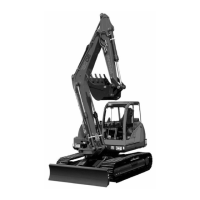
Safety instructions
This means, for example, the lifting and lowering of pipes, shaft rings or
containers with
earthmoving machinery.
6.11.2 Earthmoving machinery must not be used in lifting-gear deployment unless the
prescribed safety
devices are present and fully functioning.
For hydraulic excavators, for example, these
are:
- safe slinging facility for a load-bearing device,
- working load table,
and in addition for hydraulic excavators with a legal working load of more than
1000 kg or a
overturning moment of more than 40 000 Nm
- overload warning system,
- open-circuit monitoring system(s) at boom lifting
cylinder(s).
6.11.3
6.11.4
6.11.5
6.11.6
6.11.7
Loads must be slung in such a way that they cannot slip or fall
out.
Persons involved in guiding the load and riggers must remain within the visual field of
the machine
operator.
The machine operator must keep loads as close as possible to the ground and
prevent their
swinging.
Earthmoving machinery must not be driven with a slung load unless the roadway is as
even as
possible.
When earthmoving machinery is in lifting-gear deployment, riggers may approach the
boom only
with the consent of the machine operator and only from the side. The machine operator
must not
give his consent unless the earthmoving machine is stationary and the operating device
is not
being moved.
No damaged or inadequately dimensioned slinging aids (cables, chains) must be
used.
Protective gloves must always be worn when working with slinging aids.
Assembly, servicing, repair (maintenance)
Earthmoving machinery must not be assembled, converted or dismantled except under
the
direction of qualified personnel appointed by the contractor and with the
manufacturer’s operating
instructions being observed.
Work on such components as
- braking,
6.11.8
7
7.1
7.2
9707672_User manual_en
-A9-


 To Next Page
 Loading...