Need help?
Do you have a question about the New England Arbors Camelot and is the answer not in the manual?
Initial advice, tool recommendations, and assembly environment setup.
Location considerations and site preparation before assembly.
Limitations on adding weight loads like swings or people.
Visual identification and labeling of all components included in the kit.
Instructions to check parts and contact customer service for missing items.
Detailed list of all hardware provided with the pergola kit.
List of optional and required materials to purchase separately.
A list of necessary tools required for building the pergola.
Measuring and marking post locations for a square installation.
Excavating holes, placing posts, and filling with concrete.
Marking, drilling, and securing bolt down brackets to surfaces.
Placing posts in brackets and using shims for a level fit.
Inserting post guides, applying weld glue, and connecting column sections.
Sliding trims and fastening vinyl columns to the wood posts.
Assembling main support beam sections using joiners and end caps.
Importance of aligning holes for correct post connection.
Securing beam joiners and drilling holes for structural integrity.
Preparing wood inserts by notching them to fit rafter slots.
Installing louver boards into brackets and attaching pre-assembled louver bars.
Fastening rafter joiners and repeating assembly for all rafters.
Raising beams onto posts, hand-tightening, then securing with screws.
Placing rafters onto beams, ensuring specific spacing for louvers.
Securing the rafters to the pergola posts with screws.
Securing all intersections where beams and rafters meet.
Differentiating and laying out the various pre-assembled louver bar configurations.
Arranging the twelve louver bar assemblies according to instructions.
Inserting louver boards completely into the assembly brackets.
Pressure fitting louver bars and repeating for all sections.
Carefully lowering the louver assembly onto steel holder brackets.
Fastening the short louver bar with nuts, noting adjustments needed.
Adjusting bracket position to ensure free louver operation.
Securing steel brackets to the louver assembly from top and bottom.
Continuing the louver installation for the remaining rows.
Placing the final post caps on top of the pergola columns.
Selecting a location and mounting the turn bar holder to a post.
Attaching the turn bar to the installed holder.
Using the turn bar to change the angle of the louvers.
Tips for resolving difficulties with louver operation.
Recommendation to keep louvers open during heavy snow.
Guidelines for reducing the overall size of the pergola.
Instructions on how to cut beams and boards for modification.
A specific example of resizing the pergola to new dimensions.
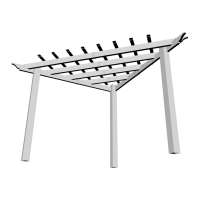
The device described in this manual is a 12 x 12 Flat Top Louvered Pergola, model Camelot, manufactured by New England Arbors. It is designed as an outdoor structure to provide shade and aesthetic appeal, featuring adjustable louvered panels on the roof.
The Camelot Pergola serves as a freestanding outdoor structure, offering a shaded area for relaxation or entertainment. Its primary function is to provide adjustable shade through its louvered roof system, allowing users to control the amount of sunlight filtering through. The louvered design enables the user to open or close the panels, adapting to varying weather conditions or personal preferences. It is designed to be installed either in-ground with pressure-treated wood posts embedded in concrete or mounted on an existing concrete or wood surface using bolt-down brackets. The structure is intended for static use and is not designed to support additional weight loads such as swings, people, or other objects.
 General
| Brand | New England Arbors |
|---|---|
| Model | Camelot |
| Category | Garden Houses |
| Language | English |


 To Next Page