Need help?
Do you have a question about the NewAir AW-121E and is the answer not in the manual?
Instructions to prevent children from operating, playing with, or crawling inside the unit.
Details on shock hazard and the necessity of proper electrical grounding for the unit.
Steps for proper placement, ventilation, and environmental considerations for installation.
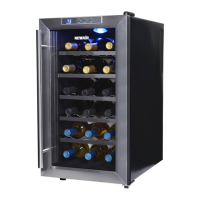
The NewAir AW-121E is a 12-bottle freestanding thermoelectric wine cooler designed to provide optimal storage conditions for your wine collection. This appliance is built with customer satisfaction in mind, offering innovative products, exceptional service, and reliable support. It is intended for home use and is not designed for commercial, industrial, garage, or outdoor applications.
The primary function of the NewAir AW-121E is to store wine at a controlled temperature, preserving its quality and enhancing its aging potential. It utilizes thermoelectric cooling technology, which is known for its quiet operation and energy efficiency. The cooler features a digital display panel that allows users to monitor and adjust the internal temperature. The unit is designed to maintain a stable environment, protecting wine from harmful elements such as temperature fluctuations, UV rays, and vibrations.
Upon receiving the unit, it is recommended to carefully remove all exterior and interior packaging and retain it for future use. The cooler comes with three slide-out shelves, a door handle with two screws, and an instruction manual. Before operating the wine cooler for the first time, the handle needs to be attached to the front of the unit using a Phillips screwdriver. Care should be taken not to overtighten the screws to avoid damage.
The AW-121E is a freestanding unit and should not be installed inside a cabinet or other built-in enclosure. For proper ventilation, a minimum of 5 inches of clearance should be maintained between the back of the unit and any adjacent walls. The cooler should be placed on a level surface strong enough to support its weight when fully loaded. The front feet at the bottom of the unit can be adjusted to level the cooler. It is crucial to install the cooler away from direct sunlight and heat sources like stoves, heaters, or radiators, as these can affect the unit's acrylic coating, increase electrical consumption, and prevent proper performance.
The wine cooler is designed to operate optimally in an ambient temperature range of 50°F to 80°F. If the ambient temperature falls outside this range, the unit's performance may be compromised, leading to fluctuations in the interior temperature and potentially preventing the cooler from reaching its optimal storage range of 50°F to 60°F. Factors such as the interior light being on or off, and the placement of bottles on different racks (upper, middle, or lower), can also influence the internal temperature.
The cooler features a display panel with "Up," "Down," and "Light" buttons. After turning on the wine cooler, the LED display will first show the ambient temperature, followed by the internal cabinet temperature. Users can adjust the desired temperature in increments of 1 degree within a range of 54°F to 66°F. Once a new temperature is set, it will flash on the display for 5 seconds before reverting to show the current internal cabinet temperature.
For optimal wine preservation, red wines should ideally be stored between 50°F and 65°F, while white wines prefer a range of 40°F to 55°F, with humidity levels between 60% and 75% RH. Corked bottles should be stored on their sides to prevent the cork from drying out and allowing air into the bottle. To protect wine from premature aging, it is important to keep bottles out of direct sunlight, as UV rays can accelerate the aging process. Additionally, heavy vibrations from motors or other sources should be avoided. Wine should also be stored separately from strong odors that could contaminate its flavor.
When moving the cooler, it is essential to remove all stored items and securely tape down any loose parts inside the unit. The leveling feet should be turned up to the base to prevent damage. The door should be taped shut, and the cooler should be kept in an upright position during transportation.
Regular cleaning helps maintain the performance and longevity of the wine cooler. To clean the unit, first unplug it and remove everything stored inside. The interior surfaces can be cleaned with a solution of warm water and baking soda (2 tablespoons of baking soda per one-quarter of water). The water reservoir at the bottom of the unit should be unscrewed and rinsed with water. For cleaning the exterior, a mild detergent and warm water can be used.
Upon initial setup, the cooler may have a "plastic" smell. To remove this, wash the interior with a mild detergent and warm water, then leave the door open to air dry thoroughly. If the smell persists, placing a dish of baking soda inside the unit or stuffing it with newspapers overnight can help. After this process, allow the unit to run for a full day to complete the airing out.
The manual provides a comprehensive troubleshooting guide to address common issues. For instance, if the cooler does not operate, potential causes include incorrect voltage, a tripped circuit breaker, or a blown fuse. Solutions involve checking the voltage, resetting the breaker, or checking the fuse. If the cooler is not cold enough, reasons could be a high external ambient temperature requiring a lower setting, frequent door openings, an improperly closed door, a faulty door seal, or insufficient clearance around the unit. Solutions range from adjusting the temperature setting and ensuring the door is securely closed to replacing the door seal or ensuring proper clearance. Issues with the light not working or the cooler vibrating or making excessive noise are also addressed, with solutions often involving checking the display board, leveling the unit, or inspecting the fan for obstructions. Problems with the door not closing properly, LED display errors, or unresponsive buttons are also covered, with solutions including checking door hinges, replacing seals, ensuring shelves are properly positioned, or contacting the manufacturer for issues related to the control board or cooling kit.
The manual emphasizes several safety precautions. To prevent child entrapment, children should not be allowed to operate, play with, or crawl inside the unit. If the unit is not in use for an extended period or is being disposed of, the door should be removed, and shelves left in place. Flammable fluids should never be used to clean appliance parts, nor should gasoline or other flammable vapors and liquids be stored near the appliance, due to fire and explosion hazards. Perishable foods should not be stored in the wine cooler, as the internal temperature is not low enough to prevent spoilage.
The cooler requires proper electrical grounding for safety. The power cord is equipped with a 3-prong plug that fits into 3-prong wall outlets. Improper use of the grounded plug can result in electrical shock. If the power cord is damaged, it should be replaced by an authorized service center. The ground wire should never be cut or removed from the power cord. The use of an extension cord is not recommended. The cord should be secured behind the cooler to prevent accidental injury and should not be exposed or left dangling.
 General
| Type | freestanding |
|---|---|
| Size | compact |
| Color | black stainless steel, stainless steel |
| Bottle Capacity | 12 |
| Minimum Wine Cooler Temperature | 53.6 degrees fahrenheit |
| Maximum Wine Cooler Temperature | 64 degrees fahrenheit |
| Defrost System | no |
| Noise level | 25 decibels |
| Number of Shelves | 3 |
| Number of Temperature Zones | 1 |
| Temperature Control | electronic |
| Interior Light | yes |
| Child Lock | no |
| Smart Home | no |
| Voltage | 115 volts |
| Current | 0.8 amperes |
 Weight and Dimensions
| Depth | 19 1/2 inches |
|---|---|
| Height | 17 1/2 inches |
| Width | 14 inches |
| Net Weight | 26 pounds |

 To Next Page