Need help?
Do you have a question about the Nexa MTG-3000H and is the answer not in the manual?
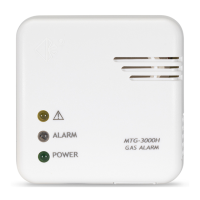
Lists key features of the Hot Wire Type Gas Leakage Alarm including sensor type, ease of installation, self-diagnostics, and gas detection capabilities.
Details the technical specifications of the gas alarm, including power source, sensitivity, power consumption, operating conditions, and gas types detected.
Provides instructions on how to install the gas alarm, covering mounting, wiring, and initial connection procedures.
Guides on where to install the gas alarm for detecting natural gas (LNG) and liquefied petroleum gas (LPG) based on ceiling or floor proximity.
Lists locations to avoid for installing the gas alarm to ensure optimal performance and prevent false alarms.
Detailed steps for electrical installation, mounting bracket attachment, and connecting the power source to the gas alarm.
Explains the initial setup, indicator lights (green, red, yellow), and normal operation modes of the gas alarm unit.
Recommends weekly testing of the gas alarm using a gas source to ensure correct functionality and alarm response.
Provides immediate actions to take when the alarm sounds, including extinguishing flames and ventilating the area.
Highlights essential safety practices for gas alarm installation and maintenance, including regular testing and avoiding electrical overloads.
Explains the meaning of the fault lamp and potential causes, such as ambient temperature issues or internal device problems.
Outlines the three-year limited warranty for defects in materials and workmanship under normal use.
 General
| Alarm decibels | 85 dB |
|---|---|
| Interconnectable | - |
| Detected gas types | Carbon dioxide (CO2), LPG, Methane, Natural gas |
| Mounting type | Wall |
| Product color | White |
| LED indicators | Alarm, Power |
| Operating temperature (T-T) | -10 - 40 °C |
| Operating relative humidity (H-H) | 0 - 95 % |
| Quantity per pack | 1 pc(s) |
| AC adapter included | Yes |
| AC input voltage | 230 V |
| DC input voltage | 12 V |
| Power source type | AC |
 Weight and Dimensions
| Width | 75 mm |
|---|---|
| Height | 35 mm |

 To Next Page