EasyManua.ls Logo

Nextiva X-885 - User Manual

Nextiva X-885
1 page
Print Icon
Loading...
Nextiva X-885 QuickReference
A
D
B
C E
F
K L
M N O
G H I J
Checking Voicemail
There must not be a call on theline whenattemptingto check voicemail.
1. Press the Voicemail button or dial *86.
2. Enter the personalvoicemailpasscode, then press #. The default is 0000.
3. Press 1 tolisten tonew or savedvoicemails.
Blind Transferring Calls
A blind (unattended) transfer involves transferring the call to another number
withoutspeakingtothe receivingparty,regardless of whethertheyanswer.
1. While on acall,press the Transfer button.
2. Dial the phone number or extension of the receiving party.
3. Press the Transfer button before the receiving party answers to
blind transfer the call.
Warm Transferring Calls
A warm (attended) transfer allows Users to speak privately with the receiving
party before transferring the call. A warm transfer also confirms the
availability of the receiving party.
1. While on acall,press the Hold button.
2. Dial the phone number or extension of the receiving party.
3. Greet the receiving party and advise them of any important
information.
4. Press Transfer , then press the Confirmation button to perform a
warm transfer.
J
I
C
I
I
F
Accessing Call History
1. Press the Call History soft key.
2. Press the left or right arrows on the 5-Way Navigation
to view All, Missed, Received, or Dialed Calls.
A
D
Soft Keys
Do Not Disturb (DND)
Confirmation
5-Way Navigation
Cancellation
Voicemail
Directory
Settings
Transfer
Hold
Mute
Volume Up / Down
Speakerphone
Headset
Page
A
B
C
D
E
F
G
H
I
J
K
L
M
N
O
Question and Answer IconNeed help?

Do you have a question about the Nextiva X-885 and is the answer not in the manual?

Overview

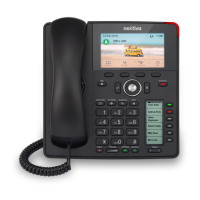
This document provides a quick reference guide for the Nextiva X-885, a business desk phone designed for efficient call management and communication. The device appears to be a standard IP phone with a monochrome or color display, a numeric keypad, and several dedicated function buttons, along with soft keys for context-sensitive actions.

Function Description:

The Nextiva X-885 is primarily designed for making and receiving calls, with advanced features for call handling such as transferring, voicemail, and accessing call history. It supports both warm (attended) and blind (unattended) call transfers, allowing users flexibility in how they manage incoming calls. The phone integrates with Nextiva's communication platform, indicated by the "nextiva" branding on the device and in the document.

Usage Features:

Call Transferring:

  • Warm Transferring Calls (Attended Transfer): This feature allows a user to speak privately with the receiving party before completing the transfer, ensuring the party is available and willing to take the call.
    1. While on an active call, the user presses the Hold (J) button.
    2. The user then dials the phone number or extension of the intended receiving party.
    3. After the receiving party answers, the user can greet them and provide any necessary information about the call.
    4. To complete the transfer, the user presses the Transfer (I) button, followed by the Confirmation (C) button.
  • Blind Transferring Calls (Unattended Transfer): This method allows a user to transfer a call directly to another number without speaking to the receiving party first.
    1. While on an active call, the user presses the Transfer (I) button.
    2. The user dials the phone number or extension of the intended receiving party.
    3. To complete the blind transfer, the user presses the Transfer (I) button again before the receiving party answers.

Voicemail Management:

  • Checking Voicemail: To access voicemail, the user must not be on an active call.
    1. The user presses the Voicemail (F) button or dials *86.
    2. The user then enters their personal voicemail passcode, followed by the # key. The default passcode is 0000.
    3. To listen to new or saved voicemails, the user presses 1.

Call History Access:

  • Accessing Call History: This feature allows users to review past calls.
    1. The user presses the Call History (A) soft key.
    2. The user can then use the left or right arrows on the 5-Way Navigation (D) pad to browse through different categories of calls: All, Missed, Received, or Dialed Calls.

Keypad and Button Layout:

The phone features a standard numeric keypad (0-9, *, #) for dialing. Several dedicated buttons and soft keys are identified:

  • Soft Keys (A): These are context-sensitive buttons located directly below the display, whose functions change based on the phone's current state (e.g., "Directory," "Call History," "Call Forward," "Help" are shown as soft key labels on the display).
  • Do Not Disturb (DND) (B): A button to activate or deactivate the Do Not Disturb feature, which silences incoming calls.
  • Confirmation (C): Used to confirm actions, such as completing a warm transfer.
  • 5-Way Navigation (D): A central directional pad (up, down, left, right, and a central select button) used for navigating menus and lists on the display.
  • Cancellation (E): A button to cancel an action or go back in a menu.
  • Voicemail (F): A dedicated button for accessing voicemail.
  • Directory (G): A button to access the phone's contact directory.
  • Settings (H): A button to access the phone's settings menu.
  • Transfer (I): A dedicated button for initiating call transfers.
  • Hold (J): A dedicated button to place an active call on hold.
  • Mute (K): A button to mute the microphone during a call.
  • Volume Up / Down (L): Buttons or a rocker switch to adjust the call volume.
  • Speakerphone (M): A button to activate or deactivate the speakerphone function.
  • Headset (N): A button to switch audio output to a connected headset.
  • Page (O): A button likely used for paging or inter-office announcements.

Display Information:

The phone's display shows:

  • Date and Time (e.g., "12/04/2018 11:08").
  • Current office or line information (e.g., "Office 1286").
  • Visual indicators for call status, messages, and other features.
  • A graphical interface with icons for Directory, Call History, Call Forward, and Help, accessible via soft keys.
  • A list of contacts or active calls (e.g., "Fiona Davis," "Andreas Poch," "Oliver Hegemann," "Robert Forster," "Mike Stern," "Mora Less").

Technical Specifications (Inferred):

  • Connectivity: Likely an IP phone, connecting via Ethernet (not explicitly stated but implied by "Nextiva" and modern business phone context).
  • Display: Features a graphical display, possibly color, capable of showing date, time, call information, and menu options.
  • Audio: Includes a handset, speakerphone, and headset support. Volume control, mute, and speakerphone/headset toggles are present.
  • Power: Not specified, but typically powered via Power over Ethernet (PoE) or an AC adapter.

Maintenance Features:

The document does not explicitly detail maintenance features. However, as a quick reference guide, it focuses on operational use rather than hardware maintenance. Software updates and configuration would typically be managed by IT administrators through the Nextiva platform or the phone's web interface.

In summary, the Nextiva X-885 is a robust business communication device designed for ease of use and comprehensive call management within a professional environment, offering essential features for efficient daily operations.
Nextiva X-885 Specifications

General IconGeneral
BrandNextiva
ModelX-885
CategoryTelephone
LanguageEnglish

Related product manuals