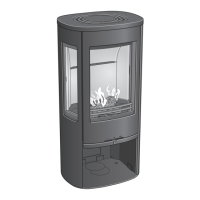
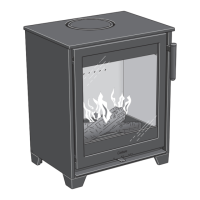
The Contura C800 Style is a wood-burning fireplace designed to provide secondary heating in homes, emphasizing efficient and safe operation. This device is built to be user-friendly, with features that simplify the lighting process, fuel management, and ongoing maintenance.
Function Description
The primary function of the Contura C800 Style is to burn wood logs to generate heat, which is then radiated into the room. The fireplace operates with a combustion air damper that controls the air supply to the firebox, allowing users to regulate the intensity of the fire and the heat output. An automatic damper system is integrated to assist with the initial lighting phase, supplying air from below until the kindling has burned down. The design incorporates a grate disc and a booster mechanism to ensure optimal air flow and combustion, especially when starting a fire or adding new logs to a low firebed.
The stove is designed for closed-door operation, enhancing safety and combustion efficiency. It features a robust construction with a glass door that allows for viewing the flames while containing the fire. The internal components, such as the hearth cladding and grate, are designed for durability, though they are considered wear parts that may require replacement over time depending on usage.
For homes in smoke control areas, the Contura C800 Style can be fitted with a permanent stop (damper blocker) to prevent the air control vent from closing beyond a 30% open position, ensuring compliance with local regulations regarding smoke emissions.
Usage Features
- Lighting the Fire: The process begins by opening the combustion air damper fully and placing approximately 1.7 kg of finely chopped kindling in the firebox, with larger logs at the bottom and smaller sticks on top, along with a firelighter. After lighting, the door is closed. The automatic damper assists in the initial ignition by supplying air from below. Once the kindling has burned down, more logs can be added. It is crucial to use dry wood (moisture content below 20%) for efficient combustion and to prevent sooting.
- Adding Logs: When adding logs, the door should be opened slowly and carefully to allow the vacuum in the firebox to equalize, preventing blowback. Users should add 2 logs weighing about 1.1-1.3 kg, placing them diagonally across each other. The combustion air damper should be fully open until the logs are burning vigorously. For slower combustion, the air supply can be reduced. An average output of 5 kW is achieved with the damper about 40% open, adding two logs every 45 minutes. For the lowest heat output (3-4 kW), the damper should be about 30% open, but it's important to keep it fully open for the first 3-5 minutes to ensure proper ignition.
- Using the Booster: If embers have died down or the firebox temperature is too low, the booster can be used to help new logs catch fire. This involves pulling the grate handle all the way out to supply air from below, which makes the logs ignite more easily. The grate handle should be closed as soon as the fire is burning to prevent logs from burning too quickly and potentially damaging the stove.
- Fuel Selection: The stove can use various types of wood, including birch, beech, oak, elm, ash, conifers, and fruit trees. Denser woods like oak, beech, and birch offer higher energy value. It is strictly prohibited to burn fossil fuels, pressure-impregnated wood, painted or glued wood, chipboard, plastic, or color brochures, as these materials can produce harmful substances and damage the fireplace. Old candle stubs should also be avoided as melted wax can damage the damper system.
- First-Time Use: When new, the fireplace may emit a particular odor, which is normal and will dissipate after a few uses.
Maintenance Features
- Cleaning the Glass: The fireplace glass may become sooty, even with dry wood. Regular cleaning with damp paper is usually sufficient. For stubborn soot, dipping damp paper in ashes and wiping clean is effective. Abrasive or corrosive cleaning agents, or those containing sodium hydroxide, should be avoided as they can damage the glass or paintwork.
- Ash Management: The ash-pan should be emptied when full. It is crucial to ensure no glowing embers remain in the ash before disposal. Ashes should be stored in a fireproof container with a lid for at least one week. The area around the ash-pan should also be cleaned to ensure the pan can be fully inserted.
- Grate and Cast-Iron Components: A wire brush can be used to clean the grate and other cast-iron components within the firebox.
- Gasket Inspection: Gaskets should be regularly inspected for wear. Worn gaskets can reduce combustion efficiency by allowing additional air into the stove.
- Painted Parts: Painted surfaces can be cleaned with a damp cloth and, if necessary, a mild washing-up liquid. Scratches can be repaired using Contura touch-up paint.
- Dust Accumulation: Due to the constant air flow, dust can accumulate behind and under the stove, requiring regular cleaning of these areas.
- Chimney Sweeping: The chimney should be swept at least twice a year by a chimney sweep. The flue connection and chimney should be swept before lighting after a prolonged shutdown. If the stove replaces an open fire, the chimney should be swept one month after installation to clear any "softer" deposits loosened by higher flue temperatures. If sweeping through the stove is not possible, alternative means like a soot door should be provided.
- Prolonged Non-Use: If the stove is to be unused for an extended period, it should be thoroughly cleaned of ash and unburned fuel residues. Leaving the air controls fully open during this time helps maintain good air flow, reducing condensation and potential damage.
- Spare Parts: Only spare parts recommended by Contura should be used for replacements.
- Safety Checks: Users should be aware of the hot surfaces during operation and avoid placing flammable materials near the stove. Persistent fume emission is dangerous and requires immediate action, including ventilating the room, letting the fire go out, checking for blockages, and seeking expert advice if necessary. A CO alarm should be fitted in the same room as the appliance.

 Need help?
 General

 To Next Page