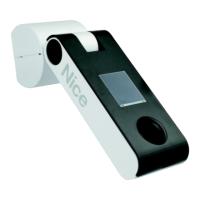
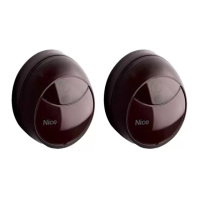
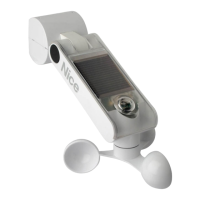
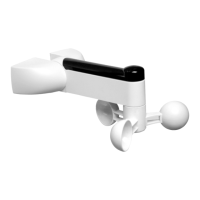
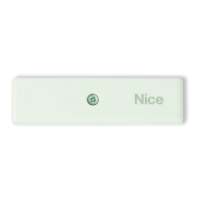
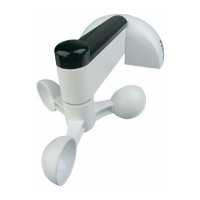
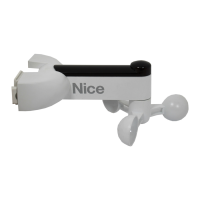
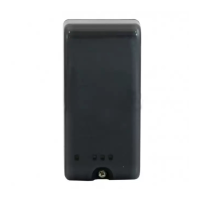
The Domi WS, WSC, and WSR are climatic sensors designed for use in automation systems for awnings, shutters, and skylights, particularly with Nice tubular motors and control units. These sensors integrate a radio transmitter and operate by real-time readings of variations in wind speed, sunlight intensity, and the presence of rain (WSR only). When the sensor readings exceed predefined thresholds (either above or below), the sensor transmits a radio signal to the motor's automation receiver, which then activates an Up or Down maneuver, depending on the signal received.
Function Description:
The Domi climatic sensor acts as a protective and convenience device for automated systems. It continuously monitors environmental conditions to ensure the safety and optimal operation of awnings, shutters, and skylights. The WS and WSR versions are mains-powered, while the WSC version is solar-powered, utilizing a photovoltaic cell that must be exposed to sunlight.
The sensor's operation is based on three main environmental parameters:
-
Wind Sensor (WS, WSC, WSR): This sensor measures real-time wind speed. If the wind speed exceeds a set threshold for at least 3 seconds, the sensor sends a "Wind over-threshold" status, which typically causes the awning or shutter to retract to prevent damage. During this time, the sensor suspends sending commands from other sensors. Once the wind speed drops below half of the threshold for at least 4 minutes, the sensor sends a "Wind under-threshold" status. After approximately 10 minutes, the sensor resumes sending commands from other sensors.
-
Rain Sensor (WSR only): This sensor operates in ON/OFF mode without threshold adjustment. When it starts to rain or snow, the sensor sends a "Presence of rain" status, triggering protective actions like retracting awnings. When the rain or snow stops, it sends an "Absence of rain" status. The rain sensor is heated, so heat emanating from it is a normal part of its operation.
-
Sun Sensor (WS, WSC, WSR): This sensor measures the brightness of sunlight. If the light intensity exceeds a set threshold for at least 2 minutes, the sensor sends a "Sun over-threshold" status, which might cause awnings to extend for shade. When the brightness drops below half of the threshold for at least 15 minutes, the sensor sends a "Sun under-threshold" status, potentially retracting awnings.
In cases where conflicting readings occur from different sensors, the device prioritizes conditions in the following order (from highest to lowest priority): wind, rain, sun. This ensures that safety-critical conditions like strong winds take precedence over other environmental factors.
Usage Features:
The Domi sensor offers several features to enhance its usability and integration into automation systems:
- Memorization: The sensor's radio code must be memorized in the receiver of the motor it controls. This can be done in either Monodirectional (MONO) or Bidirectional (BIDI) mode, depending on the system. The memorization process involves a sequence of button presses on the sensor and the transmitter, with LED feedback indicating the status. It's crucial to memorize only one type of transmitter (monodirectional or bidirectional) to avoid mixing types.
- Activation: For WSC sensors, activation involves a single press of the B Button, followed by LED flashes. For WS/WSR sensors, activation occurs by turning on the power supply, also indicated by LED flashes.
- Threshold Setting: Users can adjust the "Sun" and "Wind" thresholds to suit their preferences and local conditions. This is done through a specific procedure involving button presses and observing LED signals, which indicate the current threshold level. There are multiple levels available for both sun (e.g., 5 klux to 60 klux) and wind (e.g., 20 kph to 100 kph).
- Testing Sensors: After memorization, the sun, wind, and rain sensors can be tested to ensure they are functioning correctly.
- Sun Sensor Test: Involves illuminating the sensor with bright sunlight (or a lamp if cloudy) to trigger a lowering movement, then obscuring it to trigger a raising movement. LED flashes indicate threshold exceeded or not exceeded.
- Wind Sensor Test: Involves rotating the wind sensor blades to simulate wind, which should cause the awning to raise and prevent other commands. Stopping the blades should deactivate the protection function.
- Rain Sensor Test (WSR only): Involves placing a finger on the rain sensor to simulate rain, which should cause the awning to raise. Removing the finger should indicate the absence of rain.
- Diagnostics Mode: The sensor includes a diagnostics mode to check current weather conditions against set thresholds and identify malfunctions. This mode is activated by holding the B Button for a few seconds, and LED flashes provide feedback on wind, rain, and sun thresholds.
- Factory Reset: The sensor can be reset to its default factory settings, restoring all thresholds to their original values. This procedure involves holding the B Button for a specific duration, with LED feedback indicating the reset process. After a factory reset, the default protocol is BIDI.
- Jointed Body: The sensor's body is jointed, allowing it to be oriented as desired and installed on sloping surfaces, providing flexibility in placement.
Maintenance Features:
Maintaining the Domi climatic sensor ensures its longevity and accurate operation:
- Cleaning: For WSR sensors, the rain sensor surface must be kept clean and free of leaves, snow, or other objects. It should be cleaned with a soft damp cloth, avoiding alcohol, benzene, solvents, or other harsh cleaning agents. Similarly, for WSC sensors, the photovoltaic cell's photosensitive surface must be kept clean and unobstructed by leaves, snow, or other matter, using the same cleaning method.
- Power Supply (WS and WSR only): For mains-powered versions, a device for disconnection from the power mains with a gap between contacts that assures complete disconnection in overvoltage category III conditions must be installed on the power line.
- Battery Protection (WSC only): The WSC sensor includes battery protection. If the battery level is too low, the unit may enter sleep mode, indicated by three short red flashes. In sleep mode, it will not control automation. This can occur if the unit is mounted in a location that does not receive sufficient sunlight exposure.
- General Care: The product should be handled with care, avoiding crushing, striking, or dropping. It should not be placed near heat sources or exposed to naked flames, as this can cause damage and malfunctions.
- Professional Installation and Maintenance: All installation procedures, connections, programming, and maintenance of the product must be performed exclusively by a qualified technician to ensure safety and proper functioning. The device's protection housing should not be opened as it contains non-serviceable electrical circuits. No modifications should be applied to any part of the device other than as specified in the manual.

 Need help?
 General

 To Next Page