Need help?
Do you have a question about the Nikon Monarch/Titanium and is the answer not in the manual?
Details on acquiring mounting rings and following manufacturer instructions for scope mounting.
Warning against looking at the sun and advice on protecting the scope from elements.
Guidance on adjusting the reticle for standard range and trajectory compensation.
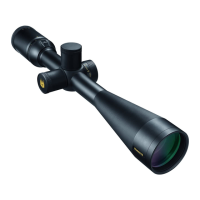
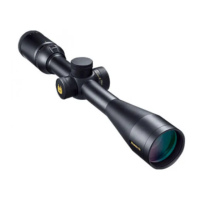
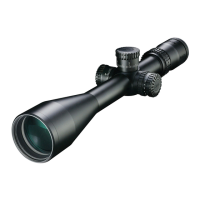
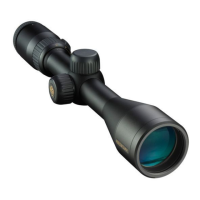
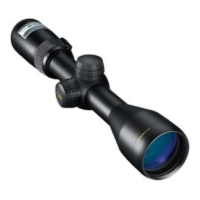
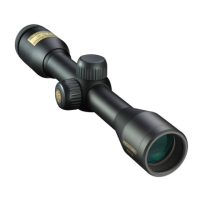
Lists and identifies all parts of the Nikon riflescope, from objective lens to adjustment caps.
Methods for cleaning scope lenses and exterior surfaces to maintain appearance and function.
Guidance on maintaining adjustment mechanisms and power selector ring.
Contact details for Nikon Scope Service in the USA and general advice for other markets.
The Nikon Riflescope Monarch/Titanium is a precision optical instrument designed for serious shooters, offering rugged and durable construction with bright optics. It is suitable for both hunting and target shooting applications.
The primary function of the Nikon Riflescope is to provide an enhanced aiming point for a rifle, allowing for greater accuracy over varying distances. It achieves this through a series of optical and mechanical adjustments. The riflescope features an objective lens that gathers light and an eyepiece lens for viewing the magnified image. Elevation and windage adjustments allow the user to correct for bullet trajectory and environmental factors, ensuring the bullet hits the aiming point. Some models include an adjustable objective (AO) feature, which allows for precise focusing and parallax elimination, particularly important for longer ranges. The power selector ring on variable magnification models enables the user to change the magnification level, adapting the scope to different shooting scenarios. Various reticle types, such as Nikoplex, Crosshair with Dot, Turkey Pro, Miliradian Dot, and BDC (Bullet Drop Compensator), are available depending on the specific model, each designed to assist with different aiming strategies and target distances.
Mounting and Alignment: The riflescope requires high-quality steel mounting rings with a standard diameter of 25.4 mm (1 inch). Users should follow the ring manufacturer's instructions for mounting. After mounting, the reticle must be aligned. The reticle should appear immediately crisp and clear to the quick glance.
Focusing: To focus the riflescope, the user positions their eye approximately 10 cm (4 inches) away from the eyepiece lens. They then look through the eyepiece and rotate the eyepiece adjustment until the reticle (e.g., Nikoplex, Crosshair with Dot, Turkey Pro, Miliradian Dot, or BDC) appears sharp. It is crucial to ensure proper eye alignment and eye relief to avoid the view appearing as a "black out." For the 2x20 model, once the eyepiece adjustment is made, the eyepiece lock ring should be firmly tightened to ensure an air-tight seal. For other models, the eyepiece adjustment is turned counter-clockwise and then clockwise until the reticle appears sharp.
Magnification: Some Nikon Riflescope models, such as the 6x42, 4x40, and 2x20, have fixed magnifications (6X, 4X, and 1.75X respectively). Other models, like the 3-9x40, 2-7x32, 1.5-4.5x20, 4-12x40 AO, 3.5-10x50, 3.3-10x44 AO, and 2.5-8x28, offer variable magnification. To change the power on variable models, the user simply rotates the power selector ring until the desired magnification aligns with the power index dot.
Adjustment of the Riflescope (Sighting In): After mounting, the rifle should be aligned with an aiming point on a target, and a trial round should be fired. If the bullet does not hit the aiming point, adjustments to elevation and windage are necessary.
Adjustable Objective (AO) Models: Models with an adjustable objective (6.5-20x44 AO, 4-12x40 AO, 3.3-10x44 AO, and 5.5-16.5x44 AO) allow for more precise focusing from at least 50 yards (45.72 m) to infinity by rotating the objective adjusting ring. This feature eliminates parallax and ensures accurate sight alignment. The distance scale on the adjustable objective serves as a reference guide. The adjusting ring is intentionally set to be stiff at the factory to prevent accidental movement during shooting.
Changing the Grip (6.5-20x44 AO only): To change the grip on the 6.5-20x44 AO model, first remove the protective cap by turning it counter-clockwise. Align the grip to the 0 (zero) position on the scale ring, remembering this alignment position. While holding the grip to prevent the scale ring from shifting, turn the bolt in the top of the grip counter-clockwise with the supplied hex key until it comes out. Remove the old grip. Insert the new grip, aligning the scale ring to 0. Reinsert the bolt and turn it clockwise with the hex key until the grip is firmly secured, again holding the grip to prevent the scale ring from shifting.
Zero Setting of Grip (except 6.5-20x44 AO): After the reticle is adjusted to the point of impact, the grip is held with fingers to prevent shifting of the aligned scale ring. The grip screw is turned counter-clockwise with a coin. The grip is then lifted up and aligned with the "▼" mark on the index mark. If the "▼" mark does not align with the index mark, it indicates a coupling pitch issue with the grip and shaft. To correct this, the grip is held to prevent shifting of the scale ring, and the grip screw is turned clockwise with a coin until the grip is firmly secured.
Adjustment Values:
General Care: The riflescope is effectively sealed against moisture and dust, allowing safe use in rain or dusty climates. To preserve its appearance, it is recommended to dry and clean the scope before storage. A soft cloth should be used for cleaning metal surfaces.
Lens Cleaning: To remove dirt or fingerprints from the lenses, soak gauze or lens cleaning paper (silicon-free paper, available at camera shops) with a small quantity of absolute alcohol (available from drugstores) and gently wipe off. Wiping with leather chamois is not recommended as it may damage the lens surface. Dust should be brushed off using a soft, oil-free brush to prevent scratching or corrosion of the lens.
Scope Exterior: The exterior of the scope should be wiped with a soft, dry cloth to remove any dirt or fingerprints. Oiling the scope's surface is not necessary.
Windage/Elevation Adjustments: These adjustments are permanently lubricated and should not be lubricated by the user. They should be kept covered with the supplied caps, except when making adjustments, to protect them from dust and dirt.
Eyepiece Adjustment: The eyepiece adjustment is also permanently lubricated and does not require user lubrication.
Power Selector Ring: No lubrication is required for the power selector ring. Users should not loosen or remove screws in the power selector ring.
Service: In the event that service is required for a Nikon Riflescope in the USA market, it should be sent directly to Nikon Scope Service. For other markets, the scope should be brought to the dealer from whom it was purchased.
 General
| Tube Diameter | 1 inch |
|---|---|
| Adjustment Graduation | 1/4 MOA |
| Waterproof | Yes |
| Fogproof | Yes |
| Shockproof | Yes |
| Lens Coating | Fully Multi-Coated |
| Objective Lens Diameter | 50mm |
| Reticle | Nikoplex |
| Parallax Setting | 100 yards |
| Eye Relief | 3.7 inches |

 To Next Page