EasyManua.ls Logo

Nippon DENON DCD-1560 - Safety Instructions

Default Icon
44 pages
Print Icon
To Next Page IconTo Next Page
To Previous Page IconTo Previous Page
Loading...
6A.
10.
11.
SAFETY
INSTRUCTIONS
Read
Instructions
All
the
safety
and
operating
instructions
should
be
read
before
the
appliance
is
operated.
Retain
Instructions
The
safety
and
operating
instructions
should
be
retained
for
future
reference.
Heed
Warnings
All
warnings
on
the
appliance
and
in
the
operating
instructions
should
be
adhered
to.
Follow
Instructions
All
operating
and
use
instruc-
tions
should
be
followed.
Water
and
Moisture
-
The
appliance
should
not
be
used
near
water
for
example,
near
a
bathtub,
washbowl,
kitchen
sink,
laundry
tub,
in
a
wet
basement,
or
near
a
swimming
pool,
and
the
like.
Carts
and
Stands
The
appliance
should
be
used
only
with
a
cart
or
stand
that
is
recommended
by
the
manufacturer.
An
appliance
and
cart
combination
should
be
moved
with
care.
Quick
stops,
excessive
force,
and
uneven
surfaces
may
cause
the
appliance
and
cart
combination
to
overturn.
Wall
or
Ceiling
Mounting
The
appliance
should
be
mounted
to
a
wall
or
ceiling
only
as
recommended
by
the
manufacturer.
Ventilation
The
appliance
should
be
situated
so
that
its
location
or
position
does
not
interfere
with
its
proper
ventilation.
For
example,
the
appliance
should
not
be
situated
on
a
bed,
sofa,
rug,
or
similar
surface
that
may
block
the
ventilation
openings;
or,
placed
in
a
built-in
installation,
such
as
a
bookcase
or
cabinet
that
may
impede
the
flow
of
air
through
the
ventilation
openings.
Heat
The
appliance
should
be
situated
away
from
heat
sources
such
as
radiators,
heat
registers,
stoves,
or
other
appliances
(including
amplifiers)
that
produce
heat.
Power
Sources
The
appliance
should
be
connected
to
a
power
supply
only
of
the
type
described
in
the
operating
instructions
or
as
marked
on
the
ap-
pliance.
Grounding
or
Polarization
The
precautions
that
should
be
taken
so
that
the
grounding
or
polarization
means
of
an
appliance
is
not
defeated.
EXAMPLE
OF
ANTENNA
GROUNDING
ACCORDING
TO
NATIONAL
ELECTRICAL
CODE
INSTRUCTIONS
CONTAINED
IN
ARTICLE
810
-
“RADIO
AND
TELEVISION
EQUIPMENT”
‘To
exTunwas
anTenmea,
mSHAVICE
GROUNDING
ARRMGNALS
OF
tercragge
391
04
sere)
lat
ee
ee
GaouNd
mate.
GROUND
CLAMAE
BONDING
JuMePEAs
TIONAL
ANTENNA
GROUNDING
ELECTRODE
\e
Vile
a
FEET
(2
46
ml
WTO
THO
GARTH
ALQUIRED
By
LOCAL
COOKE
BEE
MEC
sme
IC
TION
810
-
210
12.
13.
14.
15.
16.
17.
18.
19.
20.
Power-Cord
Protection
Power-supply
cords
should
be
routed
so
that
they
are
not
likely
to
be
walked
on
or
pinched
by
items
placed
upon
or
against
them,
paying
particular
attentior™
to
cords
at
plugs,
con-
venience
receptacles,
and
the
point
where
they
exit
from
the
appliance.
Protective
Attachment
Plug
The
appliance
is
equip-
ped
with
an
attachment
plug
having
overload
pro-
tection.
This
is
a
safety
feature.
See
Instruction
Manual
for
replacement
or
resetting
of
protective
device.
If
replacement
of
the
plug
is
required,
be
sure
the
service
technician
has
used
a
replacement
plug
specified
by
the
manufacturer
that
has
the
same
overload
protection
as
the
original
plug.
Cleaning
The
appliance
should
be
cleaned
only
as
recommended
by
the
manufacturer.
Power
Lines
An
outdoor
antenna
should
be
located
away
from
power
lines.
Outdoor
Antenna
Grounding
If
an
outside
antenna
is
connected
to
the
receiver,
be
sure
the
antenna
system
is
grounded
so
as
to
provide
some
protec-
tion
against
voltage
surges
and
built
up
static
charges.
Section
810
of
the
National
Electrical
Code,
ANSI/NFPA
No.
70-1984,
provides
information
with
respect
to
proper
grounding
of
the
mast
and
sup-
porting
structure,
grounding
of
the
lead-in
wire
to
an
antenna
discharge
unit,
size
of
grounding
conduc-
tors,
location
of
antenna-discharge
unit,
connection
to
grounding
electrodes,
and
requirements
for
the
grounding
electrode.
See
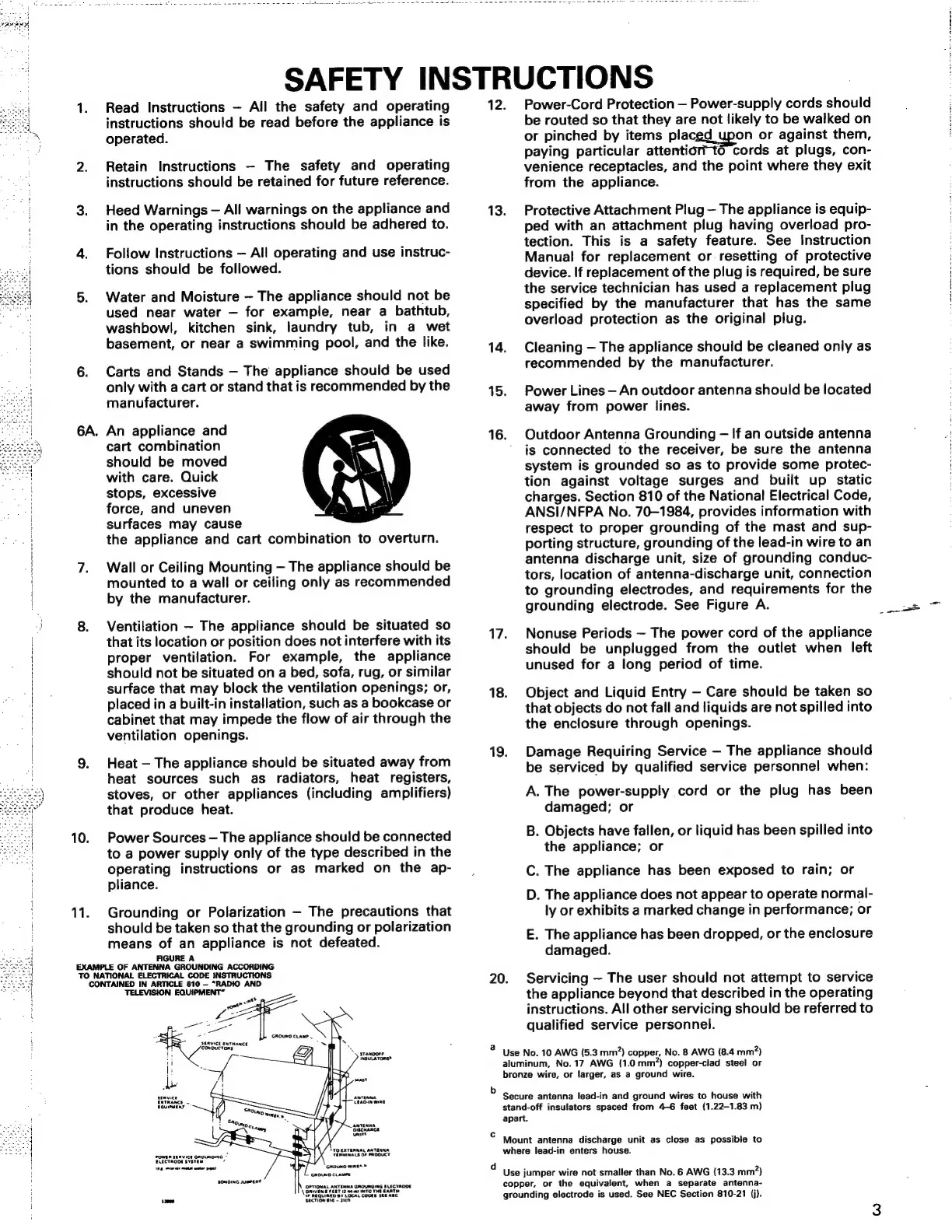
Figure
A.
Nonuse
Periods
The
power
cord
of
the
appliance
should
be
unplugged
from
the
outlet
when
left
unused
for
a
long
period
of
time.
Object
and
Liquid
Entry
Care
should
be
taken
so
that
objects
do
not
fall
and
liquids
are
not
spilled
into
the
enclosure
through
openings.
Damage
Requiring
Service
The
appliance
should
be
serviced
by
qualified
service
personnel
when:
A.
The
power-supply
cord
or
the
plug
has
been
damaged;
or
B.
Objects
have
fallen,
or
liquid
has
been
spilled
into
the
appliance;
or
C.
The
appliance
has
been
exposed
to
rain;
or
D.
The
appliance
does
not
appear
to
operate
normal-
ly
or
exhibits
a
marked
change
in
performance;
or
E.
The
appliance
has
been
dropped,
or
the
enclosure
damaged.
Servicing
The
user
should
not
attempt
to
service
the
appliance
beyond
that
described
in
the
operating
instructions.
All
other
servicing
should
be
referred
to
qualified
service
personnel.
Use
No.
10
AWG
(5.3
mm?)
copper,
No.
8
AWG
(8.4
mm?}
aluminum,
No.
17
AWG
(1.0mm?)
copper-clad
steel
or
bronze
wire,
or
larger,
as
a
ground
wire.
Secure
antenna
lead-in
and
ground
wires
to
house
with
stand-off
insulators
spaced
from
4-6
feet
(1.22-1.83
m)
apart.
Mount
antenna
discharge
unit
as
close
as
possible
to
where
lead-in
enters
house.
Use
jumper
wire
not
smaller
than
No.
6
AWG
(13.3
mm?)
copper,
or
the
equivalent,
when
a2
separate
antenna-
grounding
electrode
is
used.
See
NEC
Section
810-21
(j).
i
i
i
t
:

Related product manuals