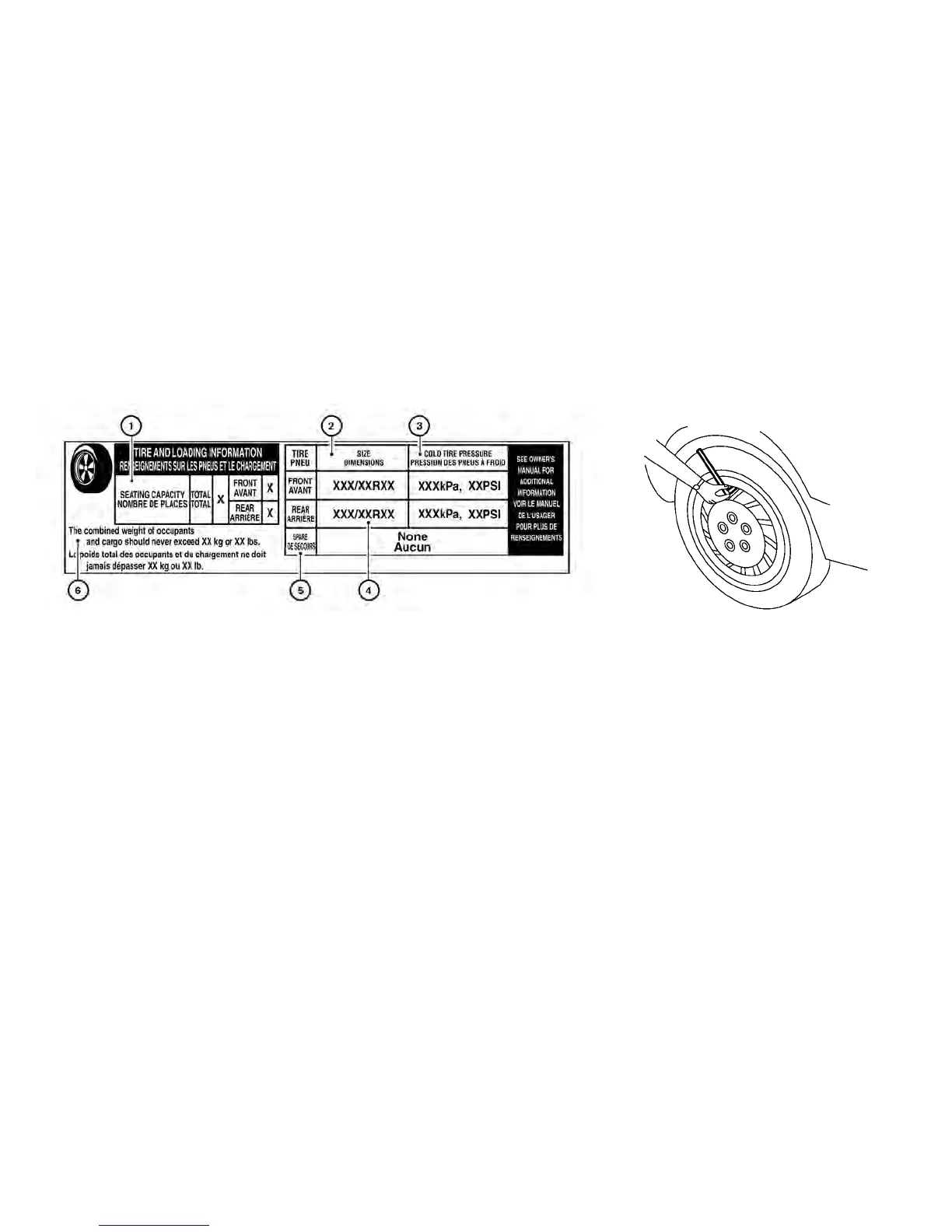
Tire and loading information label
䊊
1
Seating capacity: The maximum
number of occupants that can be
seated in the vehicle.
䊊
2
Original size: The size of the tires
originally installed on the vehicle at
the factory.
䊊
3
Cold tire pressure: Inflate the tires to
this pressure when the tires are
cold. Tires are considered COLD
after the vehicle has been parked for
3 or more hours, or driven less than
1 mile (1.6 km) at moderate speeds.
The recommended cold tire inflation
is set by the manufacturer to provide
the best balance of tire wear, vehicle
handling, driveability, tire noise, etc.,
up to the vehicle’s GVWR.
䊊
4
Tire size — refer to “Tire labeling” in
this section.
䊊
5
Spare tire size or compact spare tire
size (if so equipped)
䊊
6
Vehicle load limit: For additional infor-
mation, refer to “Vehicle loading infor-
mation” in the “Technical and consumer
information” section of this manual.
Checking tire pressure
1. Remove the valve stem cap from the
tire.
2. Press the pressure gauge securely
onto the valve stem. Do not press too
hard or force the valve stem sideways,
otherwise air will escape. If the hissing
sound of air escaping from the tire is
heard while checking the pressure, re-
position the gauge to eliminate this
leakage.
3. Remove the gauge.
Maintenance and do-it yourself 8-29



 To Next Page