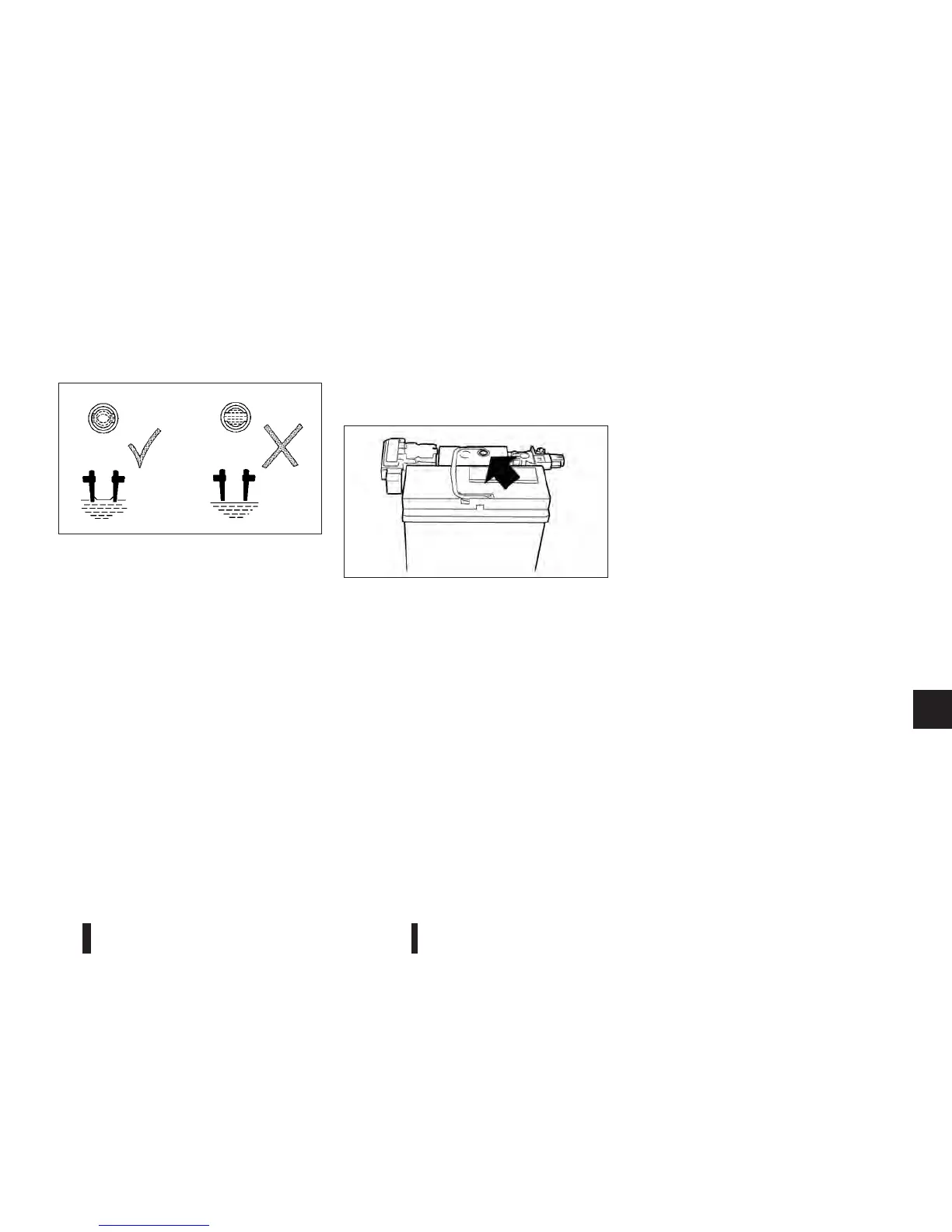
2. Add distilled water up to the UPPER level line
j1.
If the side of the battery is not clear, check the
electrolyte water level by looking directly above
the cell, as illustrated.
3. Tighten cell plugs.
CAUTION
Do not overfill battery cells. Excessive electrolyte
may leak out of the battery during charging, and
cause paint damage.
•
Vehicles operated in high temperatures or under
severe conditions require frequent checks of the
battery fluid level.
•
Keep the battery surface clean and dry. Clean
the battery with a solution of baking soda and
water.
•
Make certain the terminal connections are clean
and securely tightened.
•
If the vehicle is not to be used for more than 30
days, disconnect the negative (-) battery terminal
cable to prevent battery discharge.
Maintenance free battery (Type B)
For a maintenance free battery it is not required to
check the fluid level. However, NISSAN recom-
mends to visually check the green indicator status
periodically. If it is not visible, replace the battery as
soon as possible.
Jump starting
If jump starting is necessary, see “Jump starting” in
the “6. In case of emergency” section. If the engine
does not start by jump starting or the battery does
not charge, the battery may have to be replaced.
Contact a NISSAN dealer or qualified workshop for
replacing the battery.
INTELLIGENT KEY BATTERY
Battery replacement
CAUTION
•
Be careful not to allow children to swallow the
battery and removed parts.
•
An improperly disposed battery can harm the
environment. Always confirm local regulations
for battery disposal.
•
When changing batteries, do not let dust or oil
get on the components.
•
There is danger of explosion if lithium battery
is incorrectly replaced. Replace only with the
same or equivalent type.
SDI1480Z
Indicator
NDI1374
Maintenance and do-it-yourself 8-21



 To Next Page