FUEL RECOMMENDATION
Petrol engine models
CAUTION
Do not use leaded petrol. Using leaded petrol will
damage the three-way catalyst.
Use UNLEADED PREMIUM petrol of at least 95
octane (RON).
Diesel engine models
Diesel fuel above 50 cetane and with less than
10 ppm of sulphur (EN590) must be used.
If two types of diesel fuel are available, use summer
or winter fuel properly according to the following
temperature conditions.
•
Above –7°C (20°F)...Summer type diesel fuel.
•
Below –7°C (20°F)...Winter type diesel fuel.
If you are in any doubt, please consult a NISSAN
dealer or qualified workshop.
CAUTION
•
Do not use home heating oil, petrol or other
alternate fuels in the diesel engine, this can
cause engine damage.
•
Do not add petrol or other alternate fuels to
diesel fuel.
•
Do not use summer fuel at temperatures be-
low –7°C (20°F). The cold temperatures will
cause wax to form in the fuel. As a result, it
may prevent the engine from running
smoothly.
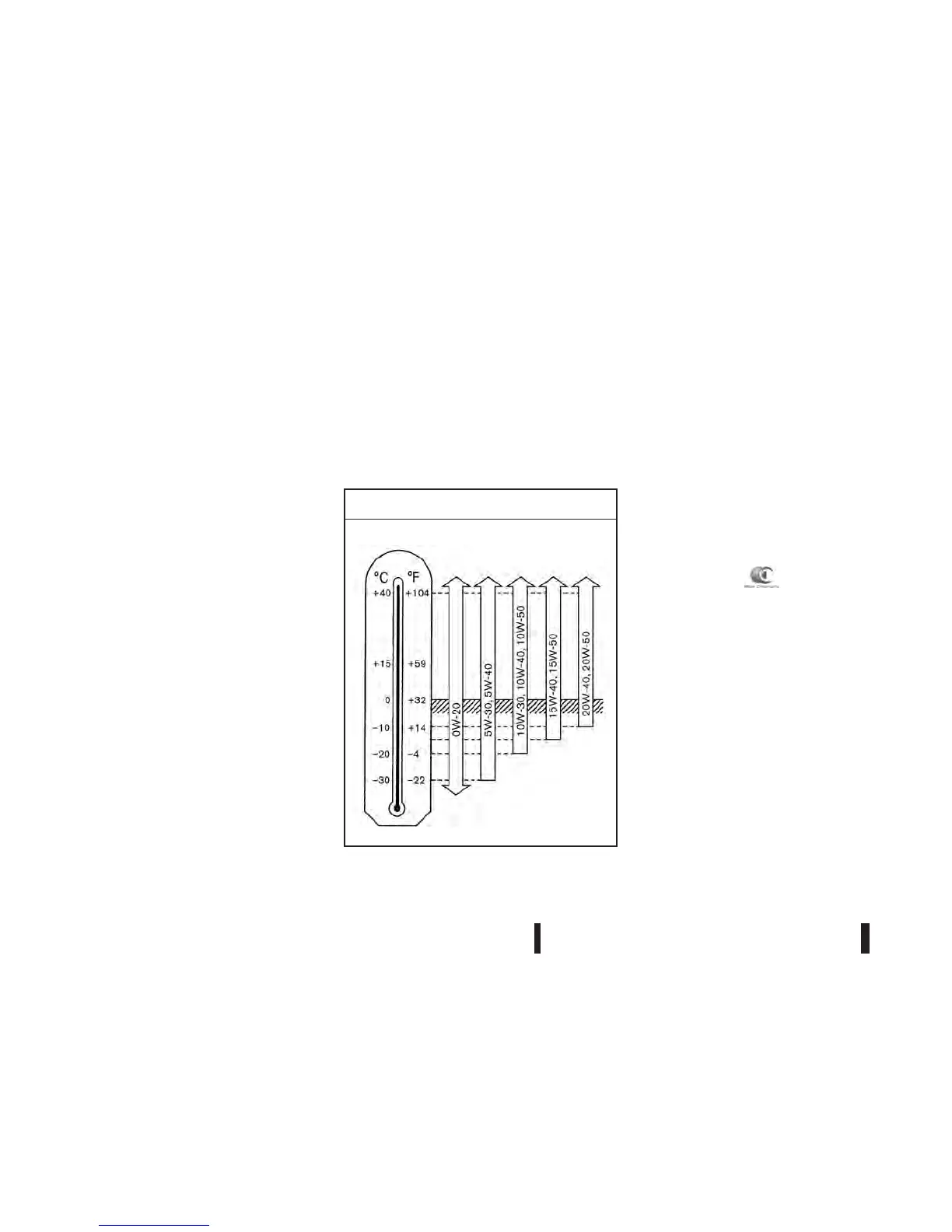
RECOMMENDED SAE VISCOSITY
NUMBER
Petrol engine oil
Outside Temperature Range
Anticipated Before Next Oil Change
PETROL ENGINE OIL
m
STI0732
0W-20 is preferable.
If 0W-20 is not available, select the viscosity, from
the chart, that is suitable for the outside tem-
perature range.
AIR CONDITIONER SYSTEM
REFRIGERANT AND LUBRICANT
The air conditioner system of your vehicle must be
charged with the refrigerant R1234yf and the lubri-
cant NISSAN A/C System Oil or equivalents. Use
of any other refrigerants or lubricants will cause se-
vere damage, and you may need to replace your
vehicle’s entire air conditioner system.
The release of refrigerants into the atmosphere is
prohibited in many countries and regions. The re-
frigerant R1234yf in your vehicle will not harm the
Earth’s ozone layer. However, it may contribute in a
small part to the global warming effect. NISSAN
recommends that the refrigerant be appropriately
recovered and recycled. Contact a NISSAN dealer
or qualified workshop when servicing the air condi-
tioner system.
9-4 Technical information



 To Next Page