•
Position the lap belt as low and snug as pos-
sible around the hips, not the waist. A lap belt
worn too high could increase the risk of inter-
nal injuries in an accident.
•
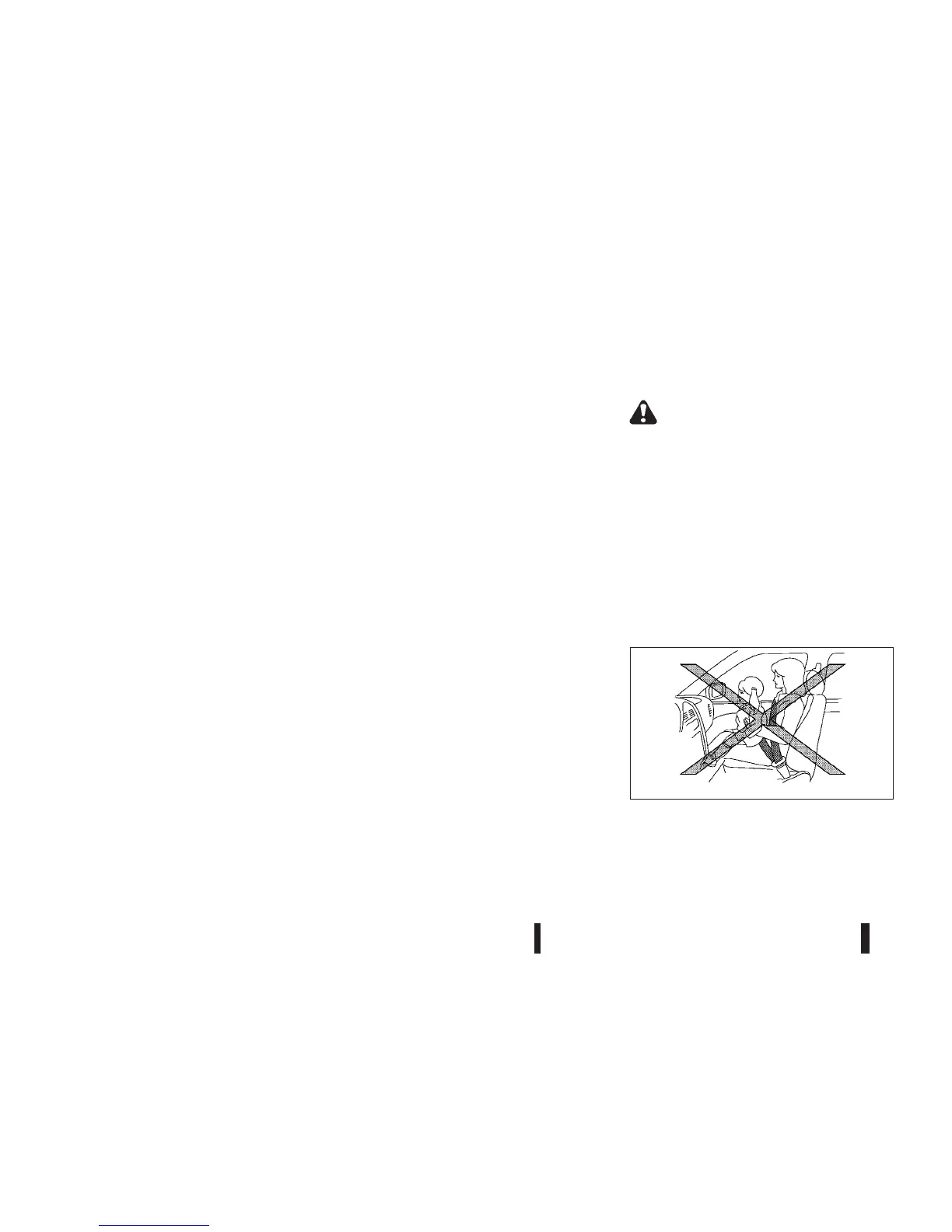
Do not allow more than one person to use the
same seat belt. Each belt assembly must only
be used by one occupant; it is dangerous to
put a belt around a child being carried on the
occupant’s lap.
•
Never carry more people in the vehicle than
there are seat belts.
•
Never wear seat belts inside out. Belts should
not be worn with straps twisted. Doing so may
reduce their effectiveness.
•
Seat belts should be adjusted as firmly as
possible, consistent with comfort, to provide
the protection for which they have been de-
signed. A slack belt will greatly reduce the
protection afforded to the wearer.
•
Every person who drives or rides in this ve-
hicle should use a seat belt at all times. Chil-
dren should be properly restrained in the rear
seat and, if appropriate, in a child restraint
system.
•
Do not run the belt behind your back or under
your arm. Always route the shoulder belt over
your shoulder and across your chest. The belt
should be away from your face and neck, but
not falling off your shoulder. Serious injury
may occur if a seat belt is not worn properly.
•
No modifications or additions should be made
by the user which will either prevent the seat
belt adjusting devices from operating to re-
move slack, or prevent the seat belt assembly
from being adjusted to remove slack.
•
Care should be taken to avoid contamination
of the webbing with polishes, oils and chemi-
cals, and particularly battery acid. Cleaning
may safely be carried out using mild soap and
water. The belt should be replaced if webbing
becomes frayed, contaminated or damaged.
•
All seat belt assemblies including retractors
and attaching hardware should be inspected
after any collision by a NISSAN dealer or quali-
fied workshop. NISSAN recommends that all
seat belt assemblies in use during a collision
be replaced unless the collision was minor
and the belts show no damage and continue
to operate properly. Seat belt assemblies not
in use during a collision should also be in-
spected and, when necessary, replaced if ei-
ther damage or improper operation is noted.
•
It is essential to replace the entire assembly
after it has been worn in a severe impact even
if damage to the assembly is not obvious.
•
Once the pre-tensioner seat belt has acti-
vated, it cannot be reused. It must be replaced
together with the retractor. Contact a NISSAN
dealer or qualified workshop.
•
Removal and installation of the pre-tensioner
seat belt system components should be done
by a NISSAN dealer or qualified workshop.
CHILD SAFETY
WARNING
•
Infants and children need special protection.
The vehicle’s seat belts may not fit them prop-
erly. The shoulder belt may come too close to
the face or neck. The lap belt may not fit over
their small hipbones. In an accident, an im-
properly fitted seat belt could cause serious
or fatal injury.
•
Always use an appropriate child restraint sys-
tem.
Children need adults to help protect them. They
need to be properly restrained. The proper restraint
depends on the child’s size.
Infants and small children
NISSAN recommends that infants and small chil-
dren be seated in a child restraint system. You
should choose a child restraint system that fits your
SSS0099Z
1-8 Safety — seats, seat belts and supplemental restraint system


 To Next Page
 Loading...