EasyManua.ls Logo

Nogueira VFN 5000 - User Manual

Nogueira VFN 5000
60 pages
Print Icon
To Next Page IconTo Next Page
Loading...
Forage Wagon - Vagónes Forrajeros
VFN 5000 / 8000 / 10000
Question and Answer IconNeed help?

Do you have a question about the Nogueira VFN 5000 and is the answer not in the manual?

Overview

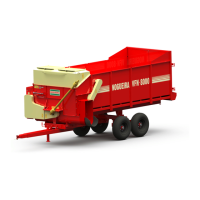
The Nogueira Forage Wagon is designed for transporting and automatically unloading silage or daily animal feed directly into a feeding trough. It can also be equipped with the Nogueira Dispenser, which adds concentrated animal feed and other additives to provide a homogeneous and highly nutritious mixture for livestock.

Technical Specifications:

The forage wagon is available in three models: VFN 5000, VFN 8000, and VFN 10000, differing primarily in load capacity and weight.

  • Minimum power for actuation: All models require a minimum of 55 HP from the tractor's power take-off.
  • Load capacity:
    • VFN 5000: 5 m³
    • VFN 8000: 8 m³
    • VFN 10000: 10 m³
  • Dispenser load capacity: Both VFN 5000 and VFN 8000 models have a dispenser load capacity of 650 liters. The VFN 10000 model does not list a dispenser capacity, suggesting it might not be equipped with one or it's an optional feature.
  • Power take-off rotation: All models operate at 540 RPM.
  • Unloading time (rear/side):
    • VFN 5000: 2.5 minutes
    • VFN 8000: 4 minutes
    • VFN 10000: 4 minutes
  • Unloading height:
    • VFN 5000: 650 to 900 mm
    • VFN 8000: 700 mm
    • VFN 10000: 700 mm
  • Weight (with dispenser):
    • VFN 5000: 1,550 kg
    • VFN 8000: 2,060 kg
    • VFN 10000: Not specified, likely without a dispenser.
  • Weight (without dispenser):
    • VFN 5000: 1,460 kg
    • VFN 8000: 1,980 kg
    • VFN 10000: 2,050 kg
  • Maximum tire pressure: All models recommend 55 lbs/in² (3.8 kg/cm²).
  • Dimensions:
    • Total length: 5,900 mm (VFN 5000), 6,700 mm (VFN 8000 & VFN 10000)
    • Length (wagon): 4,200 mm (VFN 5000), 5,100 mm (VFN 8000 & VFN 10000)
    • Total width: 2,400 to 2,500 mm (all models)
    • Height: 2,600 mm (all models)
  • Tires: All models use 10.5 x 15 x 8 tires.

Usage Features:

  • Coupling: The forage wagon must be coupled to the tractor's tow hitch. It can also be used directly with a Nogueira Forage Harvester. The jack is used to adjust the height of the tow hitch, which should be retracted after coupling. Wagons with two axles are not equipped with a jack.
  • Driveshaft: Before operation, the driveshaft length must be verified for adequacy with the tractor. If too long or short, the tractor's tow bar can be adjusted. If cutting is necessary, equal pieces should be removed from the tube and bar, and the plastic cover shield. A minimum play of 50 mm on both ends of the driveshaft is crucial to prevent damage during turns. The driveshaft must always be assembled with aligned ends and safety chains fastened. The articulation angle should not exceed 15 degrees during operation, and the power take-off should be disconnected when turning the coupled machine.
  • Unloading Options:
    • Side Unloader (Pre-dried conveyor belt): To activate, remove pin A, pull the knob to the "SIDE UNLOADER" position, replace the pin, open the front shield B, place the pin in sprocket C, latch it, and close the shield.
    • Side Unloader (Helix transporter): Similar to the pre-dried belt, remove pin A, pull the knob to "SIDE UNLOADER" position, and replace the pin.
    • Rear Unloader (Pre-dried conveyor belt): Completely open the two rear doors. Remove pin A, push the knob to "REAR UNLOADER" position, replace the pin, open the front shield B, remove the pin from sprocket D, and close the shield.
    • Rear Unloader (Helix transporter): Completely open the two rear doors. Remove pin A, push the knob to "Rear unloader" position, replace the pin, open the side shield C, remove double chain D, and close the shield. Removing the double chain stops the helix transporter and decompactors.
  • Dispenser (Optional): The dispenser automatically adds feeds and additives to forage. It has two top covers for loading and an opening at the bottom for mixing with forage. The flow is controlled by a valve and a dispenser scale on the front cover. To adjust the flow, connect hydraulic hoses to the tractor, activate the hydraulic control valve, and observe the pointer on the scale. A practical test for checking flow involves setting the dispenser to position 5, allowing product to flow for 10 seconds to fill the chute, then collecting and weighing the product discharged over 1 minute. The wagon must be empty for this test.
  • Safety System: The wagon is equipped with a safety screw that breaks in case of overload, stopping operation. To replace it, turn off the tractor, remove the ignition key, eliminate the cause of overload, open the front safety shield A, remove the broken screw, and install a new safety screw B. Only original M8 x 35 steel 8.8 hex screws with M8 steel 8.8 hex nuts (self-tapping) should be used.

Maintenance Features:

  • General Maintenance: Keep the wagon free of material remnants, lubricated, and the unloader conveyor belt properly stretched.
  • Long Stoppages: Wash the wagon completely, lubricate it, and store it in a protected place from sun and rain.
  • Conveyor Belt Adjustment:
    • Rear Conveyor Belt: Tighten stretcher screws C alternatively on each side until appropriate play is achieved. If the screw reaches its limit, remove one or two links from the chains. Ensure screws are tightened equally to keep decompactor rollers aligned.
    • Side Conveyor Belt (Pre-dried): Loosen nuts D on both ends of the axle. Loosen nut E and tighten nut F on the stretcher screws on both sides alternatively until appropriate stretching is achieved. Retighten nuts E and F.
  • Lubrication:
    • Transmission Gearboxes A and B: Use 150/CLP oil. First change after 50 operating hours, routine changes every 200 operating hours. Gearbox A capacity is 0.5 liter, Gearbox B is 1.0 liter.
    • Actuation Chains: Keep clean by washing with kerosene or diesel oil, then drying with compressed air or naturally. Apply a light layer of special chain oil (e.g., MAXLUB ND-03 Bardahl) or sprayed grease. Do not use common grease.
    • Driveshaft (Power Take-off): Lubricate cross pieces and bars with grease every 8 operating hours.
    • Other Lubrication Points: Wheel bearings, transmission driveshaft C, tandem articulations, rear conveyor belt wheels, and other grease fittings should be lubricated with lithium-based grease (NLGI 2 EP classification, e.g., LUBRAX LITH-2) every 8 operating hours.

Safety Recommendations:

  • Always read the instruction manual before operating.
  • Never operate the machine under the influence of alcohol or medications.
  • Disconnect the power take-off, turn off the tractor engine, and remove the ignition key before any adjustment, lubrication, or maintenance.
  • Ensure no tools or objects are on or inside the wagon before starting.
  • Keep animals and spectators, especially children, at a safe distance.
  • Dress appropriately: tie back long hair, avoid loose clothing, rings, chains, or other items that could get caught in moving parts.
  • Wear personal protective equipment (PPE), including hearing protectors and safety glasses.
  • Never clean or remove product scraps while the machine is on.
  • Keep hands, feet, and body parts away from moving conveyor belts, rollers, and helix transporters.
  • Stay outside the unloading area during operation.
  • Do not touch chains or gears when the machine is on.
  • Maintain legible safety adhesive labels and replace them as needed.
  • Never operate without all safety shields and protections installed.
  • It is prohibited to stand on the tow hitch, feed mixer, or inside the wagon during operation or transport.
  • Never attempt to clean or unblock the unloader helix transporter or conveyor belt when the machine is on.
  • Do not remove safety shields while the machine is on.
  • Be aware that components continue moving due to inertia after the machine is turned off; ensure complete stillness before touching.
  • If working on a hydraulically suspended machine, use additional supports. Never brace on cement blocks or hollow bricks.
  • Examine the work area for hazards and mark dangerous spots.
  • Turn off the machine immediately if any abnormality (vibrations, unusual noises) occurs.
  • Never operate the driveshaft without its safety shielding.
  • Do not operate in closed, unventilated environments due to toxic tractor exhaust gases.
  • Ensure the tractor is always maneuverable with front counterweights for ground contact.
  • Be careful when coupling/uncoupling; ensure the coupling pin is latched with a cotter pin.
  • Drive carefully and slowly when towing a loaded machine.
  • Exercise caution on sloped terrains; reduce acceleration if imbalance is noted. Keep the tractor engaged downhill.
  • Adhere to road regulations for load height when driving on public roads.
  • Never leave the tractor when the machine is on; stop the engine, disconnect power take-off, engage the parking brake, and remove the key.
  • Do not exceed the maximum load capacity.
  • Do not use the equipment for unauthorized applications or with non-original parts, as this can compromise safety and invalidate the guarantee.
  • Keep a first-aid kit accessible and know how to use it.

Nogueira VFN 5000 Specifications

General IconGeneral
BrandNogueira
ModelVFN 5000
CategoryFarm Equipment
LanguageEnglish

Related product manuals