Need help?
Do you have a question about the North Star M2681781B and is the answer not in the manual?
Defines safety alert symbols like DANGER, WARNING, and CAUTION for potential hazards.
Details on using the sprayer for agricultural pesticides in liquid form only.
Guidance on using the sprayer for non-flammable liquids and recommended precautions.
Key safety precautions to follow during the assembly process.
Essential safety guidelines for handling chemicals, including PPE and ventilation.
Safety measures for preparing and executing chemical spraying operations.
Critical safety rules to observe while actively spraying chemicals.
Guidance on cleaning the sprayer and decontaminating oneself after use.
Safe procedures for transporting the sprayer attached to a vehicle.
Immediate actions to take if the sprayer develops a leak.
First aid and medical advice procedures for chemical exposure on skin or eyes.
Steps to follow for poisoning by ingestion or inhalation, including emergency calls.
Procedures for containing and cleaning chemical spills, including seeking advice.
Locates and describes the crucial warning labels on the sprayer.
Instructions for ordering and replacing damaged or missing safety labels.
Guidance on checking for damaged or missing components upon delivery.
Lists and illustrates all hardware and small parts included in the manual bag.
Detailed instructions for attaching the sprayer legs to the frame.
Procedure for fastening the lance clips to the sprayer frame.
Step-by-step guide for attaching the gun hose to the pump.
Instructions for routing the hose and installing the hose guide and hooks.
Procedure for attaching the gun hose to the spray gun assembly.
Steps for assembling the broadcast nozzle with filter and coupler.
Detailed instructions for securely attaching the sprayer to a tractor's 3-point hitch.
Safety and step-by-step guide for connecting the remote switch to the vehicle battery.
Procedure for connecting the remote switch to the sprayer pump power cord.
Methods to verify the correct and complete connection of electrical components.
Instructions for safely disconnecting the remote switch from the battery and pump.
Steps to ensure the sprayer is properly assembled and leak-free using water.
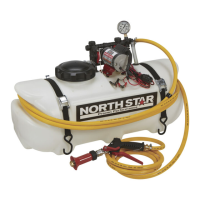
Identifies and describes essential parts like the tank, pump, frame, and controls.
Description of the spray gun, broadcast nozzle, and their operational controls.
Explanation of the tank shut off valve, broadcast nozzle shut off valve, and inline filter.
Emphasizes reading and following all chemical label instructions.
Mandatory PPE requirements for handling and spraying chemicals.
Ensuring proper ventilation and checking chemical compatibility with sprayer components.
Essential checks before spraying, including wind speed and area clearing.
Guidelines for safe practices while actively spraying chemicals.
Procedures for cleaning the sprayer and handling chemical disposal.
Critical safety instructions for driving with the sprayer attached to a tractor.
Immediate actions to take if the sprayer develops a leak during operation.
First aid for bodily contact and poisoning, including emergency contact information.
Detailed steps for containing, cleaning, and decontaminating chemical spill sites.
Steps to ensure the sprayer is securely attached and the tank is empty.
Procedure for cleaning the suction strainer to prevent clogs and contamination.
Checks for hoses, fittings, nuts, and bolts to ensure proper working condition.
Procedure for testing the sprayer for leaks with water after any repairs.
Determining suitable wind conditions and clearing the area before spraying.
Steps for safely filling the sprayer, including PPE and area selection.
Instructions for adding pesticides and water to the tank, including dilution ratios.
Guidance on mixing chemicals in the tank and securely replacing the fill cap.
Revisiting safety information related to chemical application and transport.
Procedure to open the valve allowing fluid flow from the tank to the pump.
Instructions for closing the broadcast nozzle shut off valve before spot spraying.
Steps to turn on the sprayer power and activate the pump.
How to squeeze the trigger and adjust the nozzle for desired spray pattern.
Opening the broadcast nozzle shut off valve to allow spraying.
Adjusting the broadcast nozzle for proper downward and even spray distribution.
How to begin spraying and ensure uniform coverage with proper overlap.
Procedures for safely leaving the sprayer unattended during use.
Instructions on when and how to stop use if the sprayer becomes clogged or inoperative.
Procedure for draining any remaining chemical from the sprayer tank.
Guidelines for safely storing or disposing of leftover pesticides.
Steps for flushing the sprayer with water and cleaning solution.
Procedures for decontaminating oneself and laundering contaminated clothing.
Instructions for preparing the sprayer for storage using RV antifreeze.
Steps for draining antifreeze, flushing, and properly disposing of storage fluid.
Essential safety precautions to take before performing any troubleshooting or service.
Common problems, their causes, and suggested solutions for sprayer issues.
Details on the electrical specifications, including voltage and amp draw.
Provides key performance metrics like GPM, pressure, capacity, and dimensions.
Lists the materials used for various sprayer components.
Diagram illustrating the sprayer's components and their assembly order.
Comprehensive list of all part numbers, descriptions, and quantities.
Detailed illustration and list of parts for the sprayer pump assembly.
Tables to help calibrate application rates based on chemical recommendations and speed.
Formulas for determining the correct vehicle speed for desired application rates.
Details warranty periods, coverage, and exclusions for NorthStar equipment.
Information required for filing a warranty claim, including customer details.
 General
| Brand | North Star |
|---|---|
| Model | M2681781B |
| Category | Paint Sprayer |
| Language | English |


 To Next Page