are required to declare whether or not the coal they are
exporting is liable to emit methane. However, owners and
masters should be aware that some shippers do not declare
their cargoes as liable to emit methane even where there have
been previous incidents involving the emission of methane.
The Code requires monitoring for methane in all circumstances
and anticipates a situation where methane concentrations
remain high. Guidance is provided in the IMSBC Code in relation
to the monitoring and ventilation procedures to be followed
and on the avoidance of creating sparks where methane is
being produced.
It is vitally important that vessels have on board gas detectors
suitable for use in oxygen-depleted atmospheres.
There have has been cases where catalytic-type gas detectors
have been used to test the atmosphere in an oxygen-depleted
hold. This type of instrument relies on the presence of oxygen
to test for methane and if used in an oxygen-depleted
atmosphere it will not give accurate readings.
The gas detector should be maintained and operated in
accordance with the manufacturer’s instructions which will
include regular calibration.
Liquefaction
A cargo which contains a certain proportion of small particles
(particles less than 7mm) and a certain amount of moisture
may liquefy, that is, reach a flow state under the influence of
external forces such as vibration, impaction or ship’s motions.
Prior to loading, the master should sight the cargo and ensure
that the cargo presented matches the description on the
shipper’s declaration. There have been occasions when coal
cargoes have been incorrectly declared as Group B when in fact
the cargo is Group A and B.
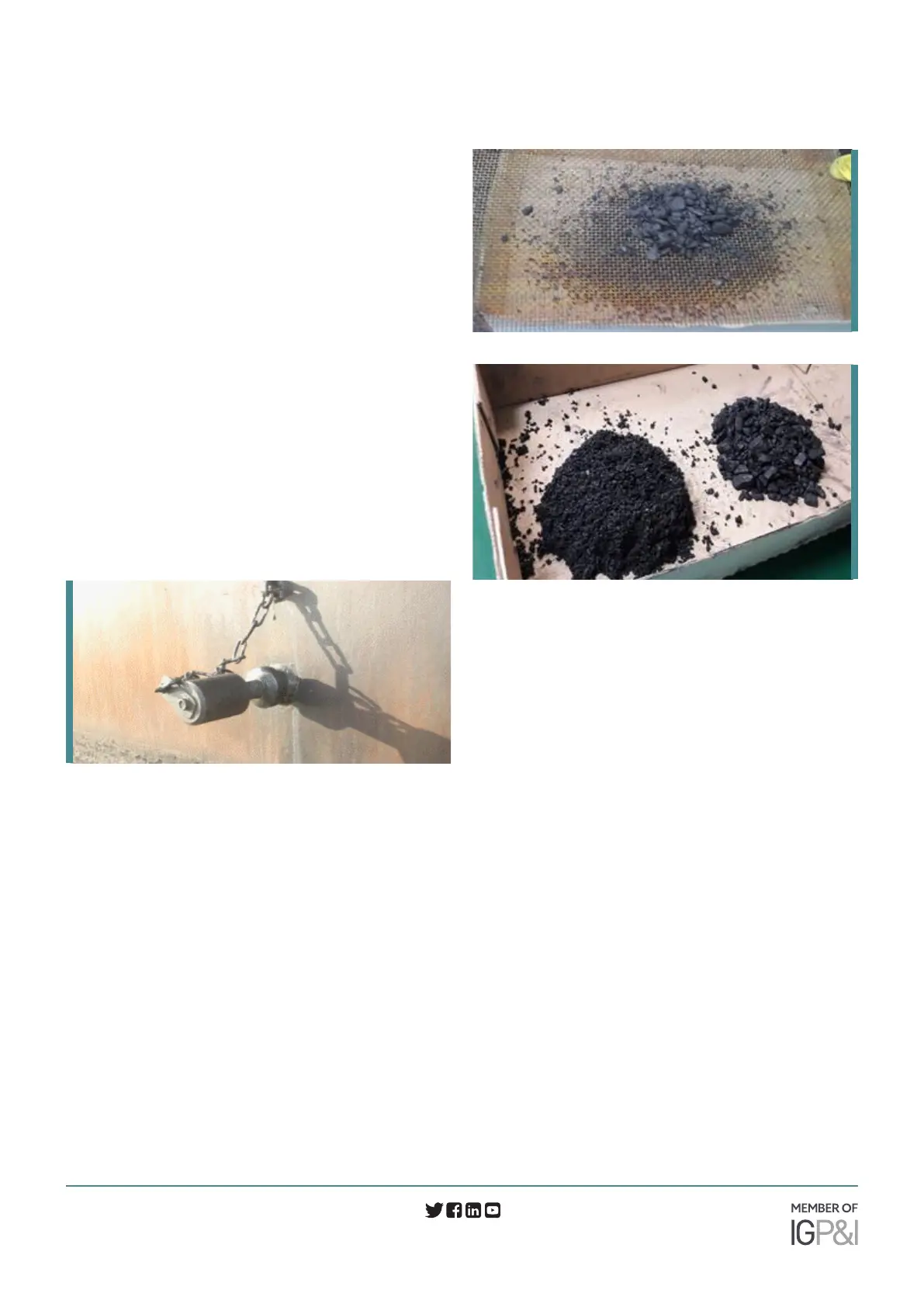
A simple method of testing the cargo for the presence of fine
particles is to use a sieve constructed of 7mm x 7mm wire
mesh to separate a sample of the cargo.
Once the sample has been separated the approximate
proportion of fine particles and lumps can be estimated as
shown in Figure 4.
The master can then perform a ‘can test’ of the fine particles to
check for the possibility of liquefaction.
The Can Test
Section 8 of the IMSBC code gives details of the can test
procedure which should be carried out by the crew. Can tests
should be performed with samples from different areas of the
cargo stockpile, particularly any groups of fine particles and
during the loading sequence. This is critical as even a layer of
cargo containing a high proportion of fine particles has the
ability to partially liquefy and de-stabilise the entire cargo in
that hold.
The results of can tests should be supported with photographic
evidence showing the outcome of the test. If the can test
results raise concerns, the master should request the
attendance of a cargo surveyor.
The master should not delegate testing for liquefaction to any
attending surveyor. They should perform the test themselves
with the assistance of a surveyor if necessary. There have been
cases where all the tests were performed solely by the
surveyor.
North’s can test training package can be downloaded here.
Visual Inspection
The master must be satisfied that the cargo is safe to load and
this can only be done by physically inspecting the cargo.
Carriage of Coal (cont.)
02 Cargo / Carriage of Coal
For more information, please visit www.nepia.com
Copyright © 2019 The North of England P&I Association Limited
Figure 2: Sampling point in hatch coaming
Figure 3: Separating fine particles and lumps of coal
Figure 4: Coal sample after separation approximately 60% fine particles and 40% lumps.


 To Next Page
 Loading...