Inspection is important as a coal cargo may appear to be dry as
seen in Figures 5 and 6.
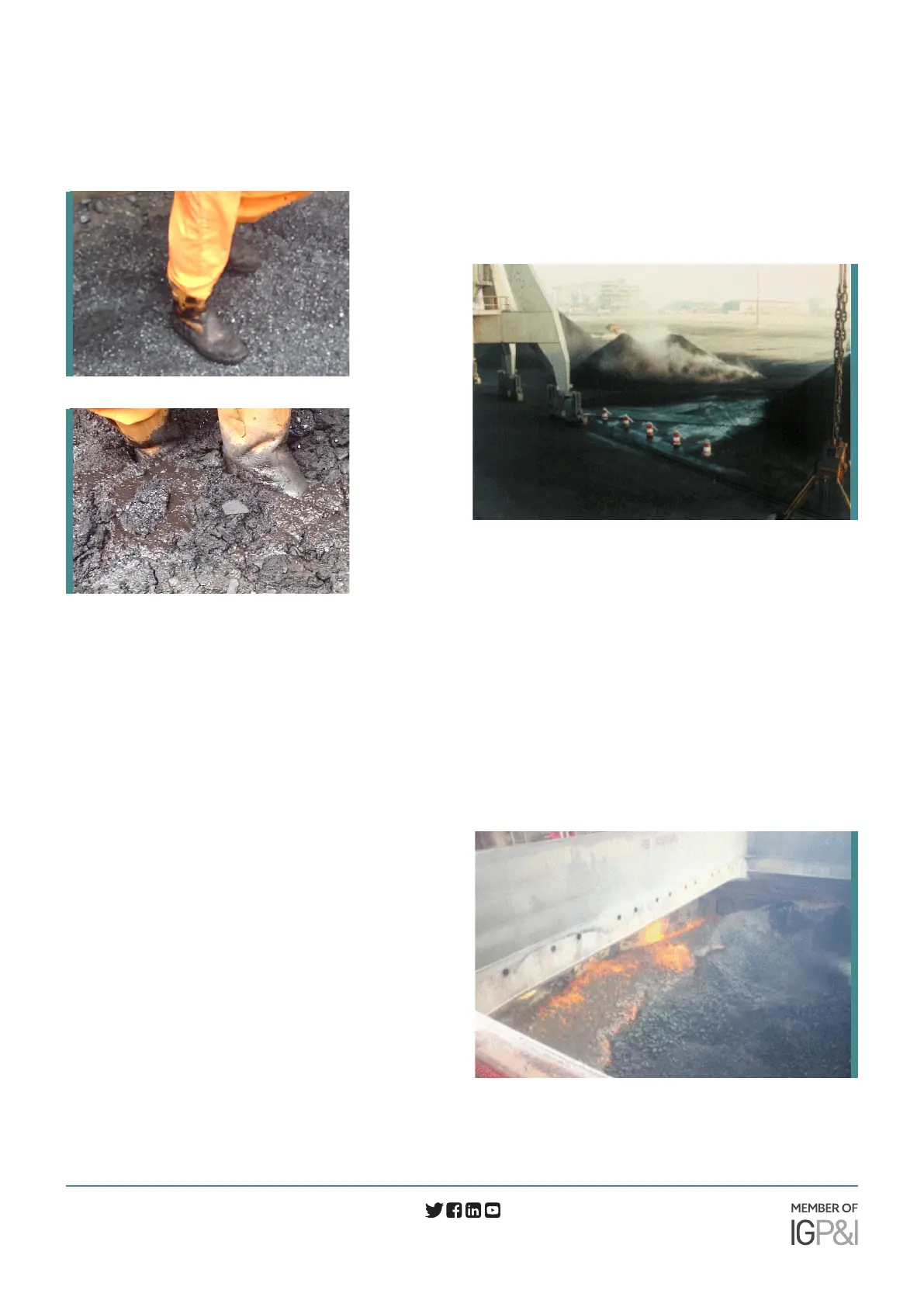
An initial inspection might suggest this cargo is dry. But a closer
inspection could prove that only the surface of the coal is dry.
There are clear signs of moisture underneath this crust. It is
very possible that the moisture content of is this cargo is above
its TML.
The crew must continue to monitor the cargo during loading
operations. Watch out for muddy splattering in the cargo holds
as this could be another indication that the cargo has a
combination of fine particles and high moisture content.
Asphyxiation
It is extremely dangerous to enter cargo holds or adjacent
spaces when carrying coal. The atmosphere may be
dangerous. Coal can produce methane, carbon dioxide and
carbon monoxide; all of which may lead to a depletion of
oxygen in the hold and result in asphyxiation.
Persons should not enter holds or adjacent spaces unless
absolutely necessary and not until they have been properly
ventilated and the atmosphere tested.
The IMSBC Code contains details on hold entry precautions to
be followed. North’s guidance on safe enclosed space entry
can be read here:
www.nepia.com/media/868999/Enclosed-Spaces-April-2016-
LP-Briefing.PDF
Self-heating
There may be many different types and grades of coal cargo,
some of which may be more liable to self-heating than others.
Shippers must declare whether or not the coal they are
exporting is liable to self-heat. Ship owners and masters should
be aware that some shippers do not declare their cargoes as
liable to self-heating or to produce methane even where there
have been previous incidents involving these problems from
the same source.
An indicator of self-heating is the level of carbon monoxide
produced in the hold. The IMSBC Code contains advice on the
monitoring of the carbon monoxide levels and the action to be
taken by the master is self-heating is suspected.
Another consideration is that coal emits methane, an
odourless, flammable gas, presenting a fire and explosion risk.
Monitoring coal cargoes for self-heating and emissions of
methane is vital. Careful monitoring allows for early action by
the vessel and can avoid serious problems.
The IMSBC Code contains advice on the monitoring that should
be done and the necessary equipment.
Firefighting, life-saving and smoke detection equipment must
be well maintained and tested at all times.
Carriage of Coal (cont.)
03 Cargo / Carriage of Coal
For more information, please visit www.nepia.com
Copyright © 2019 The North of England P&I Association Limited
Figure 5: Dry crust of coal cargo
Figure 6: Damp coal underneath a dry crust
Figure 7: Steam rising from heating coal
Figure 8: Coal on fire in a ship’s hold


 To Next Page
 Loading...