Teardrop Campers • nucamprv.com10 nucamprv.com • Teardrop Campers 11
GENERAL SAFETY
SAFETY CERTIFICATIONS
All nuCamp campers have been designed to conform with, or exceed,
the National Fire Protection Association (NFPA) 1192 standard, American
National Standards Institute (ANSI) 1192 standards, Canadian Standards
Association (CSA) Z-240 standard (for Canadian units), and ap¬plicable
federal motor vehicle standards. These standards establish the
requirements for electrical, plumb¬ing, fuel systems and equipment, re
and life safety provisions and other requirements for quality and safety.
The Recreational Vehicle Industry Association (RVIA) and the Canadian
Rec¬reational Vehicle Industry Association (CRVIA) routinely check
nuCamp product lines to ensure compliance with the above agencies and
organizations. RVIA considers nuCamp an active member in good standing
and compliance. At nuCamp our design team and Quality Standards
department take all RVIA standards into consideration when designing
new models and camper upgrades to ensure consumer safety.
SAFETY MESSAGES
Throughout your travel trailer you will nd many labels and data plates to
aid you in efcient, safe operation and servicing instructions. Tour your
trailer to read and understand these messages before operating for the
rst time. If any label or data plate has been removed, damaged, defaced
or painted over, replace it immediately. Following is a description of the
meaning of each different type of label conveying a safety message:
SAFETY ALERT SYMBOL
Recognize this symbol as an alert to important safety information
or a hazardous situation that can cause property damage, minor
or serious injury and in extreme cases, death to you or others.
Always read instructions included with this symbol.
FIRE SAFETY
These common causes are related to re safety hazards and should be
avoided at all costs:
• Smoking in bed
• Leaving children unattended
• Using ammable cleaning uids
• Leaving food unattended while cooking or baking
• Having faulty wiring
• Using damaged electrical devices
• Having propane or gasoline fuel leaks
• Being careless
In a re emergency:
• Evacuate the camper immediately. Safe escape is the most
importantpartofareemergency.
• Execute the Fire Safety Plan you developed. Refer to the GETTING
STARTED section of this manual.
• Understand the type of re you are dealing with. Using water in a
grease re may spread the re while using water for an electrical re
may result in electrocution.
• Call 911 from a safe distance away, regardless of the re size.
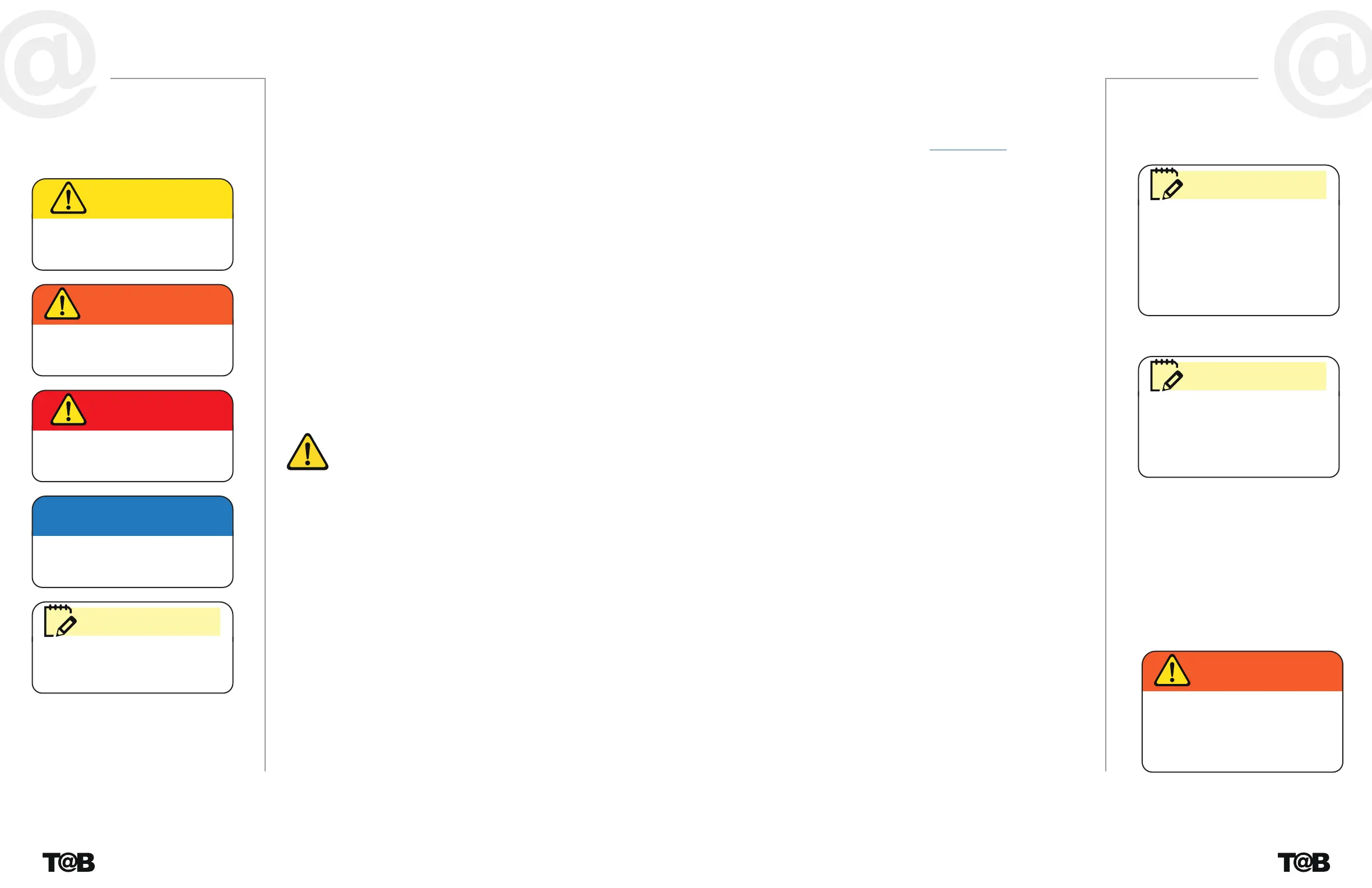
A potentially hazardous situation that
can result in moderate injury and/or
property damage.
A potentially hazardous situation that
can result in death, serious injury and/or
property damage.
A potentially hazardous situation that,
if not avoided, will result in death or
serious injury.
Attention is called to the observation
of a specic procedure to maintain a
specic condition.
The note symbol is to give you extra
information or a tip on the subject
presented.
SAFETY LABEL DESCRIPTIONS
Cultivate these safety habits in recreation to minimize re safety
hazards:
• Teach all occupants Fire Safety Practices. Consult your
local Fire Department and the NFPA (www.nfpa.org) for
more information.
• DO NOT leave a burning re of any kind unattended.
• Supervise children at all times around campres, grills and stove-
tops where there is open ame.
• Maintain a minimum three-foot area around campres, grills, and
tents are free of dry grass, leaves, pine needles, wood, bushes,
trees, or combustible materials.
• Be ready in advance to quickly and completely extinguish any type
of re at all times.
• Teach everyone how to use the P.A.S.S. method with a re extinguisher.
• DO NOT store ammable materials in closed areas or by a heat source
.
• When refueling motor vehicles rst turn off all pilot lights and
appliances in your camper.
FIRE EXTINGUISHER
A re extinguisher is located on or near the door of your camper. Read all
user instructions on the re extinguisher in its user manual, found in your
Owners Packet. The extinguisher is designed for Class B (ammable liquid,
oil, or grease) and Class C (energized electrical) res as these are the most
common in recreational vehicles.
After all occupants are evacuated from the camper and before you use the
extinguisher in a re emergency, determine the cause and severity of the re.
• If the re is large or fueled by an oil product or other ammable
liquid, stay clear of the camper and let the re department handle it.
• If the re is very small and can be managed, use the re
extinguisher.
• Keep your back to the door so you can evacuate quickly if the re
gets out of hand or the room is too full of smoke.
• Remember that any oxygen supplied to a re may further fuel it.
When operating a re extinguisher, remember the acronym P.A.S.S.
P-ull the pin. Point the nozzle away from you.
A-im the nozzle at the base of the re.
S-queeze the lever gently and slowly.
S-weep the nozzle from side to side to extinguish the re.
EMERGENCY EXIT
The Emergency Exit Window in all nuCamp campers is recognized by the
“EXIT” label and its red handles. This exit serves as a secondary means of
escape if the main entry/exit door gets blocked during an emergency. The
EXIT window is made of the same acrylic material and operates the same
as all other windows in the camper.
Practice the following:
• Teach all occupants how to operate the EXIT window before
an emergency.
• In the Family Safety Plan decide in what order occupants will exit
the camper in an emergency.
While many things can be construed as
safety related, the most important is your
common sense. If you are careless with
matches, cigarettes, ammable material,
or any other hazardous material, we can
only hope you realize that potential for
accidents is greatly increased.
COMMON SENSE
Various safety and information labels
are attached to surfaces both inside
and outside your RV. These labels are
permanent and should not be removed
or relocated for any reason.
WARNING LABELS
GENERAL NOTES
Replace the re extinguisher
immediately after using it. Contact the
local re department for instructions on
disposing of your used, non-rellable,
dry chemical re extinguisher.


 To Next Page
 Loading...