12
13
component or accessory can result in
serious injury or death.
CAUTION: Changing the
components on your bike may void
the warranty. Refer to your warranty,
and check with your Authorised
Nukeproof Dealer before changing
the components on your bike.
2.G. MAXIMUM WEIGHT
2.G.1 Nukeproof bikes are designed and
tested to ISO 4210 / EN 15194 standards; our
bikes conform to the load tolerance of 120kg
which the standards require. If the user is over
this weight when kitted, we would recommend
regular inspection and maintenance to avoid
issues and expect wear and tear parts to be
replaced more often. Third party components
may have different load and weight standards,
any concerns with components weight limits
please consult with your Authorised Nukeproof
Dealer. We cannot guarantee the integrity of
the bike and its components if the user is over
120kg.
2.H. ELECTRIC BIKE
This section contains information about the
basic properties and components for E-Bike
customers. Please read any accompanying
manufacturer’s instructions for the components
and operation of your E-Bike. Please note your
E-Bike may have different components and
operation depending on model, any doubts or
concerns contact your Authorised Nukeproof
Dealer.
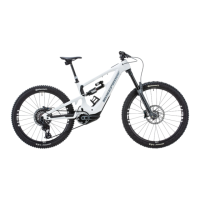
2.H.1. Differences between an E-Bike and
Bicycle
Compared to a pedal-operated bicycle, an
E-Bike will feature the following additional
components:
• Electric Assist Motor
• Battery
• Operating Control Unit
• Display
• Charger
The additional components of an E-Bike
translate into signicant differences between
an E-Bike and pedal-operated bicycle. Please
read Section 2 – Safety in full, and consider
the following when riding your E-Bike.
• An E-Bike is much heavier, and weight
is distributed differently, which will
change the E-Bikes handling. You
should familiarise yourself with the
bikes handling in a safe and trafc free
environment.
• The electric assist of an E-Bike will
inuence the braking behaviour,
please familiarise yourself with the
braking characteristics compared to a
regular bike. An E-Bike being heavier
can increase braking distances,
please ensure you are familiar with
the braking distances of your E-Bike in
different conditions and speeds.
• Increased breaking forces of a heavier
E-Bike may increase wear on brake
components, please ensure you
regularly have your brakes inspected
by a qualied mechanic or your
Authorised Authorised Nukeproof
Dealer.
• The electric motor assist will increase
the rider’s average speed. Adopt an
appropriate prudent riding style that
will ensure your safety and other trail
and road users safety considering the
higher average speed of an E-Bike.
• Only qualied mechanics with
accredited training can maintain and
repair an E-Bike electrical system.
Please take note of Section 5 -
Service, as your E-Bike will need to
be strictly maintained to ensure safety
and longevity.
• Modifying your E-Bike electrical motor/
system will void warranty and may
break local legislative laws.
2.H.3 Support While Riding
The electric motor only provides assistance
when you turn the pedals, the degree of
assistance is selected automatically in line
with:
• Your selected assistance
setting
• Your pedal force
• Load
• Speed
The electric motor only provides assistance
when you pedal up to the legislative speed
restriction in your country. If you reach a speed
higher than the limit the electric motor will
switch off automatically. If your speed drops
below the limit, the electric motor will switch on
again automatically.
2.H.4. Pushing/Walking Aid
Depending on the model of your E-Bike, it may
be installed with a pushing/walking aid. The
pushing/walking aid provides an assistance
when pushing your E-Bike. This function has
a speed limit which is dependent on local
legislation. The speed will also be affected by
the gear you have selected.
CAUTION: The cranks and pedals
will turn automatically when using the
pushing/walking aid, maintain a safe
distance from the pedals to ensure
you are not struck and to avoid injury.
2.H.5. Battery Safety
2.H.5.A. Handling the Battery
• Use the specied battery charger for
charging and observe the specied
charging conditions. Doing otherwise
may cause overheating, bursting, or
ignition.
• Do not leave the battery near sources
of heat such as heaters. Doing so may
cause bursting or ignition.
• Do not heat the battery or throw it into
a re. Doing so may cause bursting or
ignition.
• Do not deform, modify, disassemble,
or apply solder directly to the battery.
Doing so may cause leakage,
overheating, bursting, or ignition.
• Do not connect the terminals with
metallic objects. Doing so may cause
them to short circuit or overheat and
result in burns or injury.
• Do not carry or store the battery
together with metallic objects such as
necklaces or hairpins. Doing so may
cause them to short circuit or overheat
and result in burns or injury.
• Do not place the battery into fresh
water or sea water, and do not allow
the battery terminals to get wet. Doing
otherwise may cause it to overheat,
burst, or ignite.
• Do not throw or subject the battery
to strong shock. Doing so may cause
overheating, bursting, or ignition.
• Charge your battery in a visible
location within range of smoke/re
detectors.
• If your battery comes to the end of
its service life, please dispose in
accordance with your local regulations.
• Do not use a pressure washer on your
battery.
• In the unlikely event of a re, do not
use water, use an electrical certied
re extinguisher, or re blanket and
notify emergency services.
• Do not use outside of the operating
temperature range of the battery.
If the battery is used or stored in
temperatures which are outside
the following ranges, re, injury, or
problems with operation may occur.
• During discharge: -10°C - 50°C
• During charging: 0°C - 40°C
• Storage: 0°C - 35°C
2.H.5.B. Handling the Charger
• Do not allow the battery charger to
get wet. If it is wet or water is allowed
inside, it could cause a re, ignition,
overheating, or electric shock.
• Do not use it while it is wet, and do
not touch or hold it with wet hands. An


 To Next Page
 Loading...