EasyManua.ls Logo

OHM C2 - PLACING THE SPEAKERS IN YOUR LISTENING ROOM; Stereo Imaging and Speaker Placement; Bass Response and Room Boundaries; Subwoofer Placement Flexibility

Default Icon
9 pages
Print Icon
To Next Page IconTo Next Page
To Previous Page IconTo Previous Page
Loading...
Where
you
locate
the loud-
speakers
in
your
listening
room has a
considerable
influence how
the
speakers
will
sound, especially when
it
comes to
stereo
imaging
and
apparent
bass
response.
A
generally
accepted
rule
of
thumb for
obtaining a
satis-
fying
stereo effect
is
to
place
the
speakers about as far
apart
from
each other as they
are
from
you.
Placing
the
speakers
too
close
together
will
detract
from the
stereo effect,
while
having them
too far
apart
creates
an undesirable
"hole
in the middle"
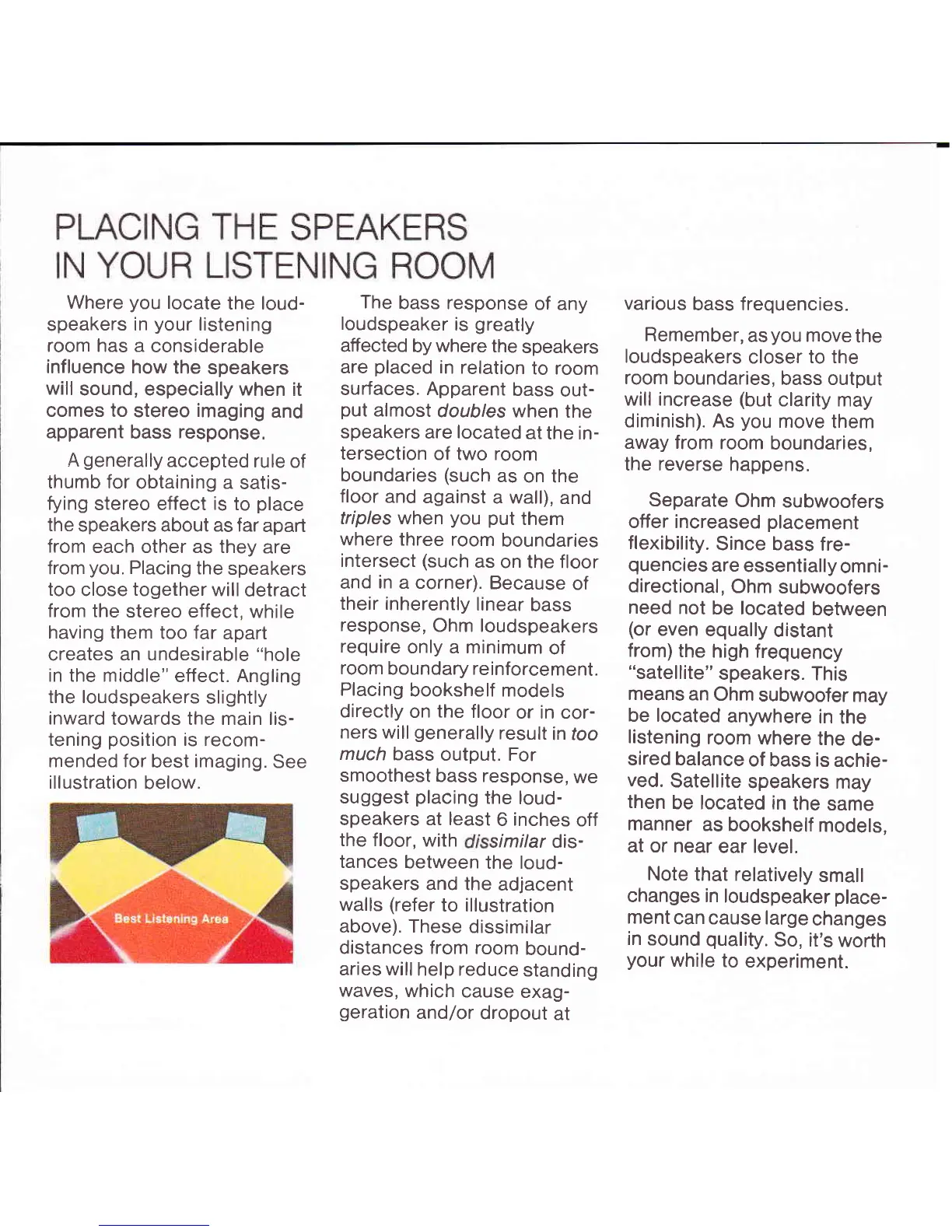
effect. Angling
the loudspeakers
slightly
inward
towards the main lis-
tening
position
is recom-
mended for
best
imaging.
See
illustration
below.
The
bass response
of any
loudspeaker
is
greatly
affected
by
where
the
speakers
are
placed
in
relation
to room
surfaces. Apparent
bass
out-
put
almost
doubles when
the
speakers
are
located
at
the in-
tersection
of two room
boundaries
(such
as
on the
floor
and
against
a wall),
and
triples when
you put
them
where three room
boundaries
intersect
(such
as
on the floor
and
in
a corner).
Because
of
their inherently
linear
bass
response,
Ohm loudspeakers
require
only a minimum
of
room
boundary reinforcement.
Placing
bookshelf models
directly
on
the
floor
or in cor-
ners will
generally
result
in too
much
bass
output. For
smoothest
bass response,
we
suggest
placing
the
loud-
speakers at least
6
inches
off
the floor,
with
simlar dis-
tances
between
the loud-
speakers
and the
adjacent
walls
(refer
to illustration
above). These
dissimilar
distances from room
bound-
aries will
help reduce
standing
waves,
which
cause
exag-
geration
and/or
dropout
at
various
bass frequencies.
Remember,
as
you
move
the
loudspeakers
closer
to the
room
boundaries,
bass output
will increase
(but
clarity may
diminish). As
you
move
them
away from
room
boundaries,
the reverse
happens.
Separate
Ohm
subwoofers
offer increased
placement
flexibility.
Since bass
fre-
quencies
are
essentially
omni-
directional,
Ohm
subwoofers
need
not
be located
between
(or
even
equally
distant
from)
the
high frequency
"satellite"
speakers.
This
means
an
Ohm
subwoofer
may
be located
anywhere
in
the
listening
room
where
the
de-
sired balance
of bass is
achie-
ved.
Satellite
speakers
may
then
be located in
the
same
manner
as bookshelf
models,
at or near
ear
level.
Note
that relatively
small
changes in
loudspeaker
place-
mentcan
cause large
changes
in
sound
quality.
So, it's
worth
your
while
to
experiment.

Related product manuals