EasyManua.ls Logo

OHM C2 - USING THE LEVEL CONTROLS TO COMPENSATE FOR ROOM ACOUSTICS; High-Frequency Level Controls; Room Acoustic Compensation

Default Icon
9 pages
Print Icon
To Next Page IconTo Next Page
To Previous Page IconTo Previous Page
Loading...
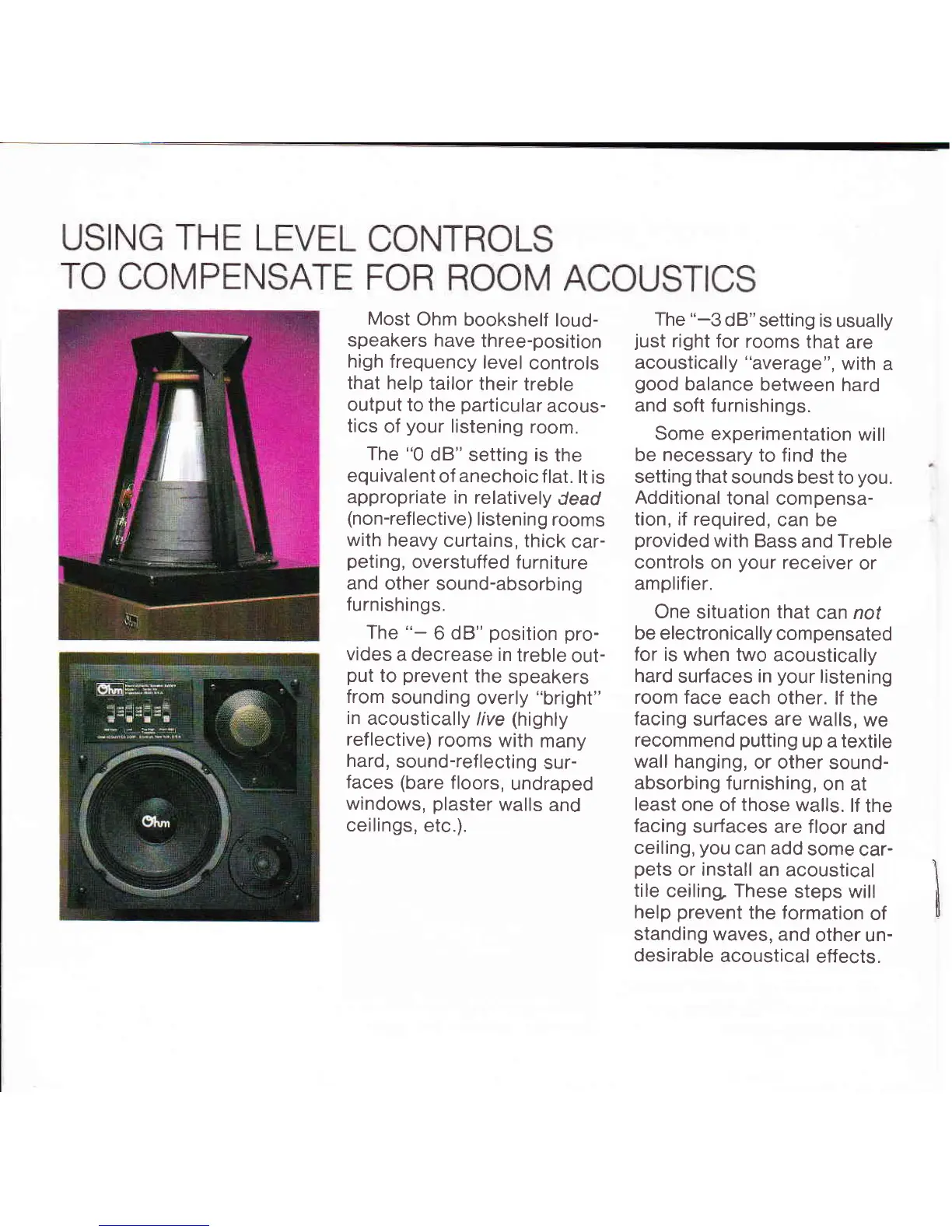
Most
Ohm
bookshelf
loud-
speakers have
three-position
high
frequency
level
controls
that help
tailor
their
treble
output to the
particular
acous-
tics
of
your
listening
room.
The
"0
dB"
setting is
the
equivalent
of
anechoic
f
lat. lt
is
appropriate
in relatively
dead
(non-reflective)
I isten in
g
rooms
with heavy
curtains,
thick
car-
peting,
overstuffed
furniture
and other
sound-absorbing
furnishings.
The
"-
6 dB"
position
pro-
vides
a
decrease in
treble
out-
put
to
prevent
the
speakers
from
sounding
overly
"bright"
in
acoustically
live
(highly
reflective)
rooms
with
many
hard,
sound-reflecting
sur-
faces
(bare
floors,
undraped
windows,
plaster
walls
and
ceilings,
etc.).
The
"-3
dB"
setting is
usually
just
right for
rooms
that
are
acoustically
"average",
with
a
good
balance
between
hard
and
soft
furnishings.
Some
experimentation
will
be necessary
to find
the
setting that
sounds best
to
you.
Additional
tonal
compensa-
tion, if required,
can be
provided
with Bass
and Treble
controls
on
your
receiver
or
amplifier.
One
situation
that
can nof
be electronically
compensated
for
is when two
acoustically
hard
surfaces
in
your
listening
room face
each other.
lf the
facing
surfaces are walls,
we
recommend
putting
up
a
textile
wall hanging,
or other
sound-
absorbing
furnishing,
on at
least
one of
those
walls.
lf
the
facing
surfaces
are floor
and
ceiling,
you
can add
some
car-
pets
or install
an acoustical
tile
ceiling These
steps will
help
prevent
the formation
of
standing waves,
and
other un-
desirable
acoustical
effects.

Related product manuals