This document serves as the Installation and Operation Manual for the ALPA Series of commercial refrigeration units, manufactured by Ojeda U.S.A. Inc. It provides comprehensive instructions for the proper location, operation, and maintenance of these units, ensuring many years of trouble-free service.
Function Description
The ALPA series coolers are designed for the merchandising of packaged food and beverage products in commercial indoor environments. These units are specifically listed for sanitation purposes, making them suitable for displaying various food and beverage items while maintaining optimal temperatures. The design emphasizes reliable refrigeration to preserve product quality and extend shelf life.
Important Technical Specifications
The ALPA series includes several models, each with specific electrical requirements and load capacities:
- ALPA 36:
- Voltage: 120V
- Current: 6A
- Circuit Required: 15A
- NEMA Config: 5-15P
- Shelf Load Capacity: 27 kg (60 lbs)
- ALPA 55:
- Voltage: 120V
- Current: 8A
- Circuit Required: 15A
- NEMA Config: 5-15P
- Shelf Load Capacity: 50 kg (110 lbs)
- ALPA 77:
- Voltage: 120V
- Current: 11A
- Circuit Required: 20A
- NEMA Config: 5-20P
- Shelf Load Capacity: 50 kg (110 lbs)
- ALPA 99:
- Voltage: 120V
- Current: 16A
- Circuit Required: 20A
- NEMA Config: 5-20P
- Shelf Load Capacity: 60 kg (132 lbs)
- ALPA 120:
- Voltage: 120V
- Current: 16A
- Circuit Required: 20A
- NEMA Config: 5-20P
- Shelf Load Capacity: 60 kg (132 lbs)
All units are designed to operate in ambient conditions of less than 75°F (24°C) and 55% relative humidity. The electrical power supply must be 115 Volts, 60 Hertz, as indicated on the ALPA serial plate.
Compressors:
- ALPA-36 and ALPA-55 models feature a single hermetic compressor.
- ALPA-77, ALPA-99, and ALPA-120 models are equipped with two hermetic compressors that start in two steps with a 10-second delay to minimize in-rush current.
Condensers:
The ALPA units incorporate a "maintenance-free" condenser design, which reduces the need for regular cleaning typically associated with fin and tube condensers. This design aims to stabilize energy expenses and ensure unobstructed operation over long periods.
Usage Features
Installation and Placement:
- Units must be located in an indoor environment with controlled ambient conditions (less than 75°F/55% RH).
- Proper air circulation is crucial; a minimum space must be kept between the cooler and air sources such as air conditioner supply or return grilles, vent hoods, appliance condenser air intake and discharge, outside doors, fans, or other air movement devices.
- Recommended minimum distances: 3" from appliance condenser air intake and discharge, 10" from air conditioner supply or return grilles, 10" from vent hood, and 15" from open doors.
- The unit is constructed to facilitate handling with a forklift (Figure 1). It should be moved as close as possible to its final location before removing the wooden skid.
- Never push, pull, or strike the front or side glass during movement.
- Shelves are fixed to the inside floor of the unit for transport and must be installed in the pilaster notches, ensuring they are at the same level.
- The products on each shelf must leave three to five centimeters of free clearance.
- The ALPA series units are intended for merchandising and must be loaded at their intended merchandising temperature.
- Before loading products, the equipment should operate empty for at least two hours.
Electronic Temperature Control:
- The unit is equipped with an electronic temperature control that monitors the temperature of the air entering the evaporator.
- The electronic control is factory-adjusted to turn off refrigeration at 35°F (1.7°C) and restart at 39.5°F (4.2°C).
- A start-up delay of 2 minutes before the compressor(s) are energized prevents damage from power failures or compressor overloads.
- The control includes a defrosting cycle scheduled to last 6 minutes every hour to ensure the evaporator performs without ice buildup.
- Factory-programmed electronic control parameters can only be modified by an authorized distributor's technical personnel.
Lighting:
- The lamp can be turned off using a switch located on the left side of the upper section, near the lamp.
Night Curtain:
- A night curtain is provided and should be pulled closed whenever the unit is not actively merchandising product to conserve energy.
Maintenance Features
General Maintenance Guidelines:
- Regular cleaning is essential. The unit must never be cleaned with water jets, flammable, or abrasive products.
- Always disconnect power before cleaning or making repairs.
- Good visibility conditions are required when working on the unit, especially around moving and/or high-temperature parts.
Cleaning the Condenser Coil:
- Although the condensers are "maintenance-free" in design, they can still accumulate dirt, which can lead to compressor failure, product loss, and increased electrical costs. Regular inspection and cleaning are recommended.
- Procedure:
- Disconnect power to the unit.
- Remove the front lower grill assembly by unscrewing the two screws in the top corners.
- Clean accumulated dirt from the condenser coil(s) using a vacuum and/or a damp rag.
- Replace the grill assembly.
- Reconnect power and verify that the condensing unit(s) are running.
- If dirt cannot be adequately removed, contact a refrigeration service company.
Cleaning Drain Lines (ALPA 55-120):
- Drain lines can become clogged over time, leading to water overflowing from the condensate pan. This is a standard maintenance item and is not covered under warranty.
- Procedure:
- Access the drain lines by removing the bottom panel from inside the unit (Figure 7).
- Locate both holes for the drain lines (Figure 8).
- Remove obstructions using compressed air, nitrogen, or a physical drain cleaner.
- WARNING: DO NOT USE A CHEMICAL DRAIN CLEANER, as this will void the warranty and potentially damage the unit.
Condensation Evaporator Tray:
- Condensed water from the environment is collected on the evaporator and drains to an evaporator tray at the bottom of the unit during off-cycles, where it is evaporated using heat from the refrigeration system.
Sliding Condensing Unit:
- The condensing unit can be pulled out approximately 40 cm (16 inches) to allow servicing of the condenser motor(s), compressor(s), and electrical components.
- To access, remove the two screws holding the lower front grill (one on each side), then remove the screws holding the front bracket that clasps the condensing unit, and gently slide it out.
- Ensure all components are returned to their original location for proper operation after servicing.
Evaporator Inspection:
- In case of a "freeze-up" condition due to high temperature or humidity, the evaporator can be inspected by removing the floor of the unit.
- If the evaporator is frozen, it can be thawed by emptying the cabinet of product and removing power until the coil is clear.
Storage:
- If the equipment is to be stored, it is recommended to keep it in its original packing.
- For long-term inactivity after use, ensure the unit is unplugged, thoroughly cleaned with a damp cloth, lukewarm water, and neutral soap, carefully dried, and then covered with a polyethylene film or similar waterproof material.

 Need help?
 General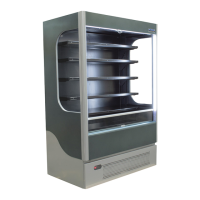

 To Next Page