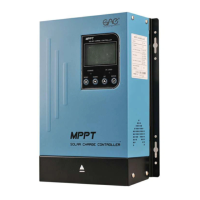
This document describes the MPPT Solar Charge Controller, a new generation product designed for off-grid solar systems. It incorporates advanced technology to optimize energy utilization from solar arrays and manage battery charging efficiently.
Function Description
The MPPT (Maximum Power Point Tracking) Solar Charge Controller is designed to extract maximum power from solar panels to charge batteries. It automatically tracks the maximum power point of the solar array, adapting to changing ambient conditions to ensure the highest energy yield throughout the day. This technology significantly increases the energy utilization rate of the solar system, achieving a transfer efficiency of up to 97%.
The controller features a quick scan of the entire I-V curve, tracking the maximum power point within seconds. It supports three types of lead-acid batteries (sealed, colloidal, and open) and lithium battery series with selectable charging programs. Its low-voltage disconnect (LVD) function prevents battery damage from over-discharge, extending battery life and improving system performance. Comprehensive self-test and electronic protection functions help avoid damage from installation errors or system faults.
Compared to traditional controllers that directly connect the solar array to the battery, the MPPT controller operates at the maximum power point, reducing energy waste, especially when there's a significant difference between the battery voltage and the solar array's maximum power point voltage (Vmp). This "increases" the charge current to the battery, balancing input and output power.
The device also includes an RS485 communication interface, enabling multi-machine communication over distances up to 1km and connection to a host computer for monitoring operating parameters.
Important Technical Specifications
Models: MP-20A, MP-30A, MP-40A, MP-50A, MP-60A, MP-80A, MP-100A, MP-120A.
Charging Pattern: MPPT automatic maximum power point tracking.
Charging Mode: Three stages: constant current (MPPT), equalizing charging, float charging.
System Type: DC12V/24V/36V/48V/96V. Automatically identifies or allows manual setup.
System Voltage Range:
- 12V System: DC9V-DC15V
- 24V System: DC18V-DC30V
- 36V System: DC27V-DC45V
- 48V System: DC36V-DC60V
- 96V System: DC80V-DC120V
Input Voltage Limit: DC150V (for 12V/24V/36V/48V/96V systems).
Input Low-Voltage Recovery: DC18V (12V System), DC34V (24V System), DC54V (36V System), DC72V (48V System), DC144V (96V System).
Input Over-Voltage Protection: DC180V (12V/24V/36V/48V/96V systems).
Input Over-Voltage Recovery: DC175V (12V/24V/36V/48V/96V systems).
Rated Current:
- 20A, 30A, 40A, 50A, 60A, 80A, 100A, 120A (depending on model).
Limit Current Protection:
- 22A (20A model), 32A (30A model), 42A (40A model), 52A (50A model), 62A (60A model), 82A (80A model), 102A (100A model), 122A (120A model).
Float Charging Voltage (Lead Acid Battery):
- 13.75V (12V System)
- 27.50V (24V System)
- 41.25V (36V System)
- 55.00V (48V System)
- 110V (96V System)
(Can be customized).
Equalizing Charging (Lead Acid Battery):
- 14.2V (12V System)
- 28.40V (24V System)
- 42.6V (36V System)
- 56.80V (48V System)
- 113.6V (96V System)
(Can be customized).
MPPT Working Voltage Range Recommended:
- 12V System: DC18V-DC60V
- 24V System: DC30V-DC80V
- 36V System: DC40V-DC100V
- 48V System: DC65V-DC150V
- 96V System: DC120V-DC200V
PV Module Configuration (Recommended Load Voltage):
- 12V System: 18V-60V
- 24V System: 36V-72V
- 36V System: 54V-144V
- 48V System: 72V-144V
- 96V System: 120V-200V
Solar Panel Maximum Input Power:
- 12V System: 280W (20A) to 1800W (120A)
- 24V System: 550W (20A) to 3400W (120A)
- 36V System: 840W (20A) to 5400W (120A)
- 48V System: 1120W (20A) to 6800W (120A)
- 96V System: 2240W (20A) to 14400W (120A)
Overall Efficiency: ≥96.5% (for 12V/24V/36V/48V/96V systems).
PV Modules Utilization: ≤99% (for 12V/24V/36V/48V/96V systems).
Soft Start Time: ≤10s.
Dynamic Response Recovery Time: <500us.
Static Power: <2W.
Output Voltage Accuracy: ≤±1.5%.
Temperature Compensation: ±0.02%/°C.
Automatic Temperature Compensation: 14.2V - (highest temperature - 25°C) * 0.3.
Battery Types Available: Maintenance-free lead acid, colloidal, liquid, lithium series batteries (other types available by customizing).
Environmental Conditions:
- Humidity: 0~90%RH (non-condensing).
- Altitude: 0~3000m.
- Operating Temperature: -20°C~+40°C.
- Storage Temperature: -40°C~+70°C.
- Atmospheric Pressure: 70~106kPa.
Machinery Protection Type: IP21.
Cooling Mode: Forced air cooling; fan speed regulated by temperature; fan runs slowly or stops when internal temperature is low; fan stops when solar controller stops working.
Audible Noise: <50dB.
Dimensions (LengthWidthHeight):
- MP-20A/30A Series: 265194100 mm.
- MP-40A/50A/60A Series: 295224100 mm.
(Gross and net weights are on random label paper).
Usage Features
Installation:
- Must be installed by a professional technician on a solid, approachable, and removable surface.
- Avoid direct sunlight to prevent overheating.
- Maintain safety distances: 20cm from edges, 20cm from height, 30cm from bottom for proper heat dissipation.
- Do not install on flammable materials, near highly flammable materials, or in dangerous explosion areas.
- Ensure a well-ventilated environment as housing parts can become hot.
- Keep away from moisture or corrosive substances.
- Use insulation tools during operation to reduce short-circuit risk.
Wiring:
- Follow specific wiring steps, including taking off the plate and releasing wiring locks.
- Battery connection: Exercise caution to avoid short circuits; ensure positive and negative terminals are correctly connected. Connect batteries only when the circuit breaker is disconnected.
- DC Load connection: Connect to DC power equipment with the same rated operating voltage as the battery.
- Photovoltaic component connection: Be aware of high voltage from PV components; connect only when the circuit breaker is disconnected.
- Temperature sensor and PC connection: The temperature sensor connects to the controller, and the controller can connect to a PC via RS485 (optional accessory, requires separate software purchase).
Operation:
- LCD display provides detailed information on PV module voltage, daily power generation, charging power/current, battery capacity, battery voltage, external/internal temperature, total power generation, date, time, and charging state (MPPT, floating charge, stop charging).
- Indicator lights show charging status (flashing for MPPT, low flashing for float, putout for stop charging) and DC load status (lighting for normal output, flashing for undervoltage, putout for stop output).
- Main menu allows access to various settings: language, time and date, contrast, brightness, sound, record query, record clearance, system information query, DC output setting, correspondence setting, and operating parameter setting.
- Parameter settings include battery type (VRLA, liquid, gel, lithium), rated battery voltage (auto-identify, 12V, 24V, 36V, 48V), charging voltage (floating charge, equalizing charge), charging current, and discharging limitation.
- DC output can be set to OFF, Automatic (turns on after battery connection), or Time Control (turns on/off according to set periods).
- Password protection for operating parameter settings.
- Factory reset option to restore default settings.
Maintenance Features
Fuse Replacement:
- If a fuse blows due to high temperature or other faults, replace it with a new one, ensuring correct connection.
Fan Vent & Heat Sink Cleaning:
- Regularly clean the fan vent and internal heat sink with a dry or slightly wet cloth.
- Do not use washing liquid or corrosive solvents.
- Ensure air vents are not blocked.
Fault Elimination:
- Controller electrified, but "battery voltage out of normal range" fault: Check battery voltage against system voltage range, or manually set rated battery voltage.
- Over-temperature protection: Check for damaged cooling fan or blocked ventilation. Ensure installation in a ventilated environment. Optimize PV module configuration to reduce temperature rise.
- Battery over-discharging protection: Indicates battery is out of power.
- Cannot test external temperature sensor: Check sensor connection and contact.
- Charging indicator light/display off/on intermittently: Check PV module voltage, charging voltage parameters, or restore factory settings. Check fuse and circuit breaker.
- Charging indicator light off/on alternatively, charging current appears alternatively: Normal in cloudy weather or evening due to insufficient light.
- No power curve and current curve display: Check if controller time and date are consistent with current time.
Quality Assurance:
- Free repair or replacement of new products during the warranty period.
- Requires invoices and purchase date.
- Trademark must be clearly visible.
- Exemption from liability for:
- Products beyond warranty period.
- Transport damage.
- Incorrect installation or modification.
- Operation in harsh environments beyond manual specifications.
- Damage caused by unauthorized service, repair, alteration, or removal.
- Abnormal natural environmental damage.
- Compensable amendment service available for problems caused by listed faults after judgment.
Note: Product size and parameters are subject to change without further notice.

 Need help?
 General

 To Next Page