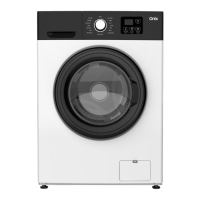
This document is a user manual for the Onix 6kg Front Load Washer, model number ON-FLW6W.
Function Description
The Onix 6kg Front Load Washer is designed for washing clothes. It offers various wash programs suitable for different fabric types and soil levels, including Mixed, Intensive, Cotton, Gentle, Wool, Night, Antibacterial, Drum Clean, Rinse + Spin, Spin, Kids Wear, Shirts, Underwear, Quick30', and Quick15'. The machine features a control panel with a program dial, water temperature button, delay function, spin speed button, start/pause button, power button, and display screen to manage wash cycles. It is a front-loading appliance, meaning clothes are loaded through a door on the front.
Important Technical Specifications
- Rated capacity (washing/spinning): 6 kg
- Rated voltage and frequency: 220–240 V~ 50 Hz
- Washing and heating input power: 2000 W
- Spin input power: 250 W
- Washing noise level: 62 dB(A)
- Spin noise level: 75 dB(A)
- Water pressure: 0.05 MPa – 0.85 MPa
- Liquid ingress protection: IPX4
- Weight: 47 kg
The machine requires a minimum water pressure of 0.05 MPa and a maximum of 0.8 MPa. The required water temperature for cold water connection is 0.02 MPa (min.) to 0.8 MPa (max.).
Usage Features
Control Panel and Programs:
The washer features a program dial to select from 15 wash programs. The display screen shows the time, delay time, speed, temperature data, and error codes.
- Program Dial: Turn the program dial clockwise or anticlockwise to switch on the machine and select the desired wash program.
- Water Temperature Button: Press to change the program's default temperature. The value will be displayed for three seconds.
- Delay Function: Press to set a delay time for your wash load, between 1 and 24 hours.
- Spin Speed Button: Press to change a program's default spin speed.
- Start/Pause Button: Press to start/pause the cycle.
- Power Button: Press to turn the machine on and off.
- Display Screen: Shows settings, remaining time, options, etc.
Wash Programs and Suitability:
- Mixed: Suitable for cotton and/or synthetic fabrics.
- Intensive: For normally soiled loads equal to the rated capacity, and for extra dirty cotton and/or synthetic fabrics.
- Cotton: For cotton clothing or linen.
- 20°C: Best suited to machine-washable clothes containing down. It is also suitable for cleaning normally soiled cotton laundry, and is the most efficient program in terms of combined energy and water consumptions for washing that type of cotton laundry.
- Gentle: For cotton and/or synthetic fabrics requiring a more gentle wash.
- Wool: For machine-washable wool fabrics.
- Night: For cotton, linen and/or synthetic fabrics, and does not have a spin function during the wash and rinse cycles - it only has one final spin at the end, making it a quieter program more suitable to nighttime washes.
- Antibacterial: For items that may be washed in very hot (85°C) water.
- Drum Clean: This hot water drum clean program is recommended for use every three months to clean the inside of the wash drum.
- Rinse + Spin: For cotton and/or synthetic fabrics that require a quick refresh. It does not require any detergent, as it will only rinse the items, not clean them completely.
- Spin: For cotton and/or synthetic fabrics that need a quick refresh. It will only spin these items, not wash or rinse them. It therefore does not require any detergent or water.
- Kids Wear: Recommended for children’s clothing (made of cotton) that are in need of thorough cleaning and odour removal.
- Shirts: Made of cotton/synthetic fabric(s).
- Underwear: Underwear items made from cotton/synthetic fabrics.
- Quick30' / Quick15': Clothes or towels that are not very dirty, but are in need of a quick refresh. This program should be used on less dirty items than those washed using the Quick30' program.
Detergent Recommendations:
The manual emphasizes using only low-sudsing detergent suitable for front load washing machines. Overdosing detergent can cause excessive suds, which may lead to overflowing from the detergent drawer. The detergent drawer has compartments for pre-wash/bleach, main wash, and fabric softener.
Safety Instructions:
The manual highlights several safety precautions, including:
- Electrical Safety: Do not connect to the power supply using an adaptor or extension cord. Ensure the power cord is not damaged.
- Water Supply: Wind the cord tightly to prevent damage. Do not unplug the machine and turn off the water after use.
- Installation: Ensure proper installation, including removing transit bolts, levelling the machine, and connecting water inlet/drain hoses correctly.
- Child Safety: Supervise children to ensure they do not play with the appliance.
- Flammable Materials: Do not wash items exposed to flammable, explosive, or toxic substances.
- Hot Surfaces: Be careful of burning when the machine drains hot washing water.
Maintenance Features
Cleaning and Care:
- Cleaning the Cabinet: Use a soft cloth to wipe any water or dirt off the washer housing. Use a mild detergent solution and a damp cloth for dirt and stains. Avoid abrasive cleaning agents.
- Cleaning the Drum: Regularly clean the drum to remove detergent residues and scum build-up. The Drum Clean program is recommended for this purpose.
- Cleaning the Detergent Drawer: Remove detergent residue regularly. Pull the dispenser drawer until you feel resistance, press down the release catch, and pull the drawer right out. Clean the drawer using a brush and warm water. Wipe all parts dry with a clean cloth.
- Cleaning the Door Seal and Glass: Wipe the glass and seal to remove lint and stains after each wash. Check for coins, buttons, and other small objects in the seal creases.
- Cleaning the Water Inlet Valve: To avoid blockages, clean the filters every 6 months or more often if there are frequent interruptions to the water supply. Disconnect the water supply hose, take out the filter screen, clean it with a soft brush, then reassemble.
- Cleaning the Universal Coupling: Clean the universal coupling every six months as described in the manual.
- Freezing Conditions: If the washing machine is exposed to temperatures below 0°C, take precautions to prevent water freezing in the pipes. This includes turning off the water tap, unscrewing the water inlet hose, unhooking the drain hose, and draining residual water.
- Drain Pump Maintenance: To avoid blockages, regularly check the drain pump filter for excess lint, threads, or items such as bobby pins and coins. Clean the filter every month or when there is a fault and the error code [E03] is displayed.
Troubleshooting:
The manual includes a comprehensive FAQ and troubleshooting guide for common error messages and problems, such as:
- Error Message [E01]: No water. Solution: Ensure tap is open, water inlet valve filter is clean, drain hose is properly fitted, and no water stoppage.
- Error Message [E02]: Door lock alarm. Solution: Ensure door is properly locked, garment is not caught in the door, and the door lock is not damaged.
- Error Message [E03]: Continuous drainage. Solution: Ensure drain hose is not squashed or kinked, drain hose filter is unblocked, and nothing is caught in or blocking the drain hose.
- Error Message [E04]: Water overflowing. Solution: Ensure water inlet is undamaged and water sensor is not malfunctioning.
- Error Message [E06]: Heater problem. Solution: Call for service.
- The washing machine does not start up: Possible causes include the door not being closed properly, items caught in the door, plug not firmly plugged in, Start/Pause button not pressed, or water tap is closed.
- The door cannot be opened: Possible causes include safety protection design working, water temperature is too high, or water has cooled.
- No water: Possible causes include water tap is closed, water is frozen in the supply hose, water inlet valve filter is blocked, or water stoppage in your area.
- Water leakage: Possible causes include water supply hose or drain hose not tightly connected, or drain hose is blocked.
- Abnormal noise: Possible causes include transit bolts not removed, machine is installed on an uneven or unstable floor, or a loose object is knocking against the drum walls.
- Too much foam in the drum: Possible cause is using low-foam detergent designed for front-load washing machines.
- Rubber smell from the drum: Possible cause is new rubber parts in the machine.
- Variations in time remaining: During spinning, if clothes are off center, the spin time will increase. If water pressure is too low, the inflow time will increase.

 Need help?

 To Next Page
 General