FRONT END ALIGNMENT
3C-25
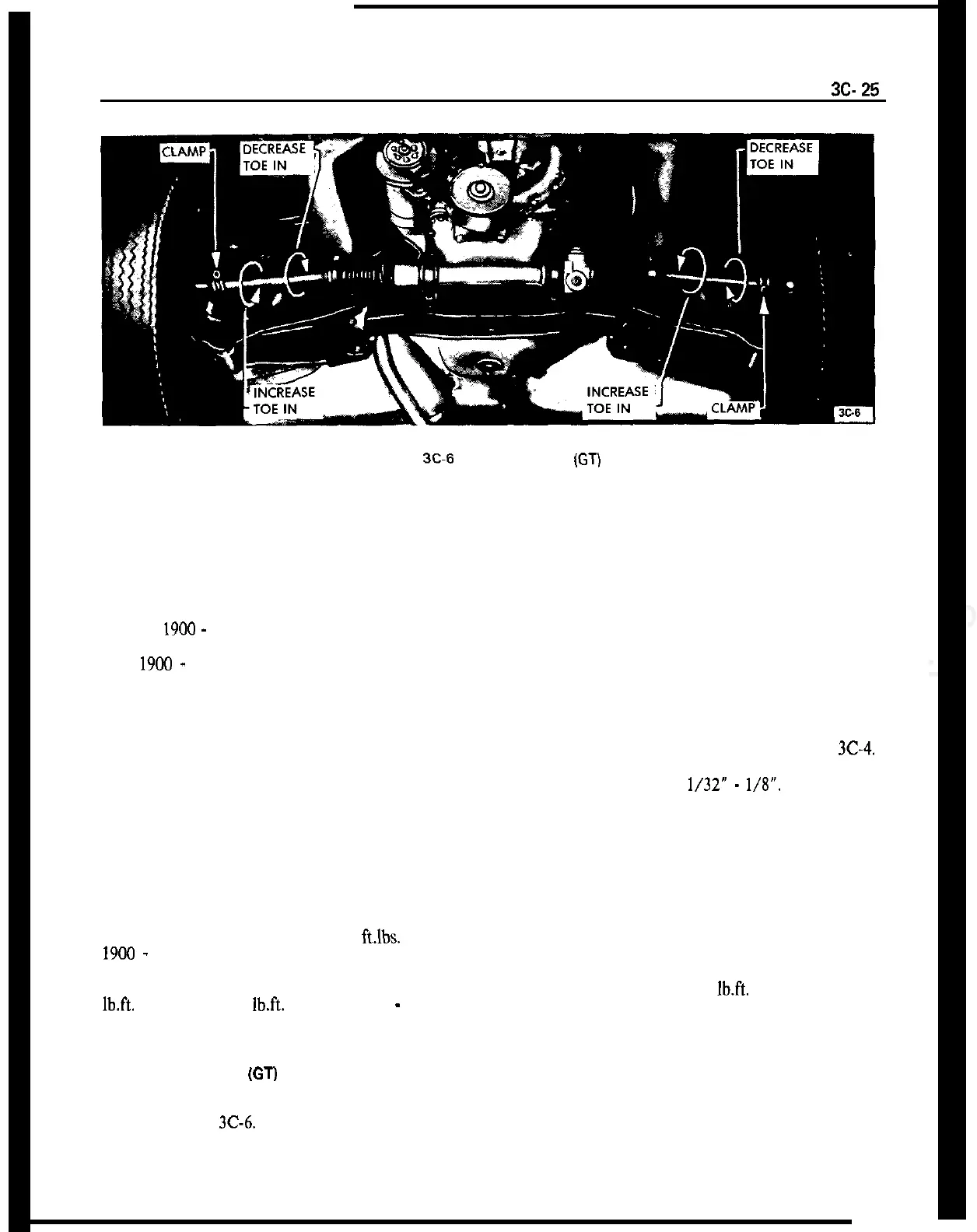
Figure
3C-6
Adjusting Toe-In
(GT)
ADJUSTING CAMBER
Camber is adjusted by turning the upper ball joint
flange 180 degrees. This means that only two possi-
ble camber adjustments can be made. At the factory
camber is set at the smallest possible positive camber
setting for GT and smallest possible negative camber
for Opel
1900
-
Manta. Rotating the flange will make
camber more positive on GT and more negative on
Opel
1900
-
Manta.
1. Raise front end of car using wood block on jack
to prevent damage to front cross member.
2. Support car below lower control arm and remove
front wheel on side to be adjusted.
3. Remove ball joint from upper control arm and
front steering knuckle.
4. Lift upper control arm and turn the ball joint
flange through 180 degrees.
5. First tighten both ball joint attaching bolts on
upper control arm and then the ball stud castle nut.
Torque to 29 ft. lbs. on GT and 44
ft.lbs.
on Opel
1900
-
Manta. Install new cotter pin.
6. Install front wheel and torque wheel nuts to 72
lb.ft.
on GT and 75
Ib.ft.
on Opel 1900
-
Manta.
7. Recheck camber.
ADJUSTING TOE-IN
(GT)
Toe-in is adjusted by rotating the tie rod sleeves.
Refer to Figure
3C-6.
1. Recheck caster and camber before proceeding
with toe-in adjustment. If correct, adjust toe-in.
2. Set wormshaft and ball nut to steering gear high
point by turning steering wheel half way from one
stop to the other, noticing the following:
(a) With the steering wheel hub button removed, the
“marking” on the steering shaft end should be in a
horizontal position.
(b) The steering wheel spokes should also be in a
centered position.
3. Remove wire clamps on left and right tie rod and
push back bellows.
4. Loosen clamp bolts and tie rods. See Figure
3C-4.
5. The toe-in should be
l/32”
-
l/8”.
When adjusting toe-in, never grip tie rod on inner
ball stud joint. To avoid ball stud resting against
inside of hole in tie rod outer end, center outer end
of each tie rod to the ball stud.
6. Pull bellows over tie rods and attach with wire
clamps. The bellows must not be twisted and wire
ends must show towards steering gear adjusting
screw opening.
7. Torque clamp bolts to 12
Ib.ft.
8. After toe-in adjustment, turn steering wheel sev-
eral times completely towards the left and right to
determine whether bellows are properly attached to
the tie rods and steering gear housing.
ADJUSTING TOE-IN (OPEL 1900. MANTA)
The adjustment of the toe-in has always to be carried
out on both tie rods.










 To Next Page