3C-26 1973 OPEL SERVICE MANUAL
1. Loosen lock nut of left and right tie rod and
slacken back nut.
2. Remove hose clamp for rubber bellows attach-
ment from respective axial joint and adjust toe-in by
turning axial joint. When doing this, observe that the
rubber bellows, having a tight seat on thejoint, is not
twisted. If necessary, lubricate seat of bellows and
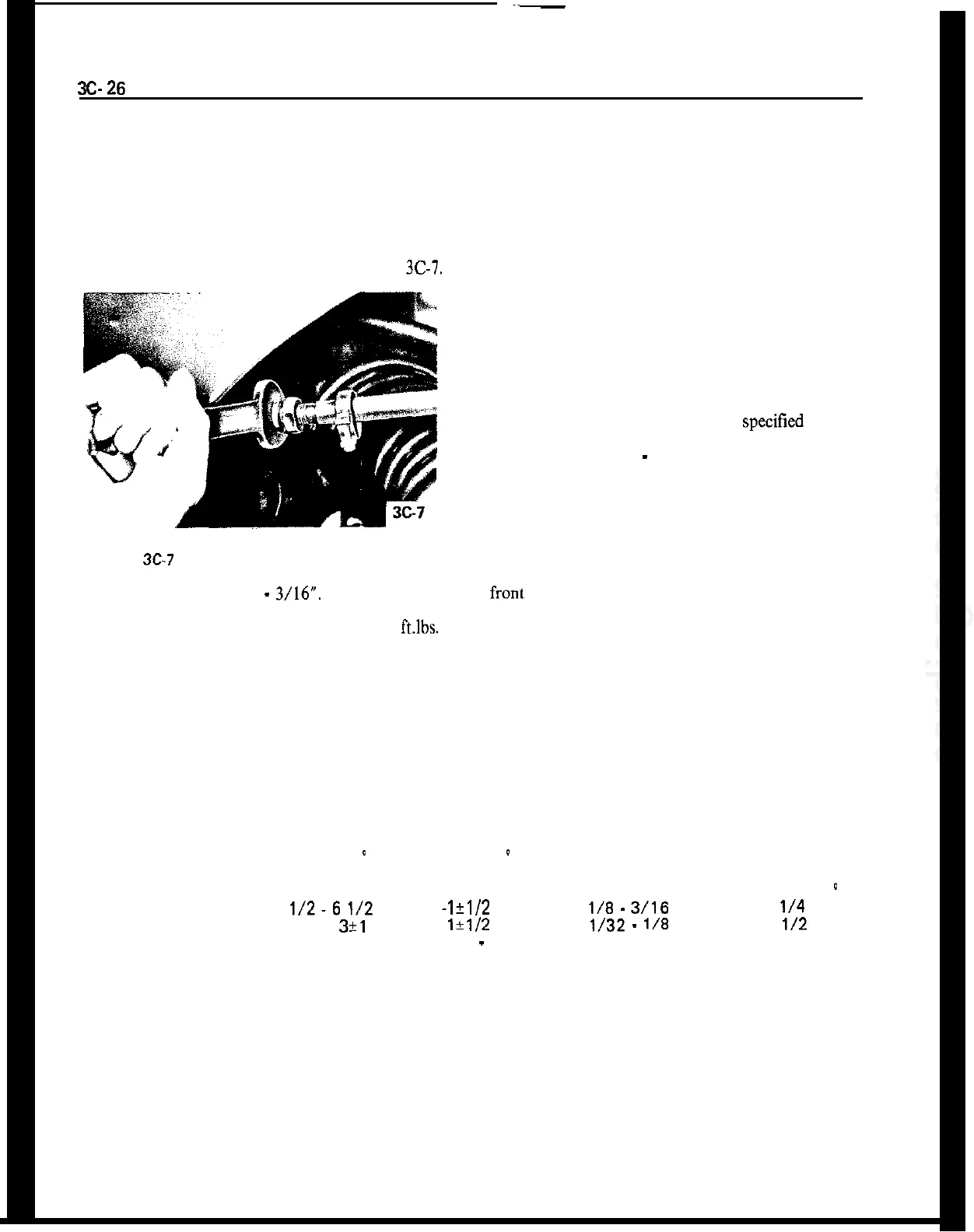
hold back bellows when turning. See Figure
3C-7.
Figure
3C-7
Adjusting Toe-In Opel 1900 Manta
3. Toe-in should be l/S”
-
3/16”.
4. Torque lock nut of left and right tie rod to 47
ft.lbs.
5. Attach respective rubber bellows with hose clamp,
making sure that clamp bolt points towards the
front. The rubber bellows must not be twisted, i.e.,
Specifications
FRONT END ALIGNMENT
the individual grooves of bellows must be in vertical
position.
6. After adjustment, turn steering several times to the
left and right to determine if a proper attachment of
both rubber bellows to the steering gear housing is
warranted.
CHECKING THEORETICAL KING PIN
INCLINATION
When checking theoretical king pin inclination, car
must be on a level surface, both transversely and fore
and aft, must have trim heights within limits, and
must be at curb load.
With camber known to be within specitied limits,
theoretical king pin inclination should check to 8.5
degrees for Opel 1900
-
Manta, and 6 degrees for GT.
If camber is incorrect beyond limits of adjustment
and theoretical king pin inclination is correct, or
nearly so, a bent steering knuckle is indicated.
There is no adjustment for theoretical king pin incli-
nation as this factor depends on the accuracy of the
fronts
suspension parts. Distorted parts should be re-
placed with new parts.
The practice of heating and bending front suspension
parts to correct errors must be avoided as this may
produce soft spots in the metal in which fatigue and
breakage may develop in service.
MODEL
CASTER
’
CAMBER
’
TOE-IN
OUTER WHEEL
MIN.. MAX.
WHEN INNER
WHEEL AT 20
’
1900
‘3
l/2-61/2
-1?1/2 I/%
-
3/16
19
l/4
GT 3+1
1+1/2
l/32
-
l/8
18
l/2
* Permissable deviation from left to right wheel
-
maximum 1”.










 To Next Page