45
| Opera Care Classic Installation Guide and Technical Specications Version 2
9. Service Life and Disposal
The service life of the care beds is approximately 5 years. This is dependent
upon the manner of use. The care bed is suitable to be put into service again if
all measures of section 2 and 7 are taken. Frequent transportation, setting up
and adjustment, reduce the service life, as does improper treatment, irregular
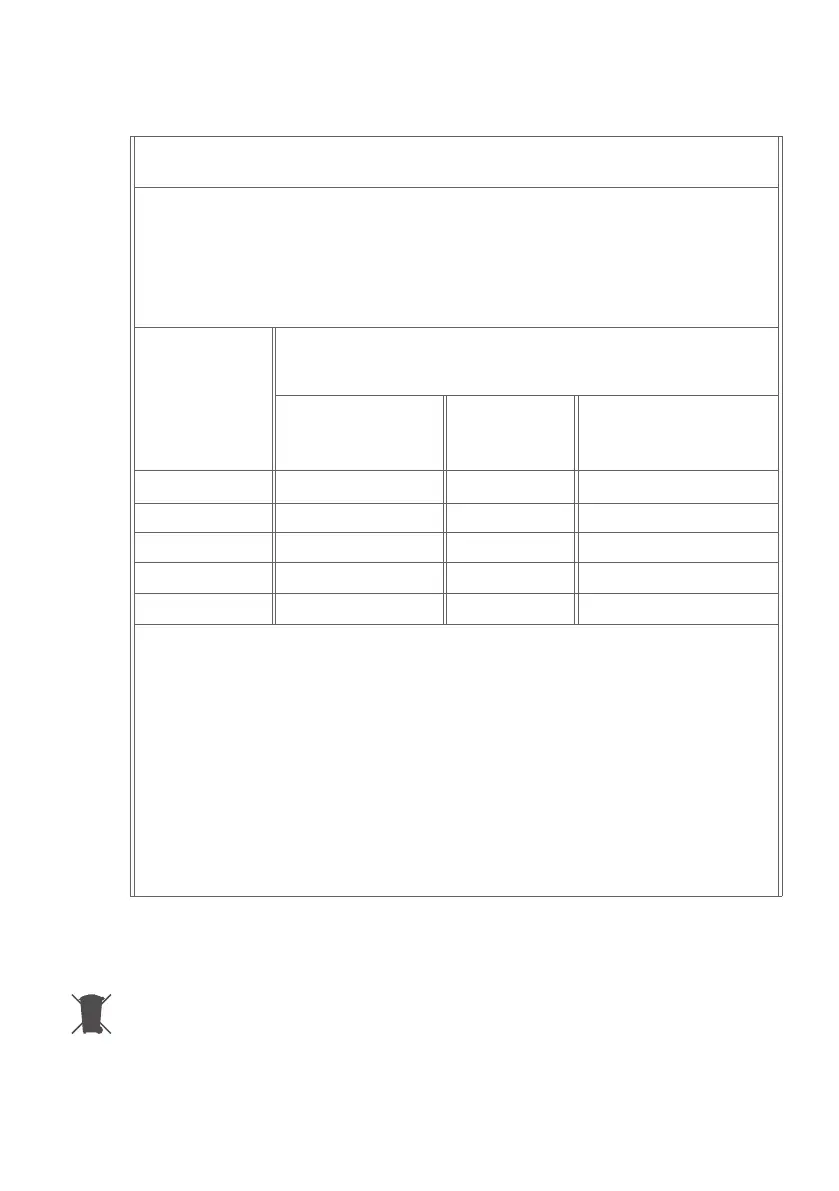
Recommended working clearances between portable and mobile RF
communications equipment and the care bed
The care bed is intended for use in the electromagnetic environment in which
radiated RF disturbances are controlled. The customer or user of the care bed can
help to prevent electromagnetic interference by maintaining a minimum distance
between portable and mobile RF communications equipment (transmitters) and the
care bed as recommended below, according to the maximum output power of the
communication device.
Output Power of
Transmitter in
Watts (W)
Working clearance according to tranmission frequency (In meters
- M)
150 kHz to 80 MHz
at 3 V/m
80 MHz to 800
MHz at 3 V/m
800 MHz to 2.5 GHz at
3 V/m
0.01 0.12 0.12 0.23
0.1 0.38 0.38 0.73
1 1.2 1.2 2.3
10
3.8
3.8 7.3
100
12
12 23
For transmitters not rated in the list above, the working clearance can be determined
using the equation, which belongs to the transmitter, where P is the nominal output
of the transmitter in Watts (W) according to specications of the transmitter
manufacturer.
Note 1: An additional factor of 10/3 is applied when calculating the recommended
working clearance between transmitters in the 80 MHz to 2.5 GHz frequency range
in order to reduce the probability that a mobile/portable communications device
unintentionally brought into the patient area could lead to interference.
Note 2: These guidelines may not apply in all situations. Propagation of
electromagnetic waves is affected by absorption and reection from structures,
objects and persons.
8. Technical Specications
8.9 Working Clearances between Communicators


 To Next Page