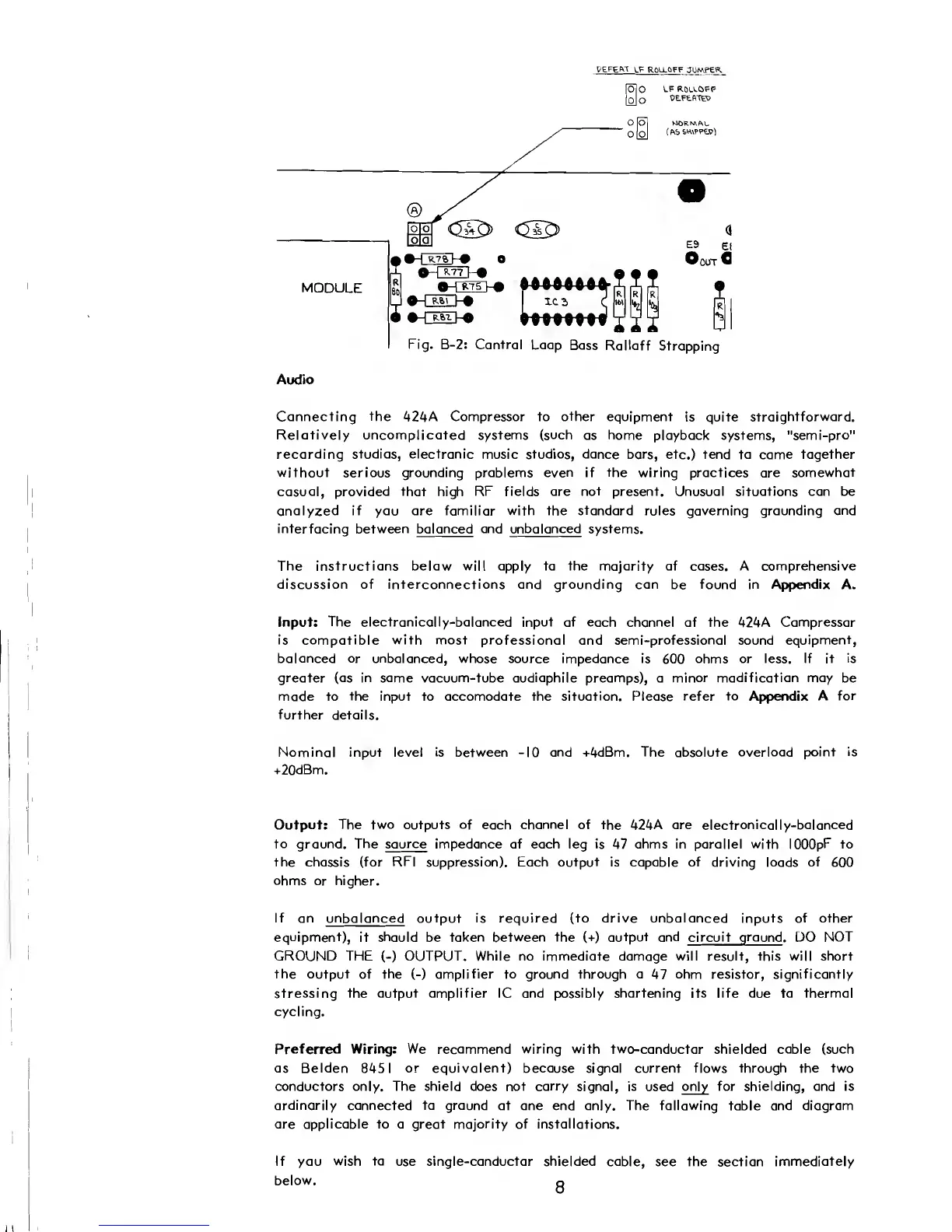
EEFF.AT IE
ROLLOFF
CJUMPER.
LF R0U.OFF
[o]o
CEFtATEO
Audio
Connecting
the
424A Compressor to
other
equipment
is quite
straightforward.
Relatively uncomplicated systems (such
as
home
playback systems, "semi-pro"
recording
studios, electronic
music studios, dance bars, etc.) tend to come together
without serious grounding problems even if
the
wiring practices are somewhat
casual,
provided that
high
RF fields are
not
present. Unusual situations can be
analyzed if you are familiar with the standard rules governing grounding and
interfacing between balanced and unbalanced
systems.
The instructions below will apply to the
majority
of
cases. A comprehensive
discussion of interconnections and grounding can
be
found in Appendix
A.
Input:
The
electronically-balanced input of each
channel of the 424A
Compressor
is compatible with most professional
and
semi-professional
sound
equipment,
balanced or unbalanced,
whose source impedance is
600
ohms or less. If it
is
greater (as in some
vacuum-tube
audiophile
preamps), a
minor modification may
be
made to
the
input to accomodate the
situation.
Please
refer to
Appendix
A
for
further
details.
Nominal input level
is
between
-10 and
+4dBm.
The
absolute
overload point
is
+20dBm.
Output:
The two
outputs
of
each
channel
of the 424A are electronically-balanced
to ground. The source
impedance of each leg is
47
ohms in parallel with
lOOOpF
to
the chassis (for
RFI
suppression). Each output is capable of driving loads of
600
ohms
or higher.
If an unbalanced output is required (to drive unbalanced inputs of other
equipment),
it
should
be
taken
between
the
(+)
output and
circuit
ground
.
DO
NOT
GROUND THE
(-)
OUTPUT. While no immediate damage will result, this will short
the output
of
the
(-)
amplifier to
ground
through a
47
ohm resistor, significantly
stressing
the output amplifier
1C
and
possibly
shortening its life due
to
thermal
cycling.
Preferred Wiring: We recommend
wiring
with two-conductor shielded cable (such
as Belden
8451
or equivalent) because signal current
flows
through the two
conductors only. The shield does not
carry
signal, is
used
only for shielding, and is
ordinarily
connected to ground
at one end only. The following
table
and diagram
are applicable to a great majority of installations.
If
you
wish to
use single-conductor shielded cable,
see the section
immediately
below.
Q



 To Next Page